No matter what you think about the recently published Mater Populi Fidelis, the Doctrinal Note reminded us that Mariology is anything but peripheral to Christology, let alone to theology as a whole. From the very beginning, the Church wrestled with Mary’s role in salvation history precisely because a better understanding of her role will only yield a better understanding of how the Triune God has been—and continues to be—at work in the world.
Development of Marian Dogma
Severe controversy in the early fifth century A.D. led the Council of Ephesus to declare Mary the Theotokos (“God-bearer”) precisely to clarify that Jesus Christ is truly God and man. The title is still honored not only by Catholic and Orthodox churches, but by some Anglican and Lutheran as well.
The conciliar declaration of 431 A.D. reflects not only on how we think about Jesus and Mary, but how we must read scripture in a spiritual and allegorical sense, not just a literal sense. Such a reading allows us to see that Christ is one “who,” a unity according to substance (hypostasis) of God and man. Christ is not just the one in whom God is, but is God really. All the activities of Christ are attributed to the same agent, and Mary is the mother of God.
The Council of Ephesus inevitably led to a closer examination of the entire life of Mary. What are the conditions that would make it possible for a woman to truly be the Mother of God? What does it mean to say that Mary is singularly “blessed among women?”
The specialness of Mary’s conception in the womb of her own mother had a long history in the Church. In the 7th century, St. Sophronius of Jerusalem, in a prayer directed to Mary, said, “You surpass all the gifts that God’s magnificence ever bestowed on any human person. More than anyone you are made rich by God dwelling in you.” Around the same time, St. Bede explained that “Mary is blessed among women, for with the dignity of virginity she has enjoyed the grace to be parent to a son who is God.” Other saints similarly venerated the Virgin from Nazareth, emphasizing her holiness as a unique vessel to bear the God-Man.
The Middle Ages were a time of unparalleled theological refinement, such that the particulars of Mary’s conception were examined in even closer detail. Understanding the issues they had to confront not only helps us celebrate the Solemnity of the Immaculate Conception more knowledgably, but to cultivate a devotion to Mary that will invariably draw us closer to her Son.
The Immaculate Conception Controversy
Just as at the Council of Ephesus, the main issue in the thirteenth century was Christological: How can we uphold the dignity of Mary’s role in salvation history without undermining the mission of her Son as our—and her—sole Redeemer?
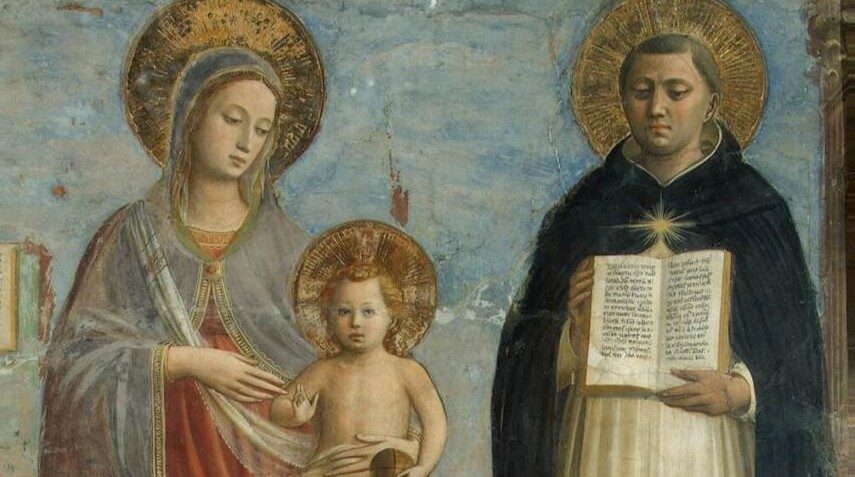
St. Thomas taught that Mary was purified from original sin only after her soul was infused into her body. Mind you, neither he nor his contemporaries had the scientific knowledge of human reproduction that we enjoy today, but his concern was to uphold the universal redemption wrought by Christ. He feared that if we assert that Mary was immaculate in her very conception, her own need for her Son’s redemptive grace could be placed into question. Alternatively, the Franciscan John Duns Scotus—beatified in 1993—held that God’s gift to Mary was so great as to warrant her preservation from original sin from the very moment of her conception, rather than her purification from it after her conception.
A dogmatic definition of Mary’s conception was finally formulated by Pope Pius IX in 1854 in the Apostolic Letter Ineffabilis Deus:
The most Blessed Virgin Mary, in the first instance of her conception, by a singular grace and privilege granted by Almighty God, in view of the merits of Jesus Christ, the Savior of the human race, was preserved free from all stain of original sin, is a doctrine revealed by God and therefore to be believed firmly and constantly by all the faithful.
Celebrating the Immaculate Conception
So, given the solemnity of this definition, how should it make any difference in your own life? What is it about this definition that should make you rejoice all the more this December 8th?
Let me suggest just one.
If you pray the rosary, you remind yourself of this definition at least fifty times a day. Each time you say “full of grace,” you are recalling God’s marvelous work of restoring us to the life and freedom we lost in the disobedience of our first parents. Each time you utter the holy name of “Jesus,” you recall the only Begotten Son who took flesh in Mary’s womb, died, and rose again to save both her and us. The one you honor in this timeless prayer of meditation is the “Genetrix of God,” the “Nutrix of our life,” as expressed in an ancient hymn by St. Romanus the Melodus.
The fullness of grace we express in the Hail Mary is not just hers, but ours. Scripture wholly confirms this, as we read in Paul’s Letter to the Ephesians: the “Father of our Lord Jesus Christ…has blessed us…with every spiritual blessing…even as he chose us in him before the foundation of the world, that we should be holy and blameless…to be his sons through Jesus Christ” (Eph. 1:3-5).
What better way to prepare for Christmas than by recalling the first fruits of Christ’s redemptive work in the Immaculate Conception of His holy mother?
What better way to rejoice in our restoration from sin to grace than by meditating on the grace that preserved her from all sin?
Her very conception reveals God’s ineffable power to save us, one and all.
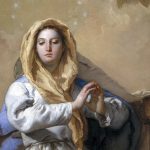
Image from Wikimedia Commons