Recent stories of note:
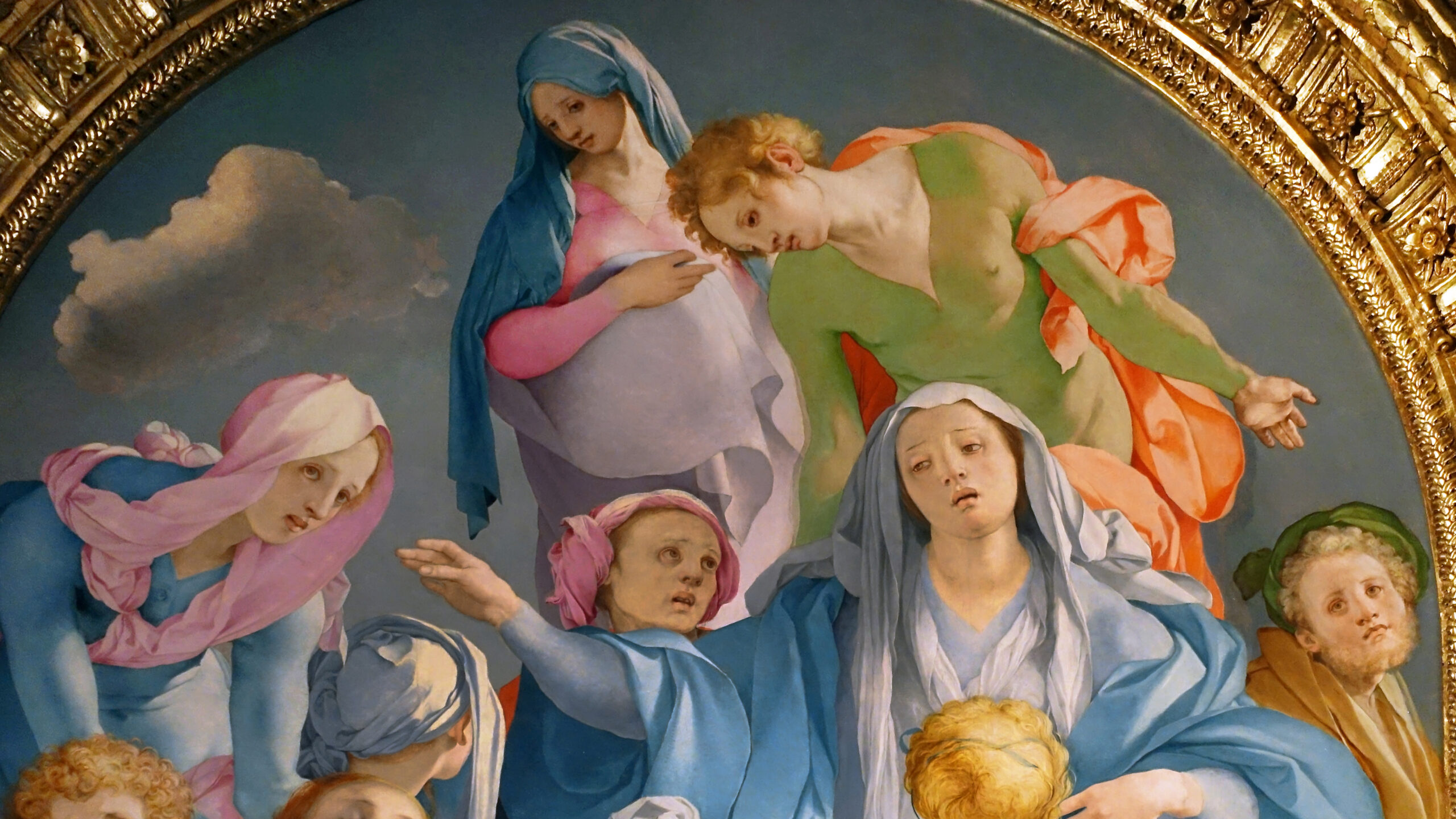
“Pontormo’s ‘Deposition From the Cross’: An Unsettling Sacred Scene”
Judith H. Dobrzynski, The Wall Street Journal
One of the great pleasures of visiting Florence is the chance to wander into any old church, usually tucked away in some piazza or other, and be suddenly confronted with a painting that you’ve last seen in an art-history textbook. One such church, rarely frequented by tourist hordes, is Santa Felicità, which contains one of the greatest—and oddest—masterpieces of the Cinquecento, Jacopo Pontormo’s Deposition from the Cross (1525–28). Gone are the harmonious perspective and the pyramid composition so typical of the Renaissance. Instead, as Judith H. Dobrzynski writes, Pontormo squeezes together eleven “entangled, elongated figures, who seem to float in space” in a bewildering circular arrangement. The colors, so light that they resemble pastel, are jarring to behold and only serve to confuse the viewer further. This is Mannerism taken to its logical conclusion, but, as striking as the work is, one is left wondering if this artificiality is not a little too distracting from the gravity of the subject matter at hand.
“The Soviet Network”
Richard Norton-Taylor, Literary Review
The story of the Cambridge Five—the quintet of students recruited by the NKVD in the 1930s to spy on behalf of the Soviet Union—has over the last half century been told and retold in countless fictional and nonfictional accounts and television adaptations, and yet somehow there is always more to uncover. A new book by Antonia Senior focuses on how instrumental Kim Philby, Guy Burgess, Donald Maclean, Anthony Blunt, and John Cairncross were in helping Stalin establish total control over Eastern and Central Europe in 1945: their reports condemned untold numbers of partisans, many of whom were receiving support from the British, to deportation and death. Even more astonishing than the scale of the treachery was the ensuing coverup: as Richard Norton-Taylor writes in his review, the British government “was terrified of the damage to their reputation and the reaction in Washington if the truth came out” and so allowed three of the spies to “slip away” to Moscow. Of course, it was a different time. Today, students at top British and American universities would never side with hostile foreign dictatorships while the media and elected officials run cover for them, would they?
“The First Political Scientist”
Daniel J. Mahoney, Claremont Review of Books
The British government’s failure to detect and put a stop to the Cambridge Five is a fine example of what a deficit of Aristotelian phrónēsis (prudence and practical wisdom) can lead to. As Daniel J. Mahoney argues in his review of a new book on the Nicomachean Ethics, Politics, and Rhetoric, Aristotle was a great political scientist because, “unlike many moderns who claim that title, he was keenly aware that scientific knowledge has inherent limits.” Since Aristotle’s politics and ethics were fundamentally intertwined, his political philosophy was always based in common sense and in “the inherently variable realm of human action”—hence the importance of practical wisdom, which was largely ignored by his great idealist predecessor, Plato. In his emphasis on the necessity of “caution, moderation, and respect for the constants of human nature” in the political arena, Aristotle was, as Mahoney intimates, a fundamentally conservative thinker, alert to the dangers of government tyranny and skeptical of prescriptive grand theories of politics.