Recent stories of note:
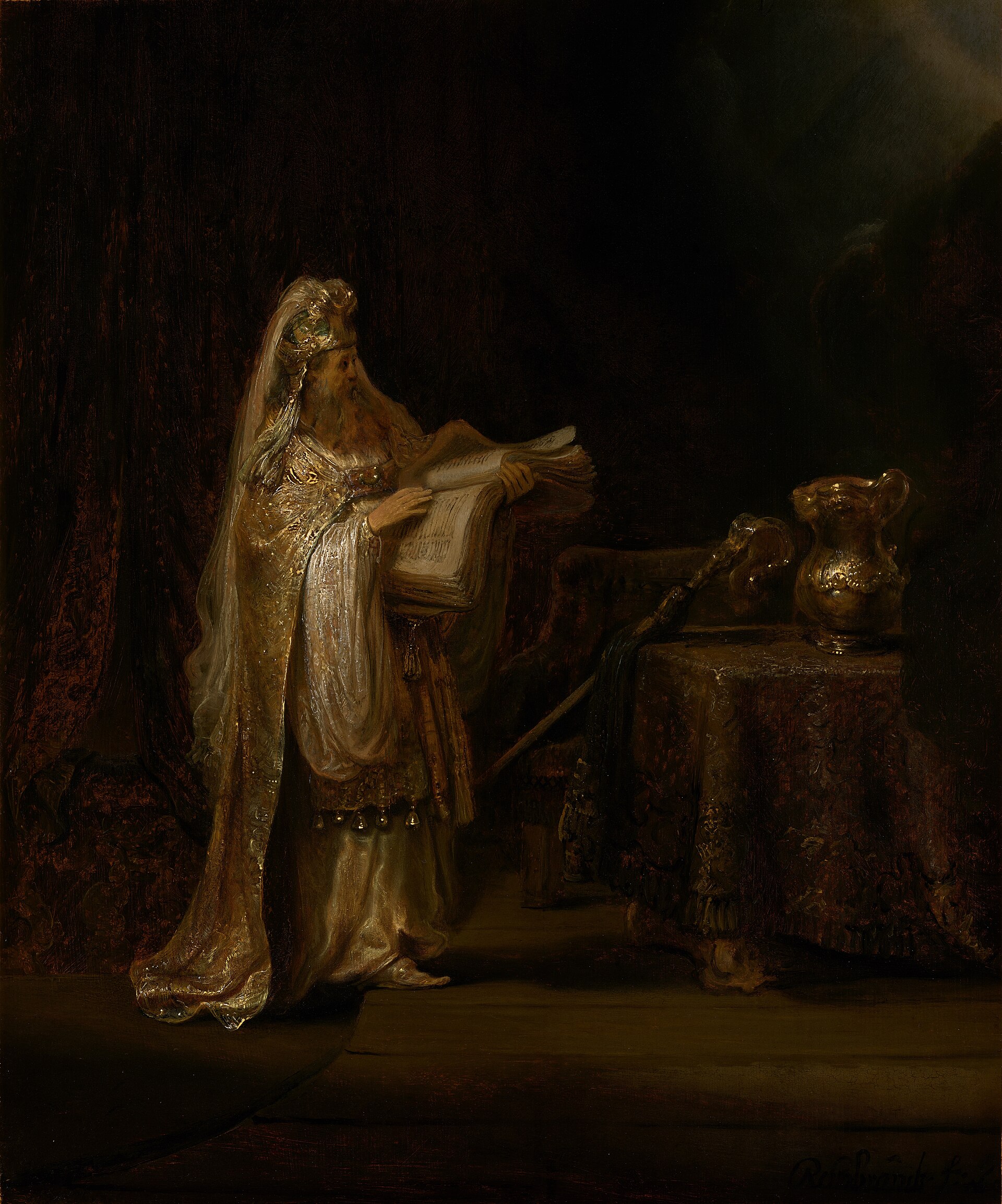
“‘Lost’ painting reattributed to Rembrandt by Rijksmuseum’s researchers”
Senay Boztas, The Art Newspaper
It’s not every day that a new Rembrandt comes to light, and yet that is exactly what the Rijksmuseum has recently announced: after careful analysis of the pigments, techniques, and underpainting used in Vision of Zacharias in the Temple (1633), the museum’s curators have proclaimed the work—long attributed to various minor imitators—to be by Rembrandt himself, as Senay Boztas reports. The painting shows the priest Zacharias holding a large open folio, as light flows in from the top-right corner of the canvas and illuminates his golden vestments. The radiance suggests the presence of Gabriel, who has been sent to announce to the elderly Zacharias the coming miraculous birth of his son, John the Baptist. Having long been tucked away in a private collection, the luminous painting is already on long-term loan at the Rijksmuseum.
“The ruff magic of Anthony van Dyck”
Adam Eaker, Apollo
By the time Rembrandt was painting his Zacharias, his contemporary Anthony van Dyck had already been not only knighted by a major European monarch—Charles I—but also made England’s first ever “principalle Paynter in Ordinary to their Majesties.” In his own lifetime, and for more than a century after his premature death in 1641, Van Dyck was far more influential than Rembrandt, who had fallen into obscurity and penury by the end of his career. As Adam Eaker writes, English painting from Hogarth to Gainsborough to Sargent is unthinkable without Van Dyck, and yet nowadays he is often reduced to a kind of celebrity-chasing fop, pumping out one flattering portrait of the high and mighty after another to get ahead. Now a new show on the Flemish portraitist in Genoa aims to revive the artist’s reputation by emphasizing his engagement with the European art scene and exploring how much the itinerant Van Dyck—with his signature richly colored costumes—owed to Italian forbears like Titian. While it is tempting to see Van Dyck and Rembrandt as foils to one another, one need only consider just how much Rembrandt was influenced by Titian’s pioneering loose application of paint to realize that the Catholic Fleming and the Protestant Dutchman may have a good deal in common.
“Cicero’s Unsentimental Education”
Ryan S. Olson, The Hedgehog Review
As far as social climbers go, one man who gives Anthony van Dyck a run for his money is Marcus Tullius Cicero. As Andrew Dyck (no relation), the most recent biographer of the eminent orator, argues, Rome’s greatest novus homo (new man), lacking the aristocratic pedigree integral for a successful political career, received nevertheless the best education money could buy. He studied and practiced philosophy, rhetoric, and law with leading figures in Athens and Rome, and it paid off when, in a high-profile corruption case in 70 B.C., he used his carefully cultivated oratorical brilliance to take down Verres, the notoriously corrupt governor of Sicily. But as Ryan S. Olson affirms in his review of Dyck’s recent biography, even as Cicero’s star rose, his “education in power” never stopped: from Pompey he learned about the weaknesses of the old aristocracy, and from Caesar how “eloquence could serve the ends of domination.” Yet not even a lifetime of maneuvering in the fractious arena of Late Republican politics inured that greatest of political animals to the reality of raw, state-sponsored violence. There’s a lesson in Cicero’s gruesome end at the hands of Mark Antony’s henchmen, a lesson that has haunted philosophers and politicians, including the Founding Fathers, ever since.