“Archeologists Uncover 2,000-Year-Old Basilica Designed by Vitruvius: ‘The Tutankhamun of the 21st Century’”
Maximilíano Durón, ARTnews
“But basilicas of the greatest dignity and beauty may also be constructed in the style of that one which I erected, and the building of which I superintended at Colonia Iulia Fanestris.” So wrote Vitruvius in De Architectura, his foundational work on classical architecture that made him one of the heroes of the Renaissance. Ever since the Quattrocento, scholars have been searching for Vitruvius’s basilica, the only building of his that he mentions in the treatise. This month, archaeologists have finally found the exact match of the Roman civic edifice that Vitruvius describes in the Italian town of Fano, as Maximilíano Durón reports. The Italian minister of culture, Alessandro Giuli, has already compared the significance of the discovery to that of the tomb of Tutankhamun, but it remains to be seen to what extent the find will really change our understanding of Augustan architecture.
“Taking the plunge”
Nigel Spivey, The Times Literary Supplement
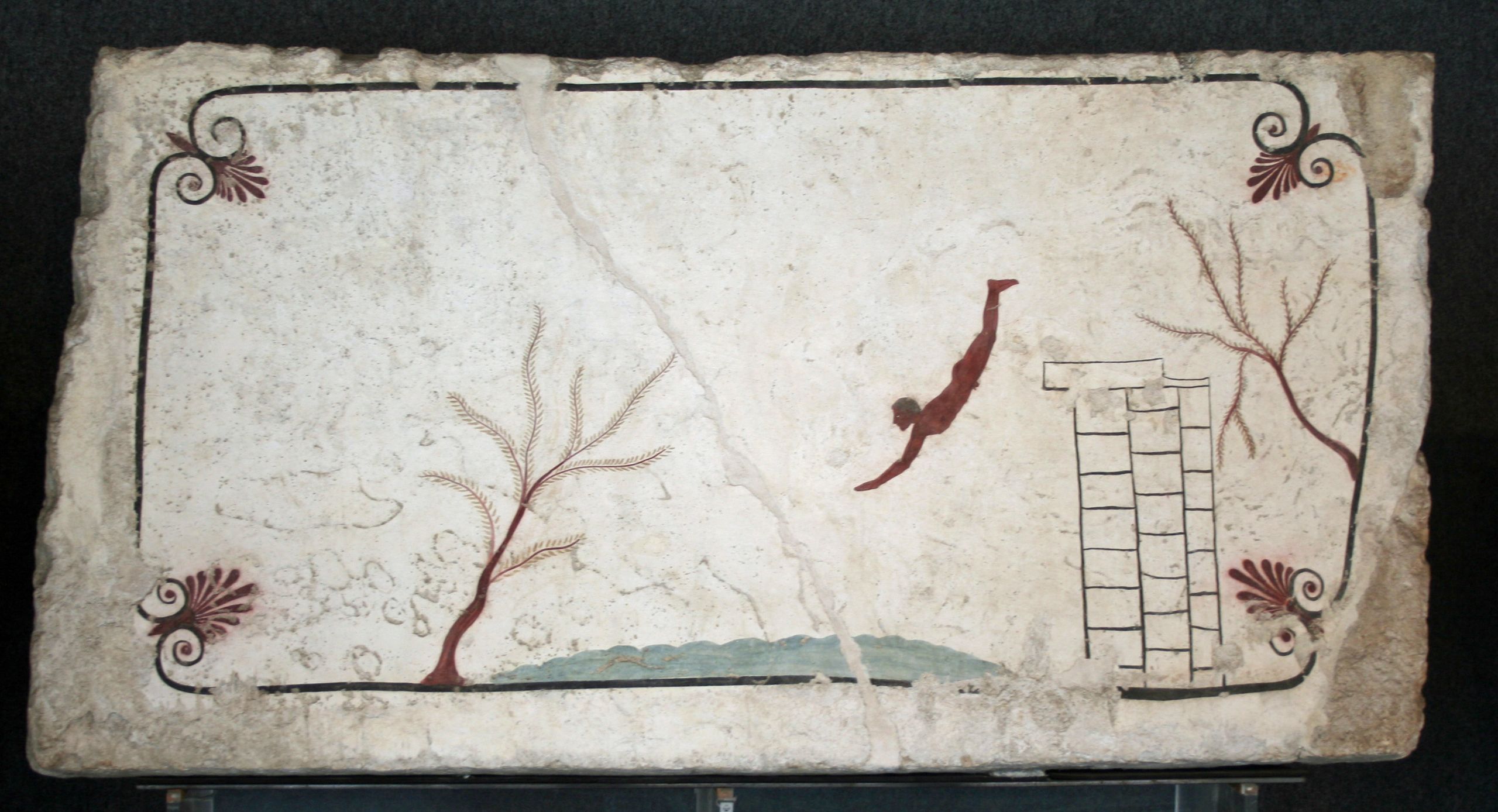
The Tomb of the Diver, located in the Greek colony of Poseidonia (now known by its Latin name of Paestum) in southern Italy, has the rare distinction of containing some of the only surviving Greek wall paintings from the classical period. By far the most famous image from the early-fifth-century B.C. tomb is that of a diving nude youth, who gives the anonymous burial its evocative name. Since the tomb’s discovery in 1968, most scholars have analyzed the iconography as relating to death: a jump into the abyss. That association has been conclusively debunked by Tonio Hölscher, who, in his recent work, The Diver of Paestum, argues that the dive represents initiation into the world of adulthood, not the realm of Hades. As Nigel Spivey writes, this interpretation makes a lot more sense, especially in light of the other wall paintings in the tomb, which show a symposium, a Greek institution by which young men were initiated into the domain of politics, philosophy, and love. Whether or not the youth buried in the tomb enjoyed literal diving, the erotic atmosphere of his final resting place, replete with pairs of recumbent men imbibing wine and flirting, suggests that he had at least fallen in love.
“Britain’s ruthless rise”
Samuel Rubinstein, Engelsberg Ideas
Very few scholarly spats ever escape the confines of the ivory tower. But ever since the publication of Eric Williams’s controversial Capitalism and Slavery (1944), one historical debate that has leaked out to the general public is centered on the role of slavery in the industrialization of eighteenth-century Britain. Unusually for academic questions, the stakes here could not be higher: if the world’s prevailing economic system was only made possible through the ruthless abuse of African slaves, then that raises the question as to whether capitalism can only function through exploitation. Edmond Smith, in his recent volume Ruthless: A New History of Britain’s Rise to Wealth and Power, 1660–1800, takes aim at the scholarly consensus that slavery played little part in Britain’s industrialization, purporting to show instead how the Industrial Revolution could not have taken off without violence and theft. But as Samuel Rubinstein points out in his review, Smith does not address the question of moral improvement, which was as central to pioneering capitalists and industrialists, many of whom were abolitionists and nonconformists, as that of economic development. It’s easy to say why Britain practiced slavery (show me a premodern country that didn’t). It’s much harder to explain why the United Kingdom led the world in abolishing the abominable practice. I suspect a certain invisible hand had something to do with it.