Joseph Pearce is the author of numerous books, including biographies of G.K. Chesterton, J.R.R. Tolkien, Oscar Wilde, Alexander Solzhenitsyn, William Shakespeare, and more, and is the editor of the Ignatius Critical Editions series. He has written books about literature, including Literature: What Every Catholic Should Know and Twelve Great Books: Going Deeper into Classic Literature, as well as Faith of Our Fathers: A History of True England. He is also a contributor to the Catholic World Report.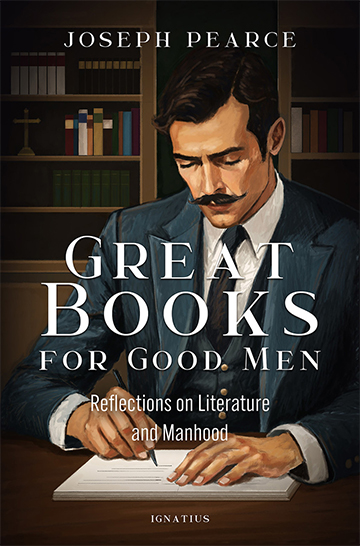
Ignatius Press recently published Pearce’s new book, Great Books for Good Men: Reflections on Literature and Manhood. We recently corresponded regarding the book, discussing literature and the many lessons and insights—in this case, especially for men—to be gleaned about pursuing a wise and virtuous life.
CWR: Before we talk directly about the book, will you share a bit about how and when you began reading great literature, and the influence it had on you?
Joseph Pearce: Although I had been introduced to some great literature by my father, and in high school, I was more interested in politics than literature as a youth. Then, when I was nineteen, I discovered the works of G. K. Chesterton and Hilaire Belloc, which had a radical influence on my perception of life, leading eventually to my conversion to Catholicism.
Other early literary influences included Tolkien, Lewis, Orwell, and Solzhenitsyn, all of whom helped to shape me and my philosophical and theological perspectives.
CWR: This book consists of 48 reflections that were first written for Exodus 90. How did that come about, and how did that shape your approach to these essays on literature and spirituality?
Joseph Pearce: I was commissioned by Exodus 90 to write reflections on literature and manhood, which challenged me to approach great works of literature with a particularly masculine focus. I was very excited by the prospect of selecting works that reflected authentic masculinity, which men should aspire towards, or that reflected erroneous models of masculinity, which men needed to guard against. Each of the 48 reflections needed to be brief, around 500 words, which necessitated discipline and precision in pursuit of succinctness.
CWR: In Part One, you reflect on poems by Chaucer, Shakespeare, and Newman, among others. What was the process for selecting poems? Do they all have common qualities, or is there a range of strengths to be found and reflected upon?
Joseph Pearce: Each of the poems reflects some aspect of masculinity or some aspect of life from a masculine perspective.
The brief excerpt from the General Prologue to The Canterbury Tales focuses on the virtues needed for a good and holy priest. The sonnet that I selected by Shakespeare looks at the harmful consequences of succumbing to sins of lust. Newman’s poem on the spiritual power of making the sign of the cross is a reminder that all prayer is a weapon against demonic power, which also strengthens us and binds us to each other in spiritual solidarity.
I also selected a poem by the Victorian convert poet Coventry Patmore on the experience of both bereavement and fatherhood, and a poem by William Blake, which demonstrates that God is not merely a lamb but a lion, and not merely a lion but a lion that can’t be tamed! Other selections by Catholic poets, such as Gerard Manley Hopkins, Francis Thompson, and Hilaire Belloc, remind us that all of creation is full of God’s grandeur, that God is a relentless hunter who pursues the sinner without ceasing, and that man is a pilgrim who must pursue the path to paradise with an untiring determination.
CWR: In Part Two, you look at Christ and manhood in twelve great works of literature. Were most of these obvious choices for you, or were some of them surprising?
Joseph Pearce: None of the twelve books was a surprise to me because I erred on the side of greatness. All the works selected warrant a place of incontrovertible honour among the truly Great Books of Western civilization. They have a sacrosanct place in the literary canon and can be said to be “canonized” in this sense.
My hope is to introduce these works to men who might not know them and to illustrate the priceless lessons that they contain, especially with respect to the role of the pater familias, the responsibility that men have to be good husbands and fathers.
CWR: Two intertwined themes that you bring out in nearly all these selections are true humility and the necessity of taking up one’s cross. Are there particular works where these themes are especially prevalent?
Joseph Pearce: The Great Books hold up a mirror to man, showing us ourselves. This is especially the case with respect to the struggle between good and evil, which is essentially about humility and its absence. Humility finds practical expression in acts of virtue, whereas pride (the absence of humility) finds practical expression in viciousness.
Thus, for instance, The Iliad shows how the prideful rage of Achilles leads to the betrayal of his country, the destruction of his friends, the angering of the gods, and ultimately to his own self-destruction. This moral lesson, that pride precedes a fall, parallels the archetypal account of the prideful fall of Adam and Eve as recounted in Genesis.
Whereas The Iliad shows us homo superbus (proud man) in the person of Achilles, Homer’s other great epic, The Odyssey, shows us homo viator (man-on-a-journey or man-on-a-quest), whose journey home is thwarted by his pride. It is only after Odysseus embraces humility and self-sacrificial suffering that he is able to achieve the goal of homecoming. In Christian terms, it is only after the hero willingly takes up his cross that progress is possible.
Wherever there is suffering, we will find the cross. Indeed, it is better to say that suffering and the cross are synonymous; they are one and the same. We will all suffer; we will all have our crosses to bear. Suffering is unavoidable; the cross is unavoidable. It’s all about how we respond. Do we accept suffering? Do we take up the cross, asking our God and our neighbour to help us shoulder the burden, or do we despise our suffering, hating the cross that is given us, refusing the help of God and neighbour?
These questions are not only asked by the twelve Great Books that I discuss, but are answered by them.
CWR: How does your deeply Catholic reading of these books compare, say, to a deconstructionist or “woke” reading?
Joseph Pearce: My reading of books in general and of these books in particular is rooted in the paradox of humility, the paradox of love, as expressed by Christ: “The first shall be last, and the last shall be first.” Another way of expressing this paradox is to say that we can only reach the heights if we learn how to kneel.
If we put ourselves first when reading a book, we will misread it. Pride poisons perception because it is blinded by prejudice. On the other hand, if we put ourselves last in deference to the author’s authorial authority, we will be able to read through the author’s eyes, thereby having our own eyes opened to truths in the text which we would not otherwise see. This is, of course, easier with respect to authors about whom much is known. But even in the case of ancient authors about whom almost nothing is known, such as Homer, it is important to treat the past with reverence and respect.
If we take the “woke” approach of treating the past with contempt, seeking to cancel it or to remodel it in our own prideful image, we will be blinded by our prejudice and chronological snobbery and will be oblivious to the wisdom that the Great Books contain. Ultimately, we think as well as we read, and we read as well as we kneel!
CWR: The third part considers twelve works or ideas from G. K. Chesterton. What are some examples of his wisdom, both for men specifically but also at large, for everyone?
Joseph Pearce: The wit and wisdom of Chesterton has much to teach us about being good men; but, as you rightly say, it has much to teach all of us, men and women alike, about the goodness, truth, and beauty of the world in which we live.
My approach in this book has been to take some of Chesterton’s aphorisms and to reflect upon them. Is there a difference between facts and truth? Why is gratitude the test of all happiness? Why is art the signature of man? Are things worth doing badly? Why is tradition the democracy of the dead? What’s the connection between laughter and the love of God?
The wonderful thing about Chesterton is that he doesn’t just ask these questions; he answers them.
CWR: The final part looks at the Catholic presence in Middle-Earth. Why do you think Tolkien’s work continues to resonate so strongly today? What are some of the spiritual truths that you write about in that particular section?
Joseph Pearce: The reason that Tolkien’s work resonates so strongly is that it is set in a timeless world in which timeless truths are made manifest. It has outlived and outlasted those authors who were trying to be up to date by following fads and fashions. Such fashionable authors doom themselves to obscurity because the things that are up to date today will be out of date tomorrow. Fads fade, and fashions become unfashionable. The truth always remains, however, and is always relevant, even when it is unpopular. Indeed, it is especially relevant when it is unpopular.
The key to understanding The Lord of the Rings is revealed in the insistence of Tolkien that it is “a fundamentally religious and Catholic work”. It is this Catholic dimension that I explore in the twelve reflections in the book.
We see how the evil power of the Ring is synonymous with the power of sin. We see how putting on the Ring is the act of sin, wearing it is living in sin, and carrying it without wearing it is bearing the burden of sin without sinning. In this sense, the ring bearer is a cross bearer. In addition, we discover Christ figures in the story, who represent Christ with a subtlety which is all the more powerful for being nuanced, and Everyman figures, who represent us and who show us ourselves in terms of who we should be and who we shouldn’t be.
CWR: There’s much concern today about the apparent drop in the reading of good books, especially among those who are younger. As someone who educates and speaks in a variety of contexts, what do you see and observe? How to stem the digital flood and encourage the reading of great books?
Joseph Pearce: As stated above, we think as well as we read. A culture that ceases to read well is condemning itself to death. This is because the Great Books furnish the Great Conversation in which the wisdom of the ages is passed from one person to another and from one generation to another. This is the living continuum of tradition, without which a society will perish in its own narcissistic nihilism.
Thankfully, I am seeing some very encouraging signs that there is a desire for something more than mere techno-distraction. In my travels and in the classroom, I meet people, especially young people, who exhibit a hunger for goodness, truth, and beauty. These people need to be encouraged to abandon the techno-driven junk culture for healthier and holier alternatives.
We need to encourage techno-minimalism. We need to encourage people to disconnect from virtual reality so that they can reconnect to real reality. We need to encourage them to trade artificial intelligence for the real intelligence that seeks understanding and wisdom, and ultimately the life of virtue that leads to heaven.
If you value the news and views Catholic World Report provides, please consider donating to support our efforts. Your contribution will help us continue to make CWR available to all readers worldwide for free, without a subscription. Thank you for your generosity!
Click here for more information on donating to CWR. Click here to sign up for our newsletter.