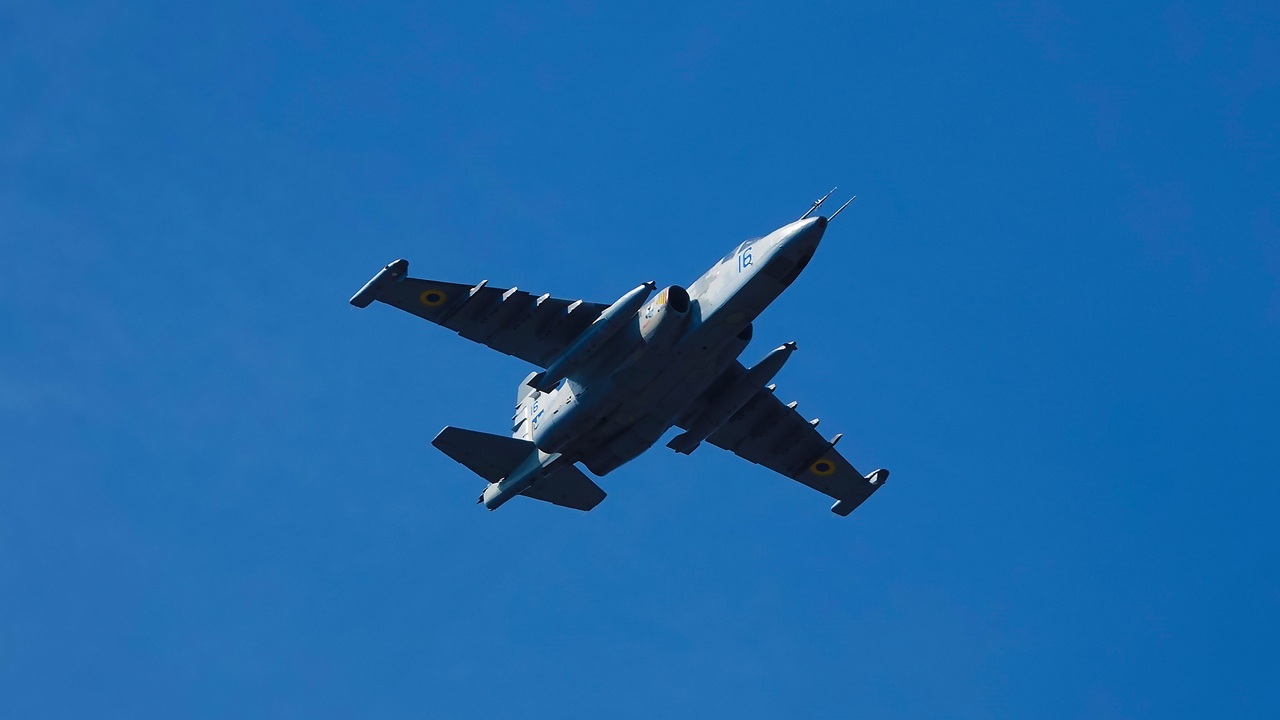
On February 7, 2024, the Ukrainian Air Force lost a Su-25 “Frogfoot” attack jet in action against Russia—an embarrassing and hurtful setback for Kyiv, which had largely held the Kremlin at bay in the skies over its territory. Now, nearly two years after the original incident, a video has emerged showing the last moments of the aircraft.
A Russian Air-to-Air Missile Shot Down the Ukrainian Su-25
In a video circulating on social media, the Ukrainian Su-25 is flying close to the ground to avoid anti-aircraft fire. Then, all of a sudden, it is struck in the rear by an R-37 missile fired from an unseen Russian fighter jet. In a matter of seconds, the Ukrainian aircraft plunges to Earth.
The pilot, Ukrainian Air Force pilot Stanislav Rykov, did not have time to eject. He died instantly after he hit the ground, along with his aircraft.
The aircraft in the video carries the tail sign “21 Blue.” Assigned to the 299th Tactical Aviation Brigade, Rykov was reportedly one of the most experienced ground attack pilots in the Ukrainian Air Force with 385 sorties under his belt.
“My heart was ripped out yesterday,” Ukrainian Air Force pilot Rostyslav Lazarenko had said on social media about the demise of his friend. Lazarenko added that Rykov “was the best pilot and commander I knew.”
- Year Introduced: 1981
- Number Built: 1,000+
- Length: 15.53 m (50 ft 11 in)
- Height: 4.8 m (15 ft 9 in)
- Wingspan: 14.36 m (47 ft 1 in)
- Weight: 19,300 kg (42,550 lb) MTOW
- Engines: Two Soyuz/Tumansky R-195 turbojet engines
- Top Speed: 975 km/h (606 mph)
- Range: 750 km (470 mi) combat range
- Service Ceiling: 7,000 m (23,000 ft)
- Loadout: One 30mm GSh-30-2 autocannon; 11 hardpoints; 4,400 kg (9,700 lb) capacity
- Aircrew: 1
Originally manufactured by the Soviet Union as an answer to Western ground attack aircraft such as the A-10 Thunderbolt (or “Warthog”), the Sukhoi Su-25 Frogfoot is a single-seat attack jet designed to provide close air support to ground troops.
Ukrainian pilots have talked about the capabilities of the Russian air-to-air munition and the difficulties they are having in dealing with it.
Three years ago, Ukrainian MiG-29 pilot Andrii “Juice” Pilshchykov spoke to The War Zone defense news outlet about the struggles against the R-37M. The Ukrainian fighter jet pilot, who was later killed in a flying accident during a mission, said that Russian fighter jets often fired the R-37M from within Russian airspace, thus limiting the Ukrainian pilots’ ability to operate freely.
“Of course, if you’re maneuvering, we are not able to provide an airstrike or something else, so the game is still very, very, very tough in the air and very, very risky. If you’re not aware of the launch of a missile, you’re dead,” Pilshchykov had added.
The Struggle for Air Superiority over Ukraine
He who controls the skies can control the ground. But despite this war truth, neither combatant has managed to wrestle control of the skies from the other side. And although that is understandable for a Ukrainian Air Force undergoing the largest transformation in its history with the infusion of several different types of Western aircraft, including F-16 Fighting Falcon, JAS 39 Gripen, and Dassault Mirage fighter jets, the same cannot be said for the Russian Aerospace Forces.
Despite beginning the war with a numerical and qualitative superiority, the Russian Aerospace Forces have failed to achieve air superiority over the battlefield. Indeed, in many ways, Russian air power has failed to achieve anything significant on the tactical and operational level. To be sure, Moscow continues to deploy strategic bombers in its long-range fires campaign against Ukrainian urban centers and critical infrastructure. But Russian tactical aviation has been largely absent from the battlefield. And that is one of the main reasons why the Russian forces on the ground have failed to achieve an operational breakthrough.
Although the loss of the Ukrainian Su-25 and Rykov is a blow to the squadron and his fellow pilots, it may be some consolation that the Russian Aerospace Forces are not any closer to achieving control of the skies in 2026 than they were at the outset of the war in February 2022.
About the Author: Stavros Atlamazoglou
Stavros Atlamazoglou is a seasoned defense journalist specializing in special operations and a Hellenic Army veteran (national service with the 575th Marine Battalion and Army HQ). He holds a BA from the Johns Hopkins University and an MA from the Johns Hopkins’ School of Advanced International Studies (SAIS). His work has been featured in Business Insider, Sandboxx, and SOFREP.
Image: Shutterstock / Blik Sergey.