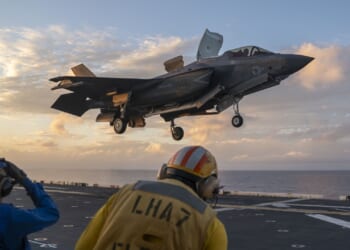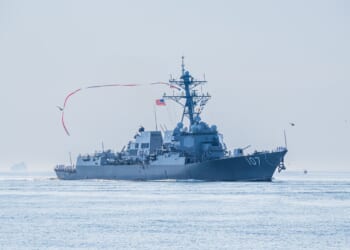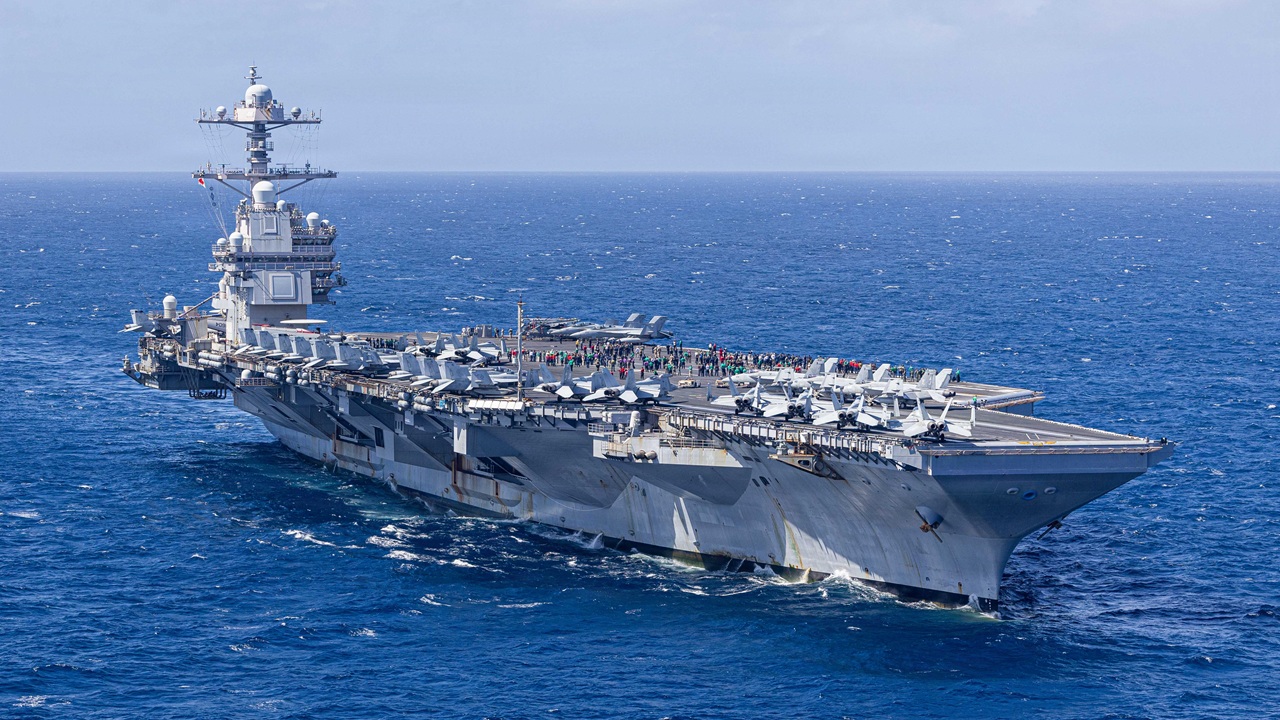
The recent fire on board the USS Gerald R. Ford (CVN-78) caused far greater damage than was initially reported—with one sailor medically evacuated from the ship, and 200 more treated for smoke inhalation.
On Monday, the United States Navy’s newest and largest nuclear-powered supercarrier arrived at Souda Bay on the Greek island of Crete, where she will undergo pier-side maintenance for at least a week, but perhaps even longer. It is unclear if the warship will remain deployed in the eastern Mediterranean or the Middle East, or begin her trip back to the United States.
The USS Gerald R. Ford’s Voyage of the Damned
The fire, which broke out in the carrier’s aft laundry facility on March 12, took several hours to extinguish, although US Navy officials have said it was not as long as the 30 hours The New York Times claimed. There remain conflicting accounts of the fire in the media, and the Pentagon seemingly attempted to downplay the severity of the fire in the immediate aftermath, leading to later confusion.
What is known is that the Ford’s laundry facilities are offline, and sailors had to have clothing flown in. In addition, upwards of 1,000 mattresses were taken from the future USS John F. Kennedy (CVN-79), suggesting damage to living quarters as well.
The fire is only the latest mishap on CVN-78. Prior to the blaze, the new supercarrier had experienced ongoing plumbing issues with its nearly 650 toilets. The vacuum collection system has been clogging throughout the current deployment—which now totals roughly 9 months at sea, far longer than a usual deployment.
The unusual length of the mission—prompted by its service in the Caribbean against Venezuela, then its immediate transfer to the Eastern Mediterranean as the crisis with Iran escalated—might have brought the Ford’s crew to a breaking point.
“There are also reports that sabotage may have been involved—not by Iranian undercover operatives, but by crew members disgruntled that their standard six-month tour of duty has been extended for the Gulf operation,” The Telegraph newspaper reported.
The warship was likely at the end of its deployment when the decision was made to extend the current mission, which dispatched it to the Middle East. Even if CVN-78 returns home, instead of heading back to the Middle East, it will almost certainly surpass the record for longest post-Cold War deployment held by USS Abraham Lincoln (CVN-72), which spent 294 days deployed from April 2019 to January 2020.
The conventionally-powered and now retired USS Midway (CVA-41) holds the record for longest deployment, spending 332 days at sea in 1972-73. That extended, nearly year-long, deployment supported operations during the conflict in Southeast Asia, including the intensified air campaigns against North Vietnam in 1972.
Such missions are taking their toll on the sailors.
“The Ford and its crew have been pushed to the brink after nearly a year at sea,” said Sen. Mark Warner (D-VA), the vice-chairman of the Senate intelligence committee, last week. “They have been paying the price for President Donald Trump’s reckless military decisions.”
The Department of Defense (DoD) hasn’t indicated whether sabotage was at play, but if so, the individual(s) would be in very serious trouble.
“You could easily get 20 years in jail for this, especially in a time of conflict,” Chris Parry, a retired Royal Navy rear admiral, told The Telegraph.
This would not be the first arson incident on board a US Navy ship. In 2012, a civilian contractor lit a fire aboard the Los Angeles-class attack submarine USS Miami while in port in Kittery, Maine—reportedly because he wanted to leave work early.
The fire gutted the vessel, causing an estimated $400 million in damage and leading to its decommissioning two years later. The contractor who lit the fire was sentenced to 17 years in prison.
Fires Are All Too Common Aboard Navy Ships
Laundry room fires can be a problem on any large ship at sea, and it is something that the cruise line industry takes seriously. In other words, sabotage may not be to blame.
“Everything is possible, and on a ship of nearly 5,000 people, there can always be some bad actors, especially when the crew has been ridden pretty hard. However, if I were a betting person, I’d say the fire was probably an accident,” Dr. John Cordle, a retired US Navy commander, told The Telegraph, adding that US Navy sailors are trained to focus on the mission.
“Laundries have lots of heat, electrics, and moving parts, and people may have just got so worn out on this tour that they’ve made mistakes,” Cordle said.
The facilities are filled with machinery that runs nearly nonstop at high speed and heat. If the ducts haven’t been cleaned out properly, it is easy for small lint particles to catch fire, potentially leading to a larger blaze—not unlike a house fire caused by lint buildup.
The issue now is how long it will take to address the fire damage and whether the supercarrier will return to the Middle East or head home.
“Taking the Ford off the board for any significant length of time means less US support to war efforts,” Daniel Schneiderman, director of global policy programs at Penn Washington, told France24. “The Ford’s role in the defence of Israel is significant.”
Still, expecting sailors to work with dirty clothes on a warship with clogging toilets isn’t likely to make for a truly combat-ready vessel.
About the Author: Peter Suciu
Peter Suciu has contributed to dozens of newspapers, magazines and websites over a 30-year career in journalism. He regularly writes about military hardware, firearms history, cybersecurity, politics, and international affairs. Peter is also a contributing writer for Forbes and Clearance Jobs. He is based in Michigan. You can follow him on Twitter: @PeterSuciu. You can email the author: [email protected].