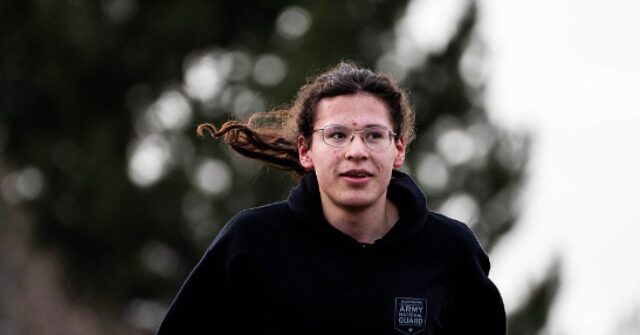
The Washington Post is taking heat for gaslighting with a gushing and highly dramatized story of a “transgender athlete,” a boy who identified as a girl and who went on to win two girls’ track championships in Washington State in 2024 and this year.
The Post tells the story of high school runner Verónica García, but the tale reads more like the script of a hagiographic TV tear-jerker one might see on the Hallmark Channel than a news story. Naturally, García is framed as a “she” and “her” throughout the piece, and the opposition to trans athletes competing in female sports is presented as mean-spirited, religious-nut cases who don’t understand “science,” not to mention are followers of hater-in-chief Donald Trump.
García earned national infamy in 2024 when a video of his Washington State Championship win in the girls’ 400m showed him running many yards ahead of his closest competition.
The Post story is unmistakably pro trans, and García is presented as beleaguered, attacked, wronged, and a target of bigotry.
For instance, in the first few sentences, the paper notes that many who oppose trans athletes in female sports feel that males entering women’s spaces can be “dangerous.” But noting that García is a small person, the paper writes: “Dangerous? She was 5-foot-7 and skinny in a way that concerned her coaches.” And quote the teen as saying, “I’m a twig,” Verónica told her mother, Traci Brown. “Who could I hurt?”
This, of course, is entirely disingenuous. No one was saying that García was going to walk up to a female opponent and punch her in the face. The “danger” García represents is in the unfairness of his advantages as a male and the gutting of girls’ sports by allowing boys to compete as girls. But the paper goes for childish theatrics instead.
The paper also tries to gin up sympathy because García’s family is not rich. The paper reveals that García’s family lived in a small apartment and often did not have enough food to eat.
To that point, the paper gives us paragraphs like this:
She reached into a cardboard box she used as a headboard and pulled out two expired power bars. They would have to last her until dinner. She slipped on her black and green track uniform, and clipped a bow around her wavy, brown ponytail. She added three beaded friendship bracelets her teammates had made to commemorate her senior season. Then she found a bare patch of floor and performed what she considered “a very important ritual.”
She swayed and threw her arms into the air as Lady Gaga’s “Abracadabra” played from a disconnected phone. When the song ended, Verónica exhaled and did her best to pretend she wasn’t nervous.
“Okay,” she said. “I’m ready.”
That is not reporting. That is dramatic TV scriptwriting.
The entire article is written that way, not as news, but as drama. This is not journalism. This is advocacy.
Meanwhile, as García is portrayed in only the warmest and fuzziest of terms, the opponents of transgender athletes are presented as bigots.
In one segment, García’s critics are reported this way:
“That’s a whole ass man and a half,” a student spectator yelled from a fence 10 feet away, where half a dozen girls had gathered to heckle Verónica. “That’s an it.”
“What was it doing on the track?” a tall girl in a hijab said. “Riley Gaines said he switched to the girls team just so he can win.”
But poor, poor Verónica:
Verónica wished she could tell those girls how wrong they were about her life. She only wanted to belong somewhere, and she wanted to do that as herself. But she would discover over the coming season that to do so, she would have to endure increasing notoriety and the abuse that came with it.
The paper portrays García as hungry, lonely, and depressed, merely hoping to make friends and be accepted “as she is.” But everyone is just so darned mean to “her.”
The story also claims that the science in favor of trans athletes is “more complicated than what feels, to many voters, like common sense.” The studies, the paper says, are often incomplete and contradictory. But, mean Trump doesn’t care:
Trump seemed to have no interest in resolving the scientific debate. Instead, he cut funding for research into LGBTQ issues, and he made good on a campaign promise. The first week of February, on National Girls & Women in Sports Day, he signed an executive order he called Keeping Men Out of Women’s Sports.
And poor, poor Verónica:
Verónica groaned. The president had been in office less than a month, but already he had signed executive orders to ban her health care and to bar trans people from joining the Army National Guard, which had been her goal. Now this.
Not only that, but when García won his second big race this year, he was mistreated by the crowd:
The crowd booed loud and long. Teenage boys yelled that Verónica should “get out,” and none of her fellow competitors clapped. Verónica pulled her shoulders back, climbed the podium and smiled.
The crowd booed again when Verónica’s relay team finished third, and later, thousands of people did their own kind of booing online. They called her cuss words and said she should be taken to jail. Verónica read every comment. The one that hurt the most was a picture Gaines posted of Lauren. While Verónica collected her medal, Lauren had carried a sign to the top of the stadium.
Throughout the long story, García is the downtrodden but plucky hero of his own tale. His opponents are presented as hateful, mean, lying, and uninformed. And the Washington Post hopes you will come away being ashamed that you don’t want men taking sports opportunities away from women.
Follow Warner Todd Huston on Facebook at: Facebook.com/Warner.Todd.Huston, Truth Social @WarnerToddHuston, or at X/Twitter @WTHuston