In the latest episode of Russia Decoded, hosts Andy Kuchins and Chris Monday unpack how Russian state media frames Washington’s sudden escalation in the Middle East.
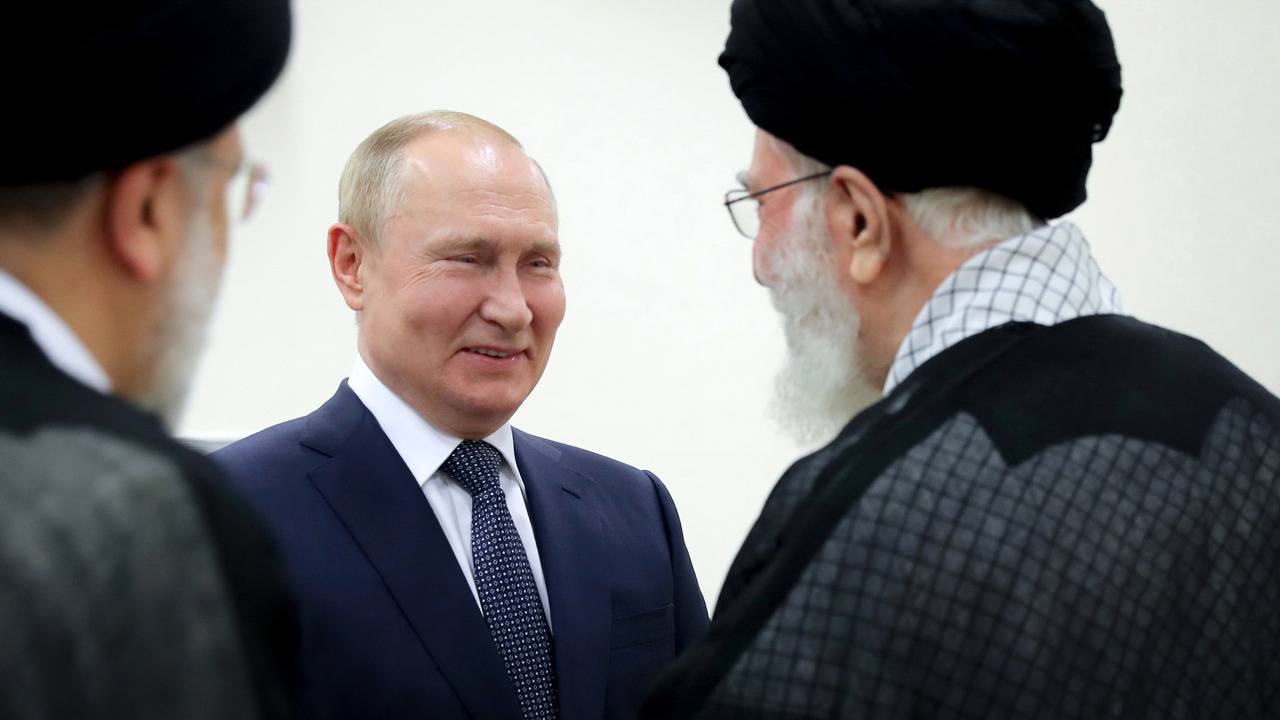
Ongoing joint US-Israeli airstrikes have effectively decapitated Iran’s Islamist regime, killing Supreme Leader Ali Khamenei and former President Mahmoud Ahmadinejad. Russian state media has taken a surprisingly muted tone, avoiding condemnation of President Donald Trump despite characterizing the strikes as a “treacherous attack” on an erstwhile ally. Vladimir Putin, seemingly taken by surprise, has conspicuously withheld any formal criticism of the US president, signaling that Moscow remains on the fence while prioritizing its high-stakes talks with Washington over the future of Ukraine.
Iran is simply no longer a core interest of Russia’s; the Kremlin appears content to watch from the sidelines, hoping the U.S. gets bogged down in another Iraq-style quagmire. This muted response is a direct consequence of Russia’s ongoing “special military operation” in Ukraine, now in its fifth year.
Last week, Russia’s Foreign Intelligence Service (SVR) alleged (without evidence) that Britain and France had provided Ukraine with components for a functional nuclear weapon. Though absurd, the accusation served a dual purpose: providing justification for further closing down Russian society and, more importantly, distracting from a recent catastrophic failure in Russian air defense. Just days before the SVR report, Ukraine launched a “Flamingo” missile deep into Russian territory, striking the state-owned Votkinsk plant, which manufactures both Iskander ballistic missiles and nuclear-capable intercontinental ballistic missiles. The Kremlin has downplayed reporting of this hit to avoid being forced into a retaliatory spiral it can ill afford.
Internally, the Kremlin is attempting a radical reconstruction of the Russian elite to prevent a repeat of the 1917 revolutions, when armed and unhappy war veterans helped overthrow the Tsarist and Provisional governments. Through the “Time of Heroes” program, managed by Deputy Chief of Staff Sergei Kiriyenko, the state is fast-tracking war veterans (many from modest ethnic and socioeconomic backgrounds) into elite civil service positions. This affirmative action for the “new elite” aims to create a class of loyalists whose status is entirely beholden to the current leadership.
Is the Kremlin hedging its bets as Washington re-enters the Middle East? Is Putin hoping the United States becomes strategically overextended without jeopardizing a potential diplomatic channel with Trump? And what does the omission of uncomfortable domestic news tell us about the regime’s internal red lines?
In the latest episode of Russia Decoded, hosts Andy Kuchins and Chris Monday unpack how Vladimir Putin and Russian elites understand the world, and how they seek to influence it. Listen now on Apple, Spotify, or wherever you get your podcasts.
About the Speakers: Andy Kuchins and Chris Monday
Andrew C. Kuchins is currently a senior fellow at the Center for the National Interest and an adjunct professor at the Johns Hopkins University School of Advanced International Studies. He has served as President of the American University of Central Asia and the Director of the Carnegie Moscow Center as well as the Russia and Eurasia Programs at the Carnegie Endowment for International Peace and the Center for Strategic and International Studies. He is the author or editor of 7 books and published columns for The Wall Street Journal, The New York Times, The Washington Post, and many other media outlets.
Chris Monday is an associate professor of economics at Dongseo University in Busan, South Korea.
Image: Russian President Vladimir Putin meets Ayatollah Ali Khamenei in July 2022 (Wikimedia Commons).