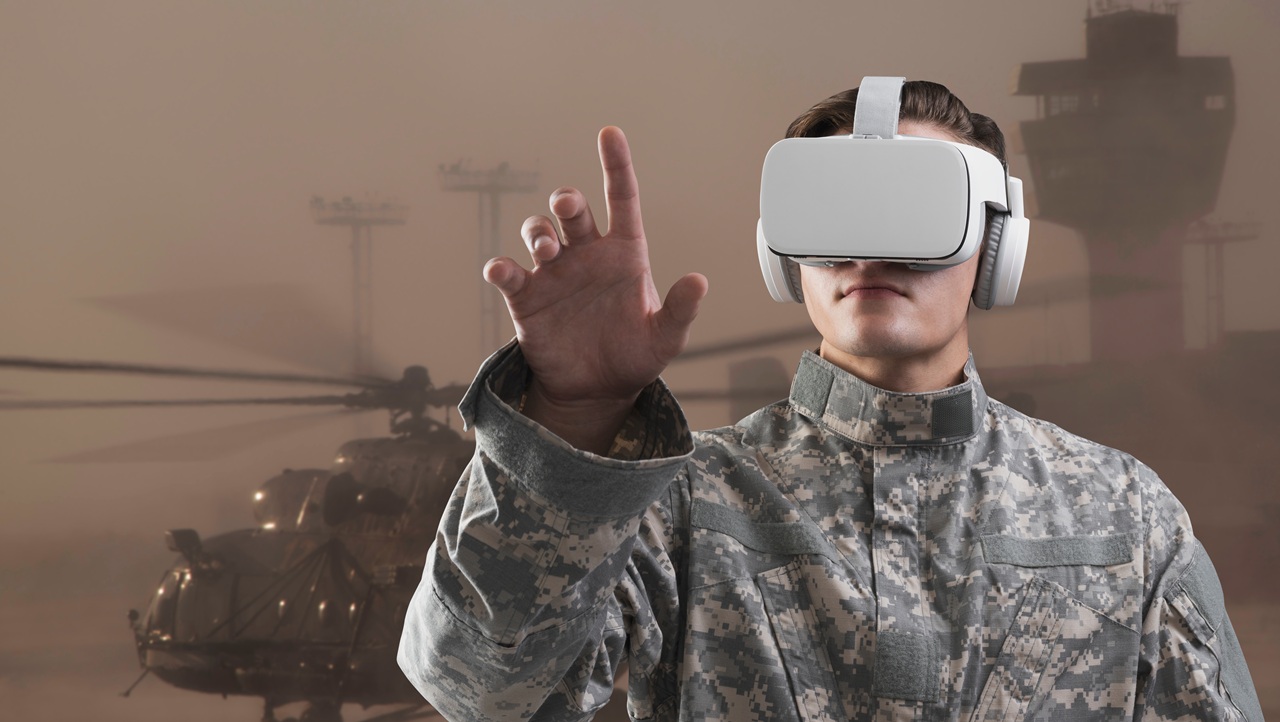
The Army has already begun some “virtual reality” training—using VR headsets to prepare soldiers to operate vehicles without needing them to be physically present at those vehicles’ location.
Logistics are a perpetual pain for the United States military. Moving large numbers of military personnel across continents for exercises, or even for routine training, is a costly and time-consuming operation that usually reduces the time troops can spend for more useful purposes.
To address this issue, the US Army announced this month it would begin to “train differently,” increasingly employing virtual and augmented reality (VR/AR).
How VR and AR Can Help Train US Troops
The new technology could further reduce temporary duty assignments (TDY), or short-term moves, which can last from days to months.
AR/VR will allow training to be conducted at a soldier’s home station, explained Army Chief of Staff Gen. Randy George during a virtual town hall at Fort Drum, New York. According to a report from Task & Purpose, AR/VR could be used in classroom lessons to provide detailed insight into weapon systems and battlefield tactics. It could be employed at all levels of the service, from enlisted personnel to general officers.
“What can be done in a virtual setting that really replicates the environment that you’re gonna be working in and what needs personal interaction? I really have a hard time seeing a future where we get rid of all in-person interaction, because there’s a professional element that requires human interaction. But that’s not to say that there isn’t a role for the online element,” David Dworak, provost of Army University, told Task & Purpose.
There is some irony in the Army seeking to cut down on training travel, but requiring hundreds of high-ranking generals and members of their staff to be present in person for Secretary of Defense Pete Hegseth’s recent pep talk near Washington, DC.
VR Vehicle Training Is Already The Norm
The use of VR and AR in classroom training is just the latest way that the Army is embracing the technology. It was nearly two years ago that the Army began testing VR systems at Fort Cavazos, Texas—where soldiers used simulators that replicated training on the M1 Abrams main battle tank (MBT), the M2 Bradley Infantry Fighting Vehicle, and the STRYKER armored vehicle.
The Army’s Operational Test Command (OTC) aided in the development of the Synthetic Training Environment (STE) to help soldiers spend more time at the controls to hone their skills without adding wear and tear to the vehicles. VR can further provide dynamic situations that aren’t available on the training ground.
It offers much of the “uncertainty, stress, and complexity” that warfighters might experience in real-world conditions.
“You can do training virtually instead of physically going out in the field and having to spend the fuel, the ammo, and the logistics of moving chow and everything,” said Robert L. Carroll, an assistant test officer at OTC’s Mission Command Test Directorate.
The Navy is Employing VR, Too
In a sign that VR is likely to continue to be employed in training, it was reported last week that US Navy sailors are using VR/AR for training as well.
Sailors aboard the US Navy’s Nimitz-class nuclear-powered supercarrier, USS Theodore Roosevelt (CVN-71), participated in a virtual training demonstration using the “Virtual Bridge and Nautical Trainer,” also known as “VIBRaNT.”
The new VR system is one of several digital tools that were developed to provide realistic yet safe training in ship navigation, ship handling, and situational awareness. In the case of VIBRaNT, it enables crews to train in complex situations, including inclement weather and stormy seas, in high-traffic areas, and in force-protection exercises, without risking the real warship or endangering the crew.
VIBRant can further allow bridge teams to continue their training during lengthy maintenance periods, when the crew may have limited opportunities to practice on the navigation systems.
VR and AR will be part of the new training reality—though they are unlikely to ever replace the hands-on aspects of training entirely.
About the Author: Peter Suciu
Peter Suciu has contributed over 3,200 published pieces to more than four dozen magazines and websites over a 30-year career in journalism. He regularly writes about military hardware, firearms history, cybersecurity, politics, and international affairs. Peter is also a contributing writer for Forbes and Clearance Jobs. He is based in Michigan. You can follow him on Twitter: @PeterSuciu. You can email the author: [email protected].
Image: Shutterstock / rawpixel.com.