WASHINGTON — The foreign minister of the Democratic Republic of Congo (DRC) told Breitbart News exclusively that her country’s government is “very enthusiastic” about the fact that in their view President Donald Trump “fully deserves” to win the Nobel Peace Prize this coming year.
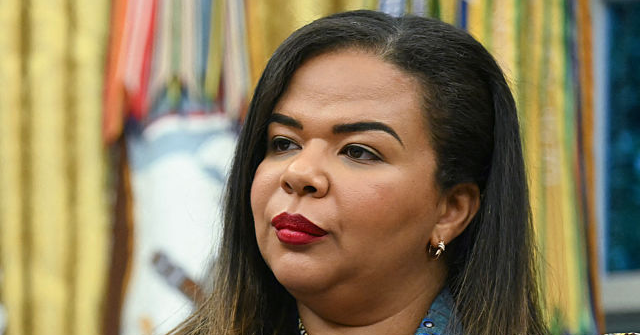
Thérèse Kayikwamba Wagner, DRC’s foreign minister, sat down with Breitbart News exclusively for an in-depth interview last week at the residence of the Congolese ambassador to the United States in the U.S. capital city. Wagner was on hand earlier this year in the summer for the historic signing of a first-step peace agreement between Rwanda and Congo in the Oval Office and then again for the next phase signing of what has become known as the Washington Accords where the presidents of both Rwanda and DRC joined Trump to sign a deal in early December. Meanwhile, DRC has also signed a separate agreement with M23, a rebel group operating in eastern DRC, that the DRC says is backed by Rwanda, in Doha, Qatar. The entire effort has culminated in a serious push from Trump and his administration to end the world’s longest-running war between Rwanda and DRC, a decades-long conflict dating back some 30 years.
When asked by Breitbart News during the interview to recount what it was like in the summer to meet with President Trump in the Oval Office, Wagner said it was totally unexpected as she thought she and her Rwandan counterpart were just signing a deal at the State Department.
“For me, it was a completely unexpected highlight to be honest because what we had been told was that we would have the signing at the State Department but then the invitation to be welcomed or to be received by President Trump — at least the information, we got it just after the signing. I was completely unprepared, if you will,” Wagner said. “So it was, you go from like, peak to peak, and then there’s another one and you didn’t even see that one.”
When she got to meet with Trump and his whole team — Vice President JD Vance and Secretary of State Marco Rubio were also on hand for that historic signing in the summer — she found he was truly genuine about ending the war.
“All of a sudden, I think that’s really for me the most important part — before the cameras came and everything — all of a sudden, you realize how genuine and sincere he is about the matter,” Wagner said. “I think this is something for me that really struck a nerve. Now, the relationship between President Trump and the DRC again, as I said, we have seen so many administrations come and go and you have all of these statements, you have statements also at the U.N. and so on and so forth. But we have yet to have had a president that committed to the issue that he dedicated so much of his energy, his team’s energy. It wasn’t just meeting President Trump in the Oval Office. He was there with the vice president. He was there with Secretary Rubio. You could feel that this was something where he said, ‘You know, I want my people, my best people, on this,’ and you feel a level of sincerity on the issue and of proximity also to the administration that we had not had in a very, very long time. So I think this has also paved the way for even stronger relationships between the U.S. and the DRC. I think this is something that we look forward to with a lot of enthusiasm, the prospect of peace, the prospect of our two countries coming closer together, and of working on shared prosperity on so many issues. So I think for me personally was it was just a highlight I didn’t even see coming, and it will definitely be one of the most memorable moments of my career.”
Trump’s genuine commitment to peace and prosperity in Africa’s Great Lakes region, Wagner said, is something that the DRC considers to be worthy of the Nobel Peace Prize. She mentioned that her country’s President, Felix Tshisekedi, has nominated Trump for the award and that he deserves it more than anyone else who has gotten it before him.
“But at the same time looking at it, taking a few steps back, and looking at it from a perspective of our respective countries but also just in a global historical sense, imagine what it means to put an end to 30 years of war,” Wagner said. “This is why, on the Congolese side, we are enthusiastic about saying President Trump fully deserves a Nobel Peace Prize — 10 million people, 10 million people, and just saying, ‘We know what we’re going to do, what has to be done to put an end to this, and we’re going to put the resources there. We’re going to stay committed. We’re not going to say, Oh well, this is getting too complicated at the first road bump.’ This is historic not just for us but for the world and this is why President Tshisekedi is very transparent about that he fully deserves the recognition that no other before him deserved.”
Despite all the enthusiasm in the immediate aftermath of the December 4 signing of the Washington Accords between both countries with Trump at the White House, there have been some major setbacks in recent weeks since. M23 has gone on a rampage inside eastern DRC and seized a major city, Uvira in the South Kivu province, something Wagner says has ended up forcing tens of thousands of Congolese citizens to flee for their safety. In addition, what she described as a “flaring up” may also entangle neighboring Burundi as munitions apparently landed in that country.
“As you said, we were all very enthusiastic. On December 4, we had this very memorable ceremony championed by President Trump,” Wagner told Breitbart News. “Unfortunately, in the immediate aftermath, we saw a flaring up — not a resumption, but rather a flaring up of fighting — in eastern Congo, more specifically in South Kivu province. So what has happened since the signing of the agreement on December 4, and it’s been barely a few days, is that the M23 — with considerable support from Rwanda — have launched an attack on the city of Uvira, the second largest city in this province, an attack which has triggered first of all the fleeing of numerous thousands of civilians. Initially we were speaking of about 200,000 but now we’re looking at over 500,000 people who have had to flee this surge in violence. What we have also seen is that the M23, supported with Rwanda, took over the city of Uvira, which means that they have extended their footprint if you will of a territory that they now illegally occupy. As I said, side by side with that, we’ve seen a lot of civilian suffering and people have to having to flee across the border into Burundi. What we also saw were that some shells landed in Burundi, which gave it all a new dimension — if you will, a conflict that for a very long time has been perceived and has been observed as opposing two countries, Rwanda and the DRC. Now, you know, you have the threat of bringing in the fold if you will Burundi as a third country that was affected by the fighting.”
In response to these developments, U.S. Ambassador to the United Nations Mike Waltz as well as Secretary Rubio and Deputy Secretary of State Chris Landau all issued statements calling on Rwanda to honor the deal.
Wagner told Breitbart News DRC welcomed the strong response from the Trump administration.
“Well, the statements provided extreme clarity on the situation on the ground and I think it was very necessary for two reasons,” Wagner said. “First of all, it reaffirmed the steadfast commitment of the Trump administration to this process that President Trump has invested so much diplomatic and political capital into. The U.S. could have said, ‘Oh well, maybe it’s a minor bump. Let’s see what happens.’ But what we saw through the very firm, clear statements of Ambassador Waltz, but also Secretary Rubio and Deputy Secretary Landau was a re-affirming of the commitment of the U.S. to stay on track with this process and to make sure that it doesn’t derail. I think that was the first very important point. The second important point was also that by doing so the U.S. also clarified that this was not an issue up for interpretation of what’s going on in the field. There was a clear violation of the agreement, the agreement that the U.S. has shepherded — shepherded the region through — and has championed. It was important for the U.S. also to explicitly say this is a violation of the agreement. I think this is very critical and has helped also not just the DRC, but Rwanda, Burundi, and the greater region have a clarity on the U.S. stance. It’s been a very strong signal to all the countries that have been following with interest this peace process. Now what needs to happen? I think the signaling has been very important and has played a key role also to get everyone’s attention. But on the other hand, we need to see clear action on the ground. I think what would be important now is to have firm and tangible deliverables. It is critical now that Rwanda pulls out all of its troops from the Democratic Republic of the Congo — we’re speaking of a number reaching up to 10,000 troops — and it is unacceptable that we project ourselves in a future of reconciliation, a future of overcoming this conflict, if some tangible steps are not made. And one key aspect of that is the withdrawal of Rwandan troops who are illegally in the DRC.”
The Rwandan side denies that it has any troops in DRC, but Wagner said they are clearly there.
“I think they have been consistently denying that they have been there,” Wagner said. “And we have been consistently not just referring to our own experts, but also referring to U.N. experts, referring to statements by the U.S. administration, by other observers. So the presence of Rwandan troops, even if it is consistently denied by Rwanda, has been established as an objective fact. It is a reality. It’s really also hard to say that they’re not, to say that you don’t know they’re there, right? Because I remember in February there was a CNN interview I think of President Kagame where he said he didn’t know if he had troops in the DRC. I’m sorry, if you have 10,000 of your guys wandering off and you don’t realize then there’s something wrong with your chain of command. So the knowledge is there. I think what is important now is to make sure that the elements of the Washington Accords that foresee the withdrawal of the Rwandan troops are accelerated and that they take shape as soon as possible. This will re-establish Rwanda’s trustworthiness and the sincerity of the commitment to this peace process that they have themselves, because of this last attack on Uvira, eroded in a very dramatic manner.”
Despite the recent flare-ups of fighting, Wagner said the DRC side is very hopeful that everything can get right back on track soon. She explained to Breitbart News the various avenues of negotiations and dealmaking that has happened, from the Washington Accords to the Doha track.
“You’re very right to point out that these are two separate tracks, when it comes to the bilateral state to state relations, if you will,” Wagner said. “This is what we call the Washington, DC process and the Washington track. This is what I just mentioned when I say that the Accords foresee the withdrawal of Rwandan troops. Now, in parallel to that, we have the Doha process or the Doha track, where the Congolese government are also in talks with M23. So what needs to happen there is that we have a framework agreement that has been adopted but that has to be complemented with a series of protocols that explain exactly how we will deal with some of the key thematic issues. What has to happen now first of all is with the withdrawal of the Rwandan troops, we need to be in a better position to accelerate also the work that has to happen with M23 that means working out these different protocols that foresee issues such as re-establishing humanitarian access, for example, and restoring the state authority. So these are the different elements that have to be worked out as soon as possible. I think what the crisis in South Kivu has shown us very clearly is peace is difficult. Peace is a process. But peace is not something that you can just wait to materialize. We need to be proactive and we need to stay on track with the task at hand. So the urgency is also on Doha to make sure that we quickly get to agreements, quickly — agreements that are also enforceable and that hold all parties accountable, as we are learning from the situation.”
The engagement from Trump and his senior-most advisers has been something Wagner says is “welcome” to those who want to see the conflict end and a new era of prosperity ushered in.
“I think we welcome it, because, again, it is proof that the Trump administration is truly committed to finding a durable solution to a conflict that has been ongoing for 30 years,” Wagner said. “I think President Trump is by far the only U.S. president who has invested so much effort in finding such a durable solution to the conflict that we have. Whenever I had the privilege of being in his presence, and of hearing him speak about this conflict, the first point that he mentioned was that it’s been ongoing for 30 years and it’s cost more than 10 million lives — and I think this is the driving force behind it, the fact that there is a sincere commitment to put an end to unfathomable human suffering and we have consistently seen that the U.S., of course, it’s not always obvious to the broader public but we have consistently seen that the U.S. has been committed to this issue through the efforts that they have deployed, through the teams that they have deployed, through the different mechanisms that have to be working behind the scenes. All of that took place or took shape very quickly and has been a consistent investment that the U.S. has made. So we are very grateful for that level of commitment and that level of follow up. Even in this very critical time, as I said, we’ve seen very strong public statements that have reaffirmed the commitment of the administration, even in these difficult times or these first stumbling blocks, we have seen that the resolve has remained steadfast and this is something that we greatly appreciate.”
On that note, too, Wagner said that is “completely legitimate” to discuss the endless possibilities for economic prosperity that exist at the end of the peace process, pushing back on what she says are critics in the media who claim that this is not a genuine push for peace if there are economic ties to the whole thing.
“I think it’s completely legitimate to speak about this. I don’t perceive it as a taboo if you want to speak about peace and then in the next sentence speak about economic prosperity,” Wagner said. “So there’s been a lot of media that has been trying to misconstrue this as something insincere or something masking itself as just economic benefits or economic greed fueling all of this and I find that very, very unfair because we have seen it in so many other regions that have successfully overcome conflict. It is about creating prosperity. It is about giving people an alternative to war, especially in an area where warfare has become a way of life. So we are looking forward to that because we see the immense potential when you look at a region like Eastern DRC, 70 percent of the world’s reserves in cobalt — just the myriad of natural resources that we dispose of and that’s not just raw material or raw minerals but other natural resources. I think it’s a natural extension of peace to consolidate this peace through economic prosperity, through perspectives that offer opportunities not just for our citizens but also for U.S. investors because this is where we enter a win-win. This is where we make sure that our raw materials, for example, are further processed and are then exported to you — to the U.S. or other destinations — through companies that have come with the sincere intent of successfully being active in the DRC. So I think this is a completely legitimate next step of consolidating peace on the long term and also of consolidating peace on the long term in a way that does not fuel the tensions within the region. This is why it’s so important that as part of the Washington Accords there is this regional dimension. It’s not just about the U.S. and the DRC and Rwanda and the U.S., but it’s seeing how all of this works together. So I think this is a very critical aspect of this endeavor and it’s one that we are very much looking forward to. This is why the deterioration of the situation in South Kivu and the latest attacks of M23 and the Rwandan defense forces are for us a frustrating setback because every step we come closer to peace is a step we come closer to actually building a strong economy, to actually investing in human capital, to investing in transformative industries, and to investing in a robust relationship with the U.S. that is based on mutual interests and that ensures that we all win equally.”
Asked what natural resources are there in Congo that the U.S. can work with in the future, she specifically said coltan, cobalt, copper, lithium, gold, and wolframite — and argued that future advances in science and technology may find even more things down the road.
“You look at coltan, you look at cobalt, you look at lithium, you’re looking at copper, you’re looking at gold, you’re looking at even more specific rare earths such as wolframite — all sorts of very critical and at times extremely specific minerals that you don’t necessarily find in that level of quality, in that level of concentration, in other parts of the world,” Wagner said. “So I think this is what we’re looking at in terms of natural resources and minerals that are available now. When we look at it from a perspective of the potential of what it means to invest in a successful exploitation of these natural resources and these minerals, I think one critical aspect — and this is where we’re very keen to work together with the U.S. — is that we are shifting our economy away from one that is based just on extraction and export to one that is based on extraction, adding value on-site, and then exporting and finding exactly, refining, and at least initial steps of transformation before these natural resources are exported. So for us, it means investing in human capital. So from there, it also brings the promise of transforming how minerals extraction has been ongoing for a very long time. We’re going away from just digging them out and shipping them out to actually having processing plants. The more you formalize this, the more you structure this, the more you’re also in a capacity to create wealth and to create human capital, to create knowledge. I think this is where the partnership with the U.S. is so critical. It means that we can look at investing in our biggest resource — and that’s the crazy thing. In a place where you have all of these natural resources, the best resource is still our human capital. So for us, it holds the promise of being able to invest in this biggest resource, the Congolese people, and making sure that they work in dignified conditions. I think this is a promise that U.S. enterprises bring to the table, that they can accumulate knowledge and that together we can continue growing. Because obviously, today we’re talking about cobalt, we’re talking about coltan, but we don’t know where science and technology is going to take us in the next 10 to 15 years — and I think this is at the heart of this partnership. It’s not just a partnership that ends a conflict here and that here and now, but it is one that lays out the foundation for a very strategic outlook towards areas and sectors that will be defining our economies and that will be defining the way our entire world economy functions in the future. The fact that we can do it together with the U.S. is critical, because it means that hand-in-hand, we can face these different challenges and adapt to these challenges. So as I said today, we may be talking about coltan. The fact that we will have U.S. enterprises may mean that we discover other rare earths, that we discover other potentialities, but also that we discover other needs and demands on the world market and that we’re in a better capacity to react to that.”
Wagner wrapped the interview by noting, again, that Trump himself seems to be genuinely interested in peace and an end to the killing here.
“I think I just want to go back to, honestly, the the first encounter I had with President Trump,” Wagner said. “It’s not something that you’re missing, but it’s something that I think we all have to revert to every once in a while when the going gets tough, and it is the human dimension that I believe also touched and motivated President Trump to commit himself to finding a solution to this conflict. I think, notwithstanding all of the ups and downs we may have in these processes, it is very important to remind ourselves that these are human lives we’re talking about. These are families, communities that are torn apart, that actually want nothing more than just to live in peace and to be able to send their kids to school, to be able to go to the hospital when they’re sick, and to live in peace with their neighbors — be it their Burundian neighbors, their Rwandan neighbors, or any other neighbors — or to make friends with Americans that come to Eastern DRC to set up their businesses there at the end of the day. This is about human lives that we are touching and we tend to lose that out. We tend to lose that when we are in the thick of these geopolitical discussions — but the heart of the matter, and I think this is what also triggered this initiative from President Trump, is the human lives at the core of it and I think it’s an important reminder for us all.”