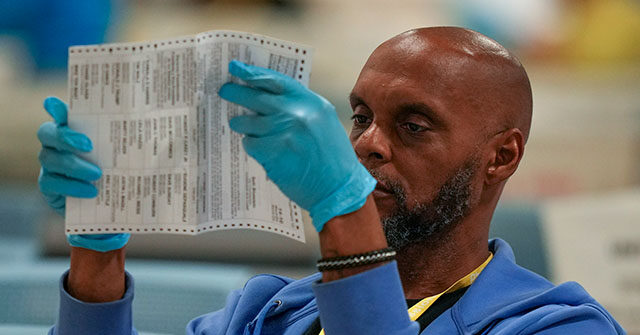
The vast majority of likely voters believe ballots should be received by Election Day, an Honest Elections Project survey – released ahead of the Supreme Court hearing arguments on the matter – found.
The survey found that the likely voters “overwhelmingly support” ballot deadlines for Election Day.
Overall, 83 percent believe ballots should be received by Election Day, and of those, 57 percent “strongly” agree they should be received by that day. There is bipartisan agreement as well, as 93 percent of Republicans, 83 percent of independents, and 74 percent of Democrats agree ballots should be received by Election Day.
Furthermore, a majority, 60 percent, of likely voters agree that mail-in ballots received after polls close on Election Day should not be counted. A majority of Republicans and independents – 80 percent and 59 percent, respectively – agree with that sentiment, but just 42 percent of Democrats join them.
The survey also found that 60 percent of likely voters believe that counting ballots received after Election Day makes it ultimately easier to cheat. Once again, while a majority of Republicans (79 percent) and independents (58 percent) agree with that, less than a majority of Democrats (44 percent) feel the same way.
Additionally, 59 percent of likely voters overall say they “would not trust the results of an election that counts ballots received after polls close on Election Day.”
“Democrats are evenly split (45% agree vs 48% disagree), showing deep bipartisan distrust,” the survey’s release added.
The survey, conducted by CRC Research, was taken March 12-17, among 1,600 likely voters. It has a margin of error of +/- 2.45 percent.
The release came ahead of the Supreme Court hearing arguments on mail-in voting in Mississippi, as the state still counts ballots as long as they are postmarked by Election Day. The ruling will have widespread implications, as over a dozen states have similar grace periods. Texas, California, and Alaska are among states that allow mail-in ballots to arrive after Election Day as long as they have been postmarked at the latest by Election Day.
The Republican National Committee (RNC), which remained laser-focused on the issue of election integrity leading up to the 2024 presidential election, filed the case. The organization contends the practice violates federal law. An attorney for the RNC, Paul Clement, reportedly told the justices that counting ballots that arrive after Election Day could change the outcome and result in more confusion and, ultimately, contestation.
“If you have an election and the election is going to turn on late-arriving ballots in a way that means what everybody kind of thought was the result on Election Day ends up being the opposite a week later, 21 days later, the losers are not going to accept that result,” Clement said. “Full stop.”
Following the conclusion of the oral arguments, Jason Snead, the Executive Director of Honest Elections Project, said they “clearly” showed “where the Supreme Court should come down: state laws that count ballots received after Election Day violate federal law, expose elections to delays, invite fraud, and fuel public doubt in the democratic process.”
He added, “Further, recent polling confirms overwhelming and bipartisan public support for Election Day deadlines. States with late ballot laws are ignoring the law, the views of the public, election best practices, and common sense. Only a ruling ending late ballots can uphold the rule of law and preserve public trust in elections.”