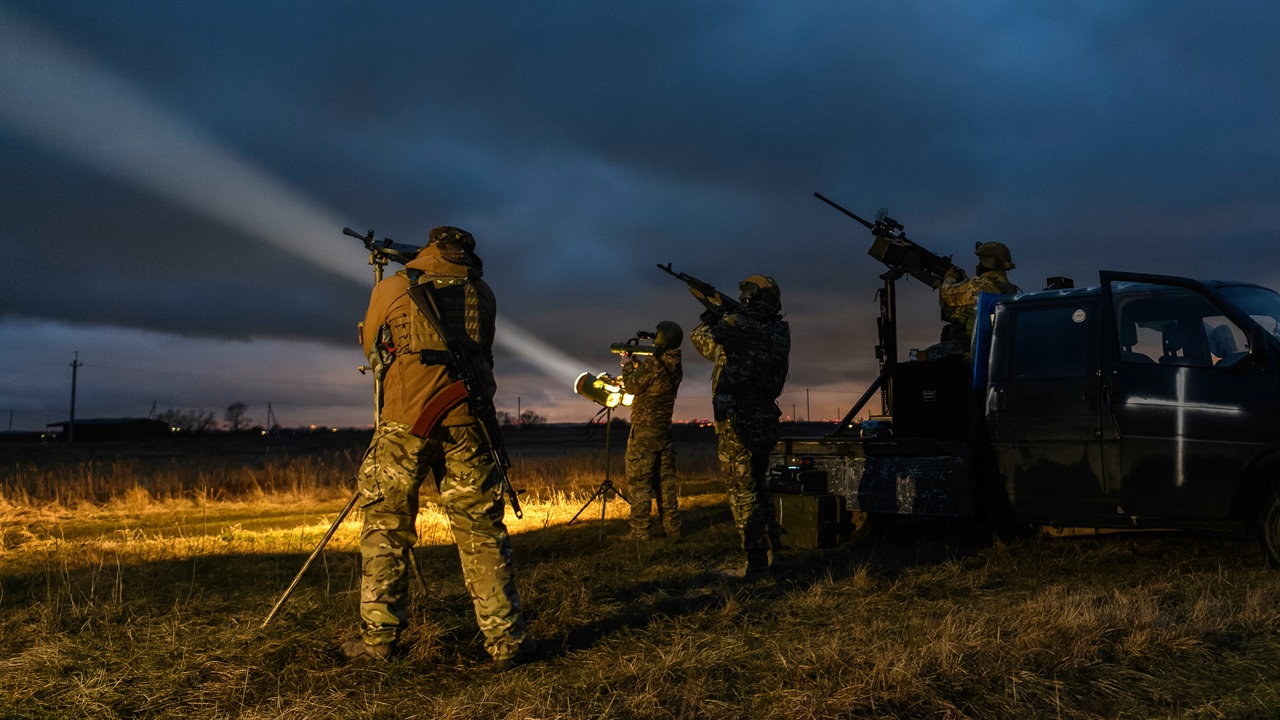
The high cost of the drone buggy’s Hellfire missile—at around $200,000 per shot—means that it can only be used for emergency situations.
Unmanned aerial systems are pivotal to the warfighting of both combatants in the ongoing war in Ukraine. Kamikaze drones in particular are responsible for a great number of casualties, and both the Ukrainian and Russian forces launch hundreds of loitering munitions on a daily basis—the Russians more so than their adversaries.
So, the Ukrainian military is pushed hard to invent and incorporate new counter-drone systems to try to curtail the Russian kamikaze drone menace. But one thing the Ukrainians have shown they know how to do very well is to invent and create new ways for killing or fending off Russian drones. The latest example of this is a drone-killing buggy armed with US-made Hellfire missiles.
About Ukraine’s Drone-Killing Buggy
The Ukrainians are pairing US-made V2X Tempest high-mobility vehicles with AGM-114 Hellfire missiles to create a remarkable drone-killing platform.
In a recent video released by the Ukrainian Air Force, the V2X Tempest buggy is seen gunning down Russian drones near the front line. The video does not specify what platform was carrying the Hellfire missiles, but it is clearly a V2X Tempest.
Equipped with a lightweight 4×4 chassis that can traverse most terrain with ease, the Tempest can also carry a compact radar, making the tactical vehicle a mobile drone-hunter. Reports from Ukraine already claim over 20 kills thus far.
The AGM-114 Hellfire is a laser-guided air-to-ground missile first developed for the US military but not widely used by Western countries today. The usual platform for the AGM-114 Hellfire munition is an attack or specialized helicopter, such as an AH-64 Apache or SH-60B/HH-60H Seahawk, or an unmanned aerial system, such as an MQ-9 Reaper. However, the Ukrainians have found a new use for the laser-guided munition.
The Russian military launches hundreds of drones as part of its large long-range fires packages. For example, during the recent attack featuring the Oreshnik ballistic missile in western Ukraine, the Russian Aerospace Forces also launched around 200 kamikaze drones, in addition to other ballistic and cruise missiles. The goal of these attacks is to saturate Ukrainian air defenses and make it harder for them to pick out and intercept the most lethal munitions.
The Drone Buggy Idea Has a Big Problem: High Missile Costs
To counter this menace, the Ukrainians are pulling out all stops. The development of the AGM-114-equipped V2X Tempest is an attempt to pick off drones that are nearing their targets. The highly mobile tactical buggies could offer a great added layer of protection around important military, infrastructural, and civilian locations.
The economics of the project also suggest that the V2X Tempest is designed to protect targets of higher value. Each AGM-114 Hellfire costs around $200,000. Each V2X Tempest can carry two munitions, worth a total of $400,000, making it an expensive interceptor choice for cheap Russian loitering munitions. (For comparison, a Shahed-type drone costs around $35,000.)
In essence, the Ukrainian military intends to intercept cruise missiles in their final approach—at which point the missiles are likely to land and cause far greater economic damage—to justify their high cost.
About the Author: Stavros Atlamazoglou
Stavros Atlamazoglou is a seasoned defense journalist specializing in special operations and a Hellenic Army veteran (national service with the 575th Marine Battalion and Army HQ). He holds a BA from the Johns Hopkins University and an MA from the Johns Hopkins’ School of Advanced International Studies (SAIS). His work has been featured in Business Insider, Sandboxx, and SOFREP.
Image: Shutterstock / paparazzza.