Though the US Navy initially downplayed the severity of the fire, it appears to have disabled the Ford’s laundry facilities and some of its crew quarters.
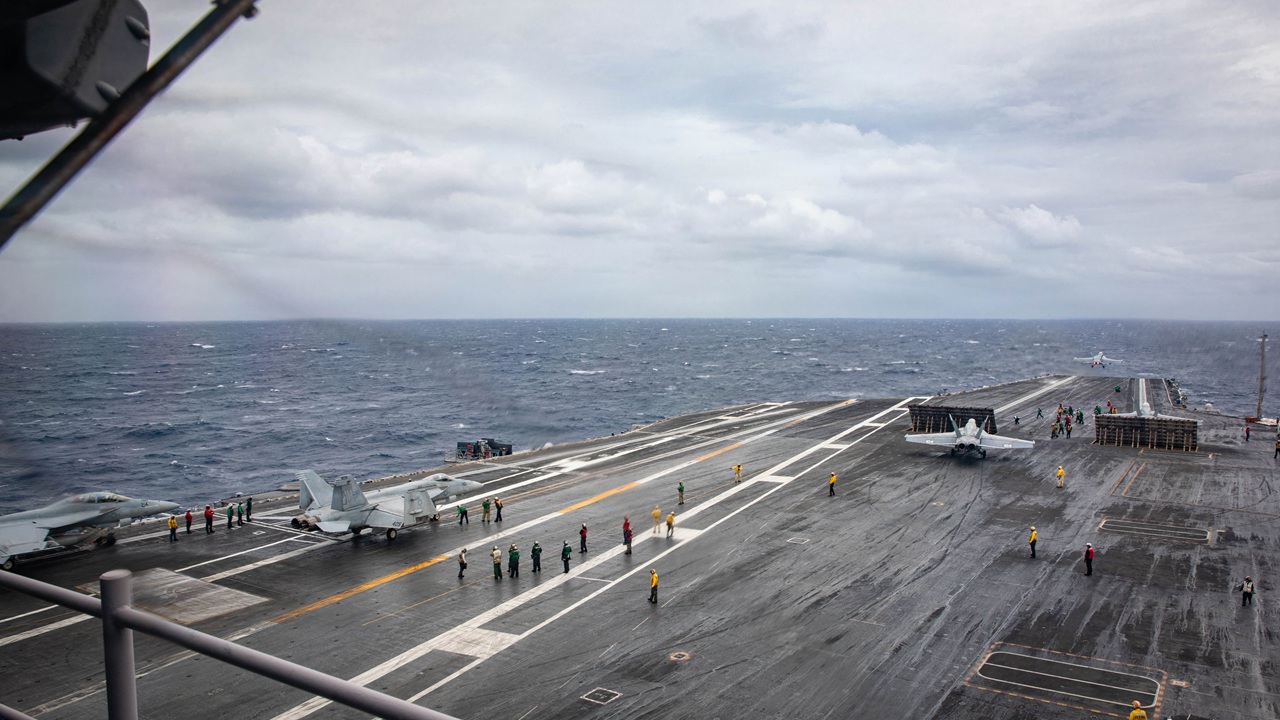
The United States Navy’s newest aircraft carrier could be sidelined for at least a week at Naval Support Activity Souda Bay on the Greek island of Crete, where pierside repairs will be carried out on the warship. The nuclear-powered USS Gerald R. Ford (CVN-78) prepared to depart the Red Sea on Tuesday and to transit the Suez Canal after suffering a fire last week in its aft laundry facility.
The US Navy initially downplayed the extent of the damage, stating it had been contained. However, this week, the Navy’s actions suggest that the fire was far more serious than initially admitted.
The blaze on Thursday, March 12 “resulted in a major damage control response that displaced sailors across the carrier and disrupted operations throughout the ship,” USNI News reported, citing a source familiar with the matter.
The US Navy had also previously stated that two sailors were treated with minor injuries. Still, it has since been reported that one sailor was “medically evacuated” due to wounds taken during the crew’s attempts to fight the blaze. The individual, who was not named, was stated to be in stable condition. In addition, more than 200 other sailors were treated for smoke inhalation and have since returned to duty.
“Ship’s force is inspecting and overhauling affected spaces, and the cause of the fire is under investigation,” a spokesperson for US 5th Fleet told USNI News. “The ship continues to operate in the Red Sea, accomplishing US Central Command tasking in support of Operation Epic Fury.”
The Ford’s Epic Fire During Operation Epic Fury
It is unclear why it has taken several days for the United States Navy to confirm the extent of the damage, or why Secretary of Defense Pete Hegseth has not spoken on the matter.
However, The New York Times reported on Monday that the fire may have lasted upwards of 30 hours—a claim that a source told USNI News was not true. Secretary Hegseth has accused the mainstream media of spreading a false narrative about the ongoing Operation Epic Fury and the ongoing bombing campaign against Iran.
Still, it could be argued that the lack of forthrightness in situations like this fire is why the media doesn’t trust “official statements” from the Pentagon.
Multiple sources have confirmed that the smoke damage from the fire extended to the ship’s berthing areas, although there are still conflicting details. USNI News and other outlets have reported that 1,000 mattresses were taken from the future USS John F. Kennedy (CVN-79), which is now undergoing its final pre-handover fitting out in Norfolk, Virginia, for use on the Ford. In addition, it was reported that sailors on the carrier have been issued more than 2,000 sweatsuits, as they have been unable to clean their clothes following the laundry room fire.
Although the fire was in the aft laundry, it seems most of USS Gerald R. Ford’s laundry facilities may be out of commission for the time being.
The US Navy put a slightly different spin on it.
“Due to the fire, several berthing spaces and subsequently, more than 100 racks (beds) were lost,” a Pentagon spokesperson told USNI News. “An immediate plan to acquire replacement cots has already been established. The resiliency and mental grit of our sailors have enabled USS Gerald R. Ford (CVN 78) to support ongoing operations.”
The exact cause of the fire is unknown, but laundry room fires can spread quickly due to a combination of factors, including machinery and flammable materials.
Ship Fires Are a Huge Problem for the US Navy
The fire is the latest mishap on the US Navy’s newest and largest aircraft carrier, which continues to experience plumbing issues with its nearly 650 toilets. The vacuum collection system has been clogging throughout the current deployment, which now exceeds 260 days at sea.
The US Navy had initially suggested that the fire wasn’t serious enough to impact CVN-78’s operational capability, but that now appears not to be the case.
Any fire at sea is a serious concern. After three devastating blazes on US Navy flattops in the 1960s—most notoriously the USS Forrestal fire in 1967, which nearly took the life of future Arizona senator and 2008 Republican presidential candidate John McCain—procedures have been put in place to reduce their likelihood and ensure that a fire can be contained before it becomes a much more serious problem.
Still, this blaze will require the carrier to return to Naval Support Activity Souda Bay for pierside repairs. It is unclear if USS Gerald R. Ford will then return to the Red Sea, or the US Navy will accept that it is necessary to end the carrier’s extended deployment and send it home before matters grow even worse.
About the Author: Peter Suciu
Peter Suciu has contributed to dozens of newspapers, magazines and websites over a 30-year career in journalism. He regularly writes about military hardware, firearms history, cybersecurity, politics, and international affairs. Peter is also a contributing writer for Forbes and Clearance Jobs. He is based in Michigan. You can follow him on Twitter: @PeterSuciu. You can email the author: [email protected].