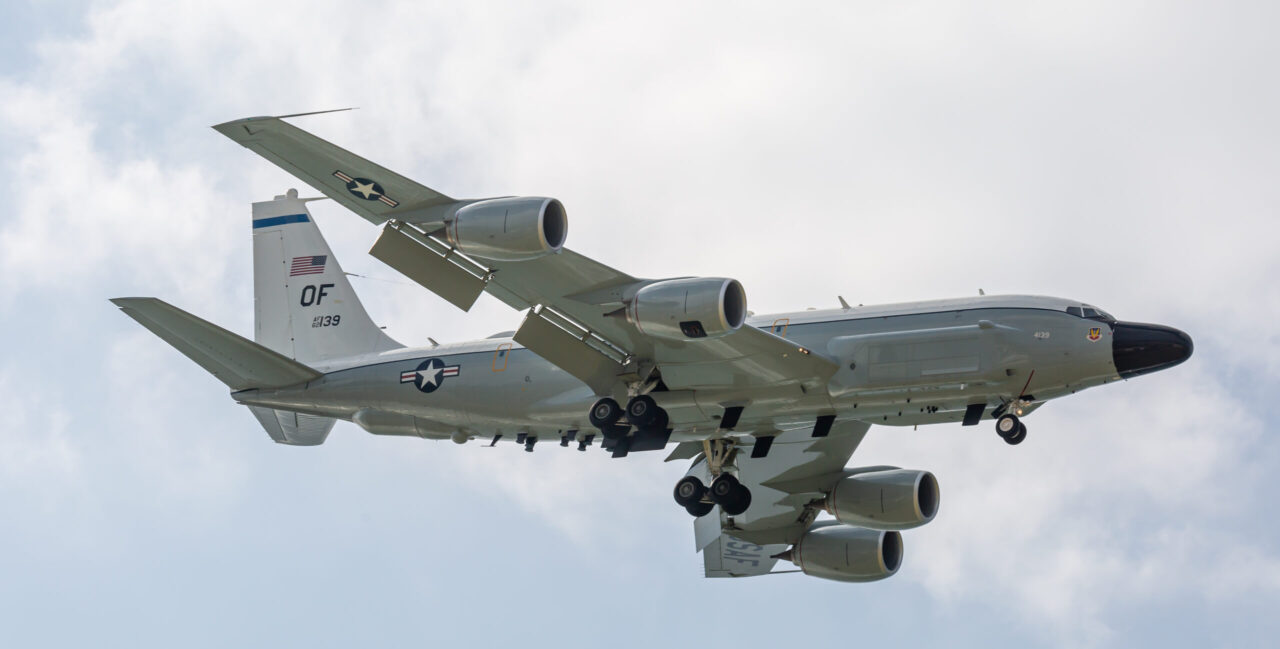
The RC-135W’s flight route near Hainan is significant, as the Chinese navy docks its aircraft carriers there.
A US Air Force RC-135W reconnaissance plane was detected flying through the airspace between Taiwan and the Philippines earlier this week. According to a Newsweek report, flight-tracking data pulled from Flightradar24 displayed the aircraft’s flight path following its departure from Kadena Air Base. Upon its departure, the plane circled the Chinese island of Hainan several times before returning to Okinawa, Japan. Designated as the “Rivet Joint,” the spy plane is often dispatched by the service to collect real-time intelligence.
The RC-135W’s flight route near Hainan is significant, considering two of the People’s Liberation Army Navy’s (PLAN) aircraft carriers are docked there. On Tuesday, Chinese officials said that its newest Fujian carrier carried out its first “live-force training” mission to test its operational readiness. On X, the Chinese military noted, “It is learned that [CNS Fujian’s] maritime training is a normal arrangement in accordance with the work plan, aiming to test the training effectiveness of the Fujian carrier strike group and enhance its capability to safeguard China’s national sovereignty, security and development interests.”
About the Fujian Aircraft Carrier
- Year launched: 2022
- Number Built: One
- Length: 316 meters (1,040 feet)
- Beam (Width): 76 m (249 ft 4 in)
- Displacement: Full load: 80,000-85,000 tons (79,000-84,000 long tons)
- Engines: Conventional steam turbines and diesel generators.
- Top Speed: 30 knots
- Range: 8,000 to 10,000 nautical miles
- Armaments: Features a variety of defensive systems like the Type 1130 and HHQ-10 gun/missile-based close-in weapon systems. Can support a host of aircraft, including the J-15T, J-35, and KJ-600.
- Crew: Likely 3,000-5,000
As part of the Fujian’s recent test sail, the carrier conducted various launches of Chinese aircraft. J-15T jets, J-15DT electronic warfare jets, and KJ-600 Airborne Early Warning and Control aircraft practiced take-off and landing procedures via the carrier’s Electromagnetic Aircraft Launch System (EMALS), according to Chinese reports. The Fujian is the service’s first carrier capable of catapult-assisted take-off but arrested recovery (CATOBAR). Naval Technology detailed other notable improvements featured on the Fujian, including a reduced radar cross-section, active electronically scanned array (AESA) radar, and an integrated funnel that powers the carrier’s electromagnetic catapults for aircraft launch.
What About China’s Other Aircraft Carriers?
In addition to the Fujian, the PLAN operates two other carriers, the Liaoning (16) and the CNS Shandong (17). The Liaoning is a Soviet-era vessel that initially reached operational capacity with the PLAN back in 2021. The Shandong is the service’s second-introduced carrier. Although the warship was fully built on Chinese territory, its design is largely a mirror copy of its Soviet-era predecessor. The Shandong was officially commissioned with PLAN in 2019 and hosts several improvements over the Liaoning. While Beijing’s overall naval expansion poses a challenge for US national security, its carrier force still does not hold a candle to the American Nimitz and Ford-class carriers. The United States currently operates 11 nuclear-powered vessels, compared to China’s three. Since the aircraft carrier truly embodies overseas power projection, the US Navy’s larger fleet is critical.
About the Author: Maya Carlin
Maya Carlin, national security writer with The National Interest, is an analyst with the Center for Security Policy and a former Anna Sobol Levy Fellow at IDC Herzliya in Israel. She has over 1,000 articles published over the last several years on various defense issues. Carlin has bylines in many publications, including The National Interest, Jerusalem Post, and Times of Israel. You can follow her on Twitter: @MayaCarlin.
Image: Balon Greyjoy – Own work, CC BY-SA 3.0, Wikimedia Commons.