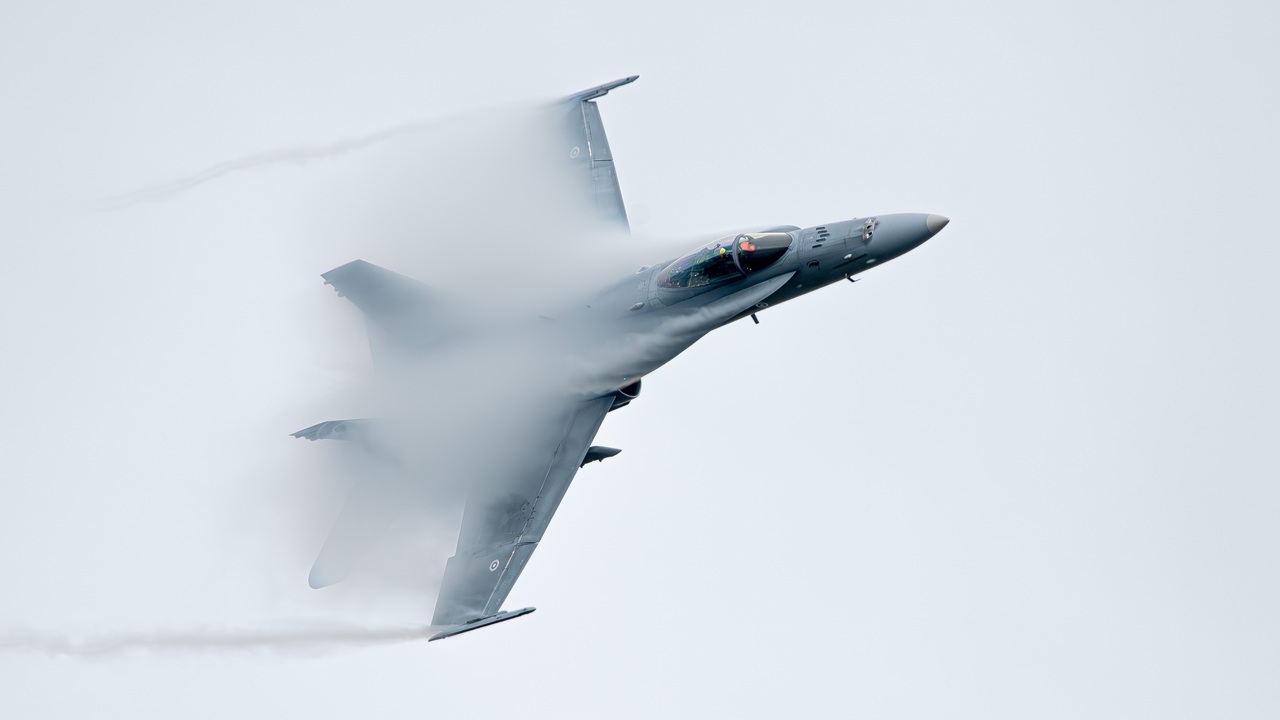
In essence, the F-16 is faster and more maneuverable, while the F/A-18 is built for survival. But which one would actually win in a fight?
Both the F-16 and F/A-18 can trace their roots to the US Air Force’s Lightweight Fighter (LWF) competition. The F-16 emerged directly from the YF-16 prototype, while the F/A-18 evolved indirectly from the competing YF-17. What began as a single contest produced two extremely different aircraft—both of which have served as cornerstones of their respective services for a generation, one optimized for agile air combat, the other for multirole carrier-based operations.
Launched in the late 1960s, the LWF competition aimed to produce a low-cost, high-performance fighter. The Air Force selected the YF-16, discarding the YF-17. The Navy, meanwhile, wasn’t interested in a single-engine design for carrier use, but was intrigued with the YF-17 in other respects. After several carrier-specification modifications, the YF-17 was evolved into the F/A-18, a multirole strike fighter. The decision changed the YF-17’s size, weight, and mission set, resulting in an aircraft that was never meant to be an F-16 analog.
F-16 Fighting Falcon vs. F/A-18 Hornet: A Head-to-Head Comparison
| Aircraft | F-16 Fighting Falcon (US Air Force) | F/A-18 Hornet (US Navy) |
| Year Introduced | 1978 | 1983 |
| Number Built | 4,600+ | ~1,480 (A, B, C, D variants) |
| Length | 49 ft 5 in (15.1 m) | 56 ft (17.1 m) |
| Wingspan | 32 ft 8 in (10 m) | 40 ft 4 in (12.3 m) |
| Weight (MTOW) | ~42,300 lb (19,200 kg) | ~51,900 lb (23,500 kg) |
| Engines | One Pratt & Whitney F100, or General Electric F110, afterburning turbofan | Two General Electric F404-GE-402 turbofans |
| Top Speed | 1,353 mph (2,178 km/h) / Mach 2.0 | 1,190 mph (1,915 km/h) / Mach 1.8 |
| Range | ~2,600 mi (4,200 km) ferry; ~340 mi (550 km) combat radius | ~2,070 mi (3,330 km) ferry; ~400 mi (650 km) combat radius |
| Service Ceiling | ~50,000 ft (15,240 m) | ~50,000 ft (15,240 m) |
| Loadout | One 20mm M61 cannon; 9 hardpoints; up to 17,000 lb (7,700 kg) payload capacity | One 20mm M61 cannon; 9 hardpoints; up to 13,700 lb (6,200 kg) payload capacity |
| Aircrew | 1 | 1–2, depending on variant |
The F-16 Is Fast and Agile, While the F/A-18 Is More Balanced
At a glance, one can see that the F-16 and the F/A-18 were built for different purposes. The F-16 is a single engine fighter, with a smaller airframe and lower empty weight. The F/A-18 features twin engines, a larger structure, and reinforcements for carrier operations. The twin engines offer redundancy and survivability over water. While the F-16 trades redundancy for performance, the F/A-18 trades speed for flexibility—reflecting the risk tolerances of the respective branches.
As a dogfighter, the F-16 has clear advantages over the F/A-18. It features relaxed static stability, enabling exceptional instantaneous turn rates. With a high thrust-to-weight ratio, the F-16 is known for vertical acceleration, energy maneuverability, and a pilot-centric feel. Conversely, the F/A-18 flies with extremely forgiving handling and excellent high-angle-of-attack control, which enables safe recoveries and the ability to operate from carriers. The F/A-18 emphasizes control and predictability, while the F-16 emphasizes agility and performance margins.
Moreover, in spite of the F/A-18’s twin engines, the F-16 is much faster—clocking at speeds above Mach 2, with a longer unfurled range and efficient high-speed performance. The F/A-18 has far slower operations and a shorter range, especially without external drop tanks. On the other hand, the F/A-18 can carry more diverse ordnance, having been designed for strike capability as well as air combat. So while the F-16 excels at fighter and precision strikes, the F/A-18 excels as a true multirole workhorse.
Both aircraft have upgraded their avionics significantly over time. The F-16 is export-friendly and the radar and weapons systems have been tailored per user. The F/A-18 is more modestly exported, with integrated naval avionics and electronic warfare compatibility (EA-18G).
So Which Plane Would Win in a Fight?
In a head-to-head contest, neither the F-16 nor F/A-18 is guaranteed to win over the other. In BVR engagements, the outcome would depend on radar, missiles, support, and a variety of other factors.
In a WVR engagement, it seems clear that the F-16 has an energy advantage and better turn performance. On the other hand, the F/A-18 counters with high-AoA nose pointing and control at low speeds. The outcome would likely depend on pilot and tactics and setup.
And yes, similar conclusions could be made about most aircraft-to-aircraft matchups, but the F-16 and F/A-18 are well matched if optimized for different fighting styles. Ultimately, the F-16 wins on performance; the F/A-18 wins on versatility. Both have been enormously successful as cornerstone aircraft for their respective services, since their inception, and through the foreseeable future.
About the Author: Harrison Kass
Harrison Kass is a senior defense and national security writer at The National Interest. Kass is an attorney and former political candidate who joined the US Air Force as a pilot trainee before being medically discharged. He focuses on military strategy, aerospace, and global security affairs. He holds a JD from the University of Oregon and a master’s in Global Journalism and International Relations from NYU.
Image: Shutterstock / Richmarks.