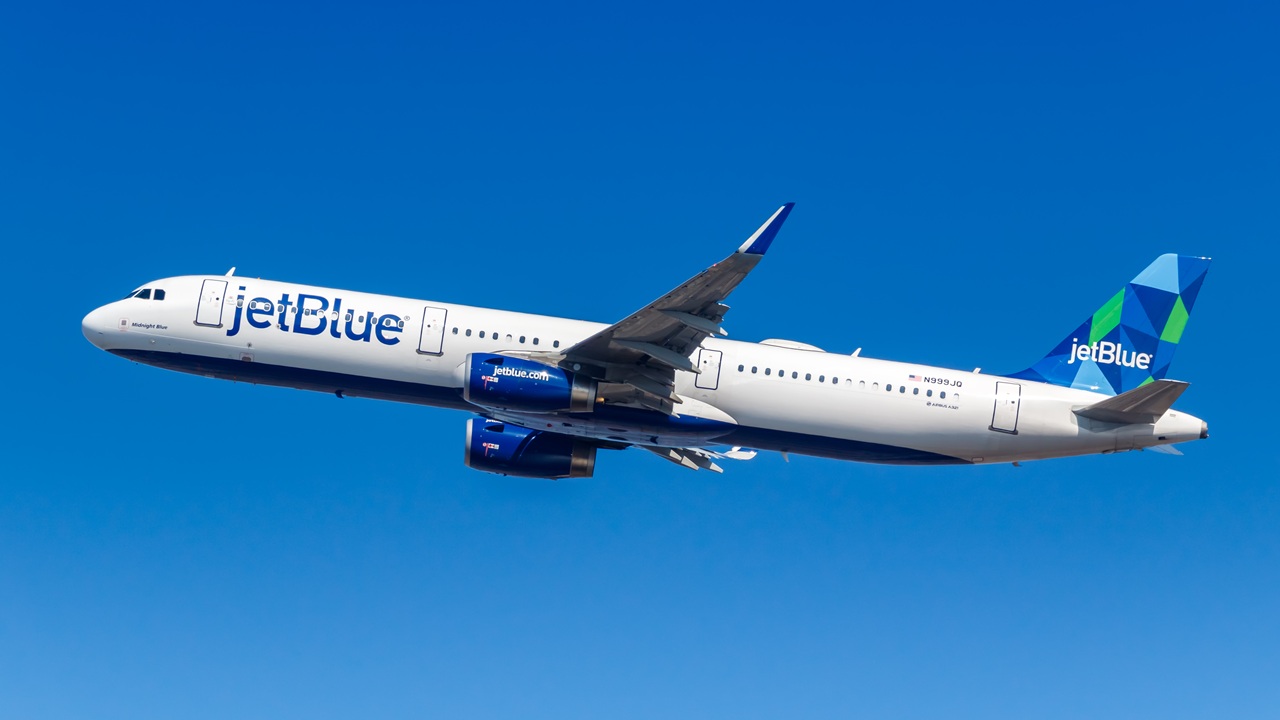
A JetBlue pilot described the near-collision between his plane and a military aircraft with its transponder turned off near Curaçao “outrageous.”
A JetBlue passenger aircraft was forced to halt its ascent to avoid a collision with a United States Air Force refueling tanker in the Caribbean on Friday. JetBlue’s Flight 1112 from Curaçao, which is about 40 miles north of the coast of Venezuela, was departing for New York City’s John F. Kennedy International Airport (JFK) when the pilot noted the presence of a US military aircraft crossing its flight path at 34,000 feet.
The type of tanker hasn’t been disclosed, but according to reports, it was operating without its transponder. The JetBlue aircraft was forced to halt its climb to make way for the tanker.
“We almost had a midair collision up here,” the JetBlue pilot stated, according to a recording of his conversation with air traffic control, per the Associated Press. “They passed directly in our flight path. … They don’t have their transponder turned on, it’s outrageous.”
The US Air Force aerial refueler was likely part of the massive build-up of US military forces in the Caribbean as the Trump administration puts increased pressure on Venezuela, which Washington has designated as a narco-terrorist regime. The tanker aircraft was headed towards Venezuelan airspace at the time of the incident, according to the JetBlue pilot.
“We just had traffic pass directly in front of us within 5 miles of us — maybe 2 or 3 miles — but it was an air-to-air refueler from the United States Air Force, and he was at our altitude,” the pilot added. “We had to stop our climb.”
In November, the Federal Aviation Administration had warned US civilian aircraft to “exercise caution” while operating in Venezuelan airspace due to the “heightened military activity in or around” the Latin American nation.
The United States Air Force has conducted multiple patrols with long-range strategic bombers near Venezuelan airspace.
“We have reported this incident to federal authorities and will participate in any investigation,” Derek Dombrowski, a spokesperson for JetBlue, told the AP on Sunday. “Our crewmembers are trained on proper procedures for various flight situations, and we appreciate our crew for promptly reporting this situation to our leadership team.”
Friday’s incident also comes as President Donald Trump acknowledged that ground targets within Venezuela could begin soon.
The Curaçao Incident Wasn’t the First Close Call
In July, a United States Air Force Boeing B-52 Stratofortress long-range bomber had a close call with a regional jet. The B-52 completed its planned flyover for the North Dakota State Fair near Minot when a Delta Connection (SkyWest) aircraft, which had cleared for landing, encountered the bomber unexpectedly. The SkyWest pilot was forced to execute a sharp, aggressive turn and then performed a go-around of the airport.
“This is not normal at all,” the SkyWest pilot told the passengers.
That incident raised concerns regarding the coordination between military and civilian air traffic. The B-52’s aircrew had remained in contact with Minot Air Force Base (AFB) controllers, while a contractor-run tower was directing the SkyWest regional jet at Minot International Airport (MIA), which lacked radar.
In January, a US Army Sikorsky UH-60 Blackhawk helicopter collided with an American Airlines jetliner in Washington, as the commercial jet was on approach at Ronald Reagan Washington National Airport (DCA). All 67 passengers and crew on both aircraft were killed.
About the Author: Peter Suciu
Peter Suciu has contributed over 3,200 published pieces to more than four dozen magazines and websites over a 30-year career in journalism. He regularly writes about military hardware, firearms history, cybersecurity, politics, and international affairs. Peter is also a contributing writer for Forbes and Clearance Jobs. He is based in Michigan. You can follow him on Twitter: @PeterSuciu. You can email the author: [email protected].
Image: Shutterstock / Markus Mainka.