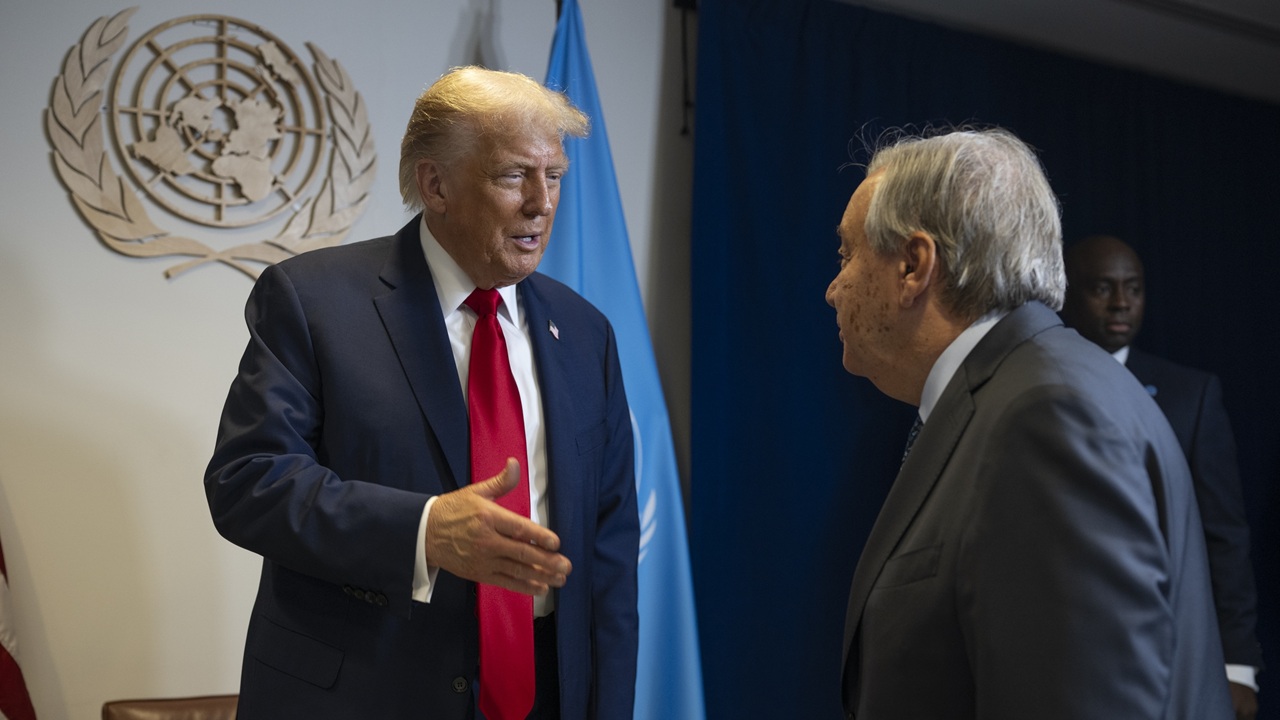
The United States has successfully pressured the United Nations to institute sweeping budgetary reforms. But more work is needed—and it must be accomplished with carrots as well as sticks.
Early in his second term, President Donald Trump suspended funding to the United Nations regular budget—which primarily underwrites the salaries and benefits of the UN bureaucracy and activities like translation and conferences. The subsequent cash crunch aggravated a liquidity crisis for the organization, leading Secretary-General Antonio Guterres to propose budget and staff cuts, review UN activities, and initiate additional structural reforms. This financial pressure aided by tough diplomacy led the UN in December to endorse reforms sought by the United States—and approve the largest budget cut in UN history.
What the UN Cut from Its 2026 Budget
Specific achievements in the new plan include a $270 million reduction in the UN regular budget from $3.72 billion in 2025 to $3.45 billion in 2026—the largest reduction, both in dollar and percentage terms, in its history. The reforms also resulted in the abolition of over 2,900 UN staff posts achieved by eliminating vacant positions, voluntary separation of over 1,000 staff, and termination of existing staff. The member states also requested the International Civil Service Commission (ICSC) , which recommends salary and benefits for UN staff, explore options to reduce the margin between UN staff and equivalent US civil servants.
In addition, the United States successfully enhanced the discretion of the Office of Internal Oversight Services, the UN’s inspector general equivalent, to focus resources on high priority investigations, required more oversight for major UN capital projects like the renovation of UN facilities in Nairobi, negotiated a reduction in the budget for the deeply flawed Human Rights Council, reduced funding for most Special Political Missions, including reductions in posts, and consolidated or eliminated unnecessary special envoys for Cyprus and the Republic of Georgia.
This is an unqualified success and validation of the use of financial leverage to pressure the organization and other member states to undertake tough budgetary measures. Overall, the budget cut will result in a $570 million reduction in member state assessments compared to last year according to US Representative for UN Management and Reform Jeffrey Bartos. Of this larger total, the United States will save $125 million—an unalloyed good for the American taxpayer.
Further Reforms Are Needed at the UN
Still, these achievements are only the first step in a process that will require continued diplomacy, negotiation, and strategic use of financial leverage going forward.
For instance, while UN member states have broadly endorsed the Secretary General’s UN80 reform agenda, further budget cuts and the other necessary changes are likely to be an uphill battle. The first of the three “work streams” of the agenda was a budget reduction, which was partially adopted in December. “Workstream 2” proposes a review of nearly 4,000 instructions—called “mandates”—to the UN system based on their relevance with those falling short to be eliminated. The review is common sense, but a previous attempt failed. And the “Workstream 3” proposal to consolidate UN funds and programs to reduce bureaucracy and eliminate redundancy will be thornier still.
In addition, the US successfully pressed Guterres to impose a 15 percent reduction in budgets for UN peacekeeping operations in October, including a 25 percent cut in civilian and uniformed personnel. But making these savings permanent will require hard negotiations in the next six months. Likewise, the US effort to instruct the ICSC to reduce UN salaries needs close attention if it is to be realized. Finally, Trump recently signed an executive order announcing that the US would cease funding for a number of UN departments, commissions, and activities funded through the regular budget. It would make sense for the US to seek to eliminate these activities, which it sees as wasteful, from the UN regular budget.
Trump Must Fund Good UN Programs, Too
This is a daunting agenda. The success of the US in securing reductions in the UN regular budget last month is a vindication of American financial leverage. But sticks, though necessary, are insufficient. Carrots must also be used to entice cooperation from the UN and the other member states.
Withholding is a tool to leverage policy outcomes. Now that the UN has adopted funding cuts and reforms sought by the US, it should be willing to reward good behavior. Specifically, the US should pay the remaining $435 million in regular budget arrears from 2024. This would partially relieve the substantial financial constraints besetting the UN. More importantly, it would demonstrate that the United States is negotiating in good faith.
Going forward, the administration should work with Congress to link its unpaid 2025 and 2026 assessments to specific reform objectives. For instance, partial payments could be linked to lowering the US peacekeeping assessment to 25 percent, permanently bringing UN salaries and benefits into line with comparable US civil servants, and implementing the UN80 reform agenda. In addition, financial incentives could be linked to other cuts in the regular budget related to the recent executive order.
This strategy would mirror the successful Helms-Biden legislative approach to UN reform from 25 years ago, which similarly tied US arrears to specific reforms sought by the US. The situation today is very similar. By working with Congress, the Trump administration would send a strong, unified signal to the UN and help cement its approach beyond 2028.
About the Author: Brett Schaefer
Brett Schaefer is a senior fellow at the American Enterprise Institute, a former member of the UN Committee on Contributions, and a former member of the UN Task Force for the United States Institute of Peace. He has recently written on the WHO in The Dispatch, UNESCO in The Hill, and UNIFIL in National Review.
Image: Shutterstock / carlos110.