The Trump administration’s newfound interest in Central Asia must be coupled with European coordination and a focus on developing the region’s critical mineral processing and refining.
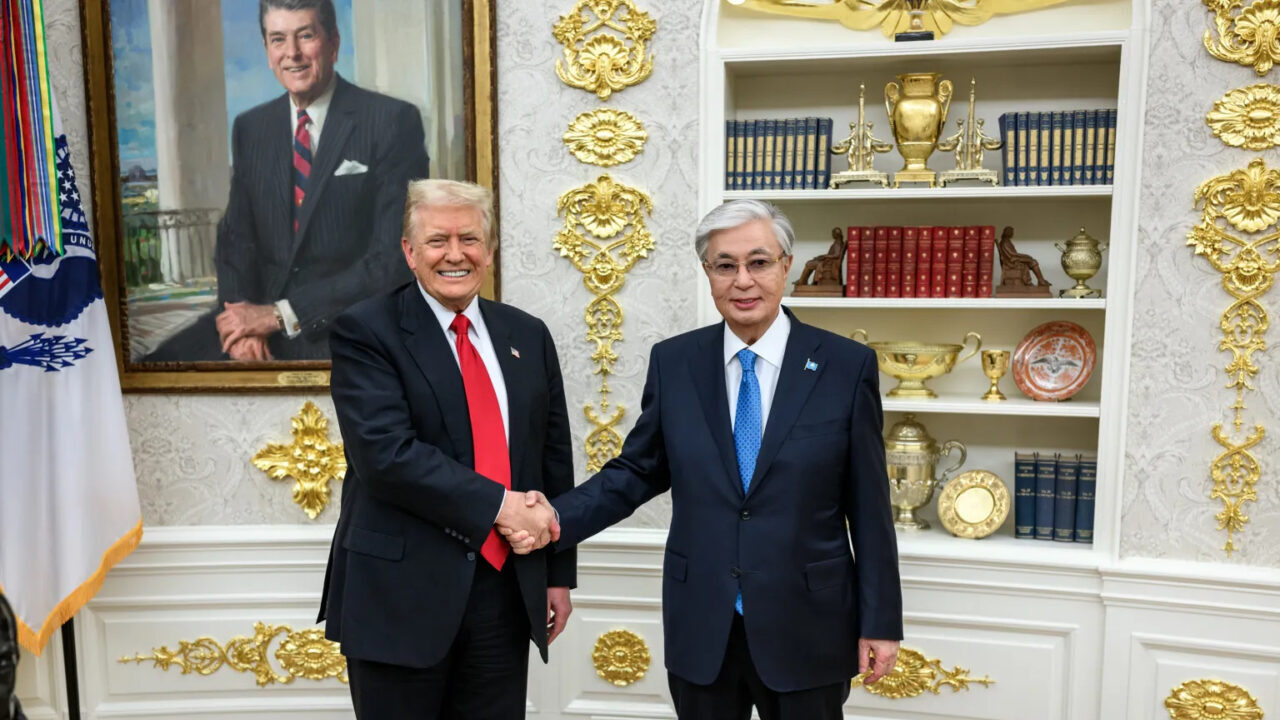
For the first time in years, Central Asia is drawing sustained strategic attention from Washington. With the recent C5+1 Summit meeting between President Donald Trump and the leaders of the five Central Asian republics in Washington, the administration deserves credit for elevating a part of the world that is too often ignored. Central Asia remains persistently overlooked, despite its reserves of oil, gas, uranium, and critical minerals.
For decades, the US willingness to engage persistently and strategically in Central Asia has been episodic, with a focus on security cooperation and governance assistance rather than sustained economic partnership. The Trump administration’s renewed emphasis on “energy dominance,” economic self-interest, and geopolitical competition with China and Russia creates an opening to recalibrate US engagement in the region.
Central Asia is strategically necessary for US economic interests and uniquely positioned within the Eurasian landmass as a crossroads of potential that has drawn external powers for centuries. As global access to critical minerals, resilient east-west connectivity, and alternatives to Russian and Chinese dominance increasingly matter profoundly for America’s long-term security and economic interests, Central Asia’s importance will only grow for US national and economic interests.
But if the Trump administration’s laudable instinct to elevate American engagement in the region is to be successful, it needs a coherent strategy and plan that matches in ambition and recognizes the region’s importance.
And if the summit reflected the right instincts, what happens next will be far more important than the fanfare of launch announcements, which this administration seems to relish. Follow-through will be key. Central Asia has seen many waves of great-power enthusiasm rise and recede; it has also seen ambitious partnership agendas evaporate under the weight of bureaucracy, geopolitics, other higher priorities regionally and globally, or mismatched expectations – challenges we can both speak to from our personal experience in prior administrations.
The United States now faces a simple but demanding challenge: the region will judge Washington not by the boldness of its declarations, but by whether it can translate opportunity into durable progress that aligns with the disparate and often contradictory interests of the five Central Asian countries. Implementation—not aspiration—will decide whether the current momentum becomes a strategic turning point or just another diplomatic footnote.
The administration’s focus on critical minerals is a good starting point and will serve as a barometer of its ability to translate ambitions into concrete progress. Kazakhstan, Uzbekistan, Kyrgyzstan, and Tajikistan hold deposits of rare earths, uranium, copper, and other materials essential to everything from electric vehicles to precision-guided munitions. The logic of diversifying supply chains away from Beijing and Moscow is sound, and the surge of US commercial interest is welcome.
Yet Central Asian leaders repeatedly emphasized a point sometimes overlooked in Washington: mining is only the first step, and it will take decades to tap into Central Asia’s potential. Without rapid investment in processing, refining, logistics, and downstream manufacturing, the region will remain a source of raw ore rather than an integrated link in global value chains—and the United States will remain dependent on countries like the PRC that control the mid- and downstream stages of production.
This is where implementation becomes decisive. Helping Central Asia develop the infrastructure and regulatory frameworks for environmentally sound, commercially viable mineral development requires patient coordination across agencies and with private partners. It also requires sustained diplomatic engagement to navigate real political sensitivities. These governments want investment, but they also want to avoid being pulled into a zero-sum confrontation with their two largest neighbors. A US approach that is too heavy-handed or too narrowly extractive will falter.
Connectivity—the other major theme of the summit—poses similar tests. Central Asia’s geography makes it a natural corridor linking East Asia, South Asia, the Caspian Basin, the Caucasus, and Europe. The so-called Middle Corridor, running from western China through Kazakhstan and the Caspian Sea to the South Caucasus and onward to Turkey and European markets, holds genuine promise as an alternative to routes dominated by Russia. Expanding it could help stabilize regional economies and enhance Europe’s energy and trade security. But realizing this vision requires years of coordinated investment in ports, rail, customs harmonization, and digital infrastructure.
The administration’s TRIPP initiative between Armenia and Azerbaijan would fit perfectly into this Middle Corridor. Yet there are reports that little has been done to begin implementing this seminal agreement. The private sector is eagerly awaiting signs that the administration is serious about investing in a Middle Corridor linking Central Asia and the South Caucasus to markets east and west. A targeted program of critical minerals, energy, and infrastructure-focused assistance and investment—led by American firms, backed by US financing institutions, and aligned with the administration’s national security and trade agenda—could yield significant returns for US interests.
No single country—not even the United States—can do this on its own. And this is where the administration’s instincts, while strategically sound, need a complementary and equally deliberate effort: close cooperation with allies, especially in Europe. The European Union has already invested heavily across the region through its Global Gateway initiative and remains Central Asia’s largest trading partner. European firms are increasingly present in the renewables, transport, and manufacturing sectors. Japan and South Korea are major investors. These actors bring financing, technology, regulatory expertise, and political credibility that can reinforce US initiatives rather than duplicate them.
If Washington hopes to build something lasting, it should treat the summit not as a unilateral breakthrough but as an opportunity to align a coalition of like-minded partners. A trilateral or quadrilateral framework—bringing together the United States, the EU, and key Asian allies, along with the C-5—could help guide infrastructure standards, coordinate financing, and ensure that connectivity projects meet high environmental and governance benchmarks. It would also give Central Asian governments confidence that they are not overly dependent on any single external partner. This reassurance helps them maintain their prized multi-vector foreign policies.
Furthermore, allied cooperation is essential for the broader geopolitical implications of this moment. Moscow’s influence in the region, while diminished, remains deeply woven into security services, labor markets, and energy infrastructure. Beijing’s presence is even more extensive, built over decades through the Belt and Road Initiative, long-term loans, and strategic infrastructure investments. Central Asian leaders are unwilling—and in many cases unable—to sever those ties. They are also wary of the administration’s mercurial and increasing willingness to isolate and pressure Ukraine into a peace deal with Russia that is dangerously aligned with Russian interests.
Despite this wariness of both US staying power and Russian influence in Central Asia, countries in the region are increasingly eager for alternatives that give them more room to maneuver between the traditional powers. A coordinated Western approach could strengthen their hand. A fragmented one will only weaken it.
Finally, the United States should recognize that its credibility will depend not only on commercial deals and infrastructure plans but also on its willingness to engage in governance, transparency, and inclusivity. These issues do not need to dominate the agenda, nor should they be wielded punitively. But in countries where corruption, weak institutions, and limited political competition remain persistent challenges, high-quality investment cannot succeed without parallel improvements in the rule of law and regulatory practice. Here, too, European partners bring invaluable experience and incentives.
The C5+1 summit has opened a window. The instincts behind it are the right ones, and the desire to re-engage a strategically vital region should be welcomed across the political spectrum. But Central Asia has heard ambitious rhetoric before. The United States has the technology, capital, and policy tools to reclaim leadership in this critical region. By re-engaging in Central Asia, the United States can restore its relevance in the heart of Eurasia and demonstrate a competitive, results-oriented, and firmly grounded model of foreign economic engagement aligned with America’s national interest.
The test now is whether the United States can sustain attention, coordinate with allies, and invest in the patient, often unglamorous work of building infrastructure, strengthening institutions, and deepening economic ties. If Washington can do that, it has a chance to reshape its strategic position in Eurasia for a generation. If it cannot, the region will simply continue drifting toward the gravitational pull of its larger neighbors. Momentum matters. But execution matters more.
About the Authors: Michael Schiffer and Mark Simakovsky
Michael Schiffer, a partner at Scalare Advisors, associate fellow at the International Institute for Strategic Studies, senior fellow at the Center for American Progress, and distinguished senior fellow at the Sasakawa Peace Foundation USA, served as the assistant administrator of the USAID Bureau for Asia from 2022 to 2025. Prior to that, he was senior advisor and counselor on the Democratic staff of the Senate Foreign Relations Committee. From 2009 to 2012, he served as deputy assistant secretary of defense for East Asia. Before joining the Department of Defense, he was a program officer at the Stanley Foundation, a Council on Foreign Relations Hitachi International Affairs Fellow, and worked on the staff of Senator Dianne Feinstein (D-CA), including as her national security adviser and legislative director.
Mark Simakovsky is a nonresident senior fellow with the Atlantic Council’s Eurasia Center, Europe Center, and Scowcroft Center for Strategy and Security. Simakovsky is also the founding partner of Heartland Global Advisors, LLC, a strategic advisory firm in Washington, DC that supports companies operating in the government, development, defense, energy, banking, and technology sectors to help them enhance their product offerings and secure their market positions. Previously, Simakovsky served as the deputy assistant administrator for Europe and Eurasia at the US Agency for International Development (USAID) from 2022 to 2025.
Image: White House / Public Domain / Wikimedia Commons.