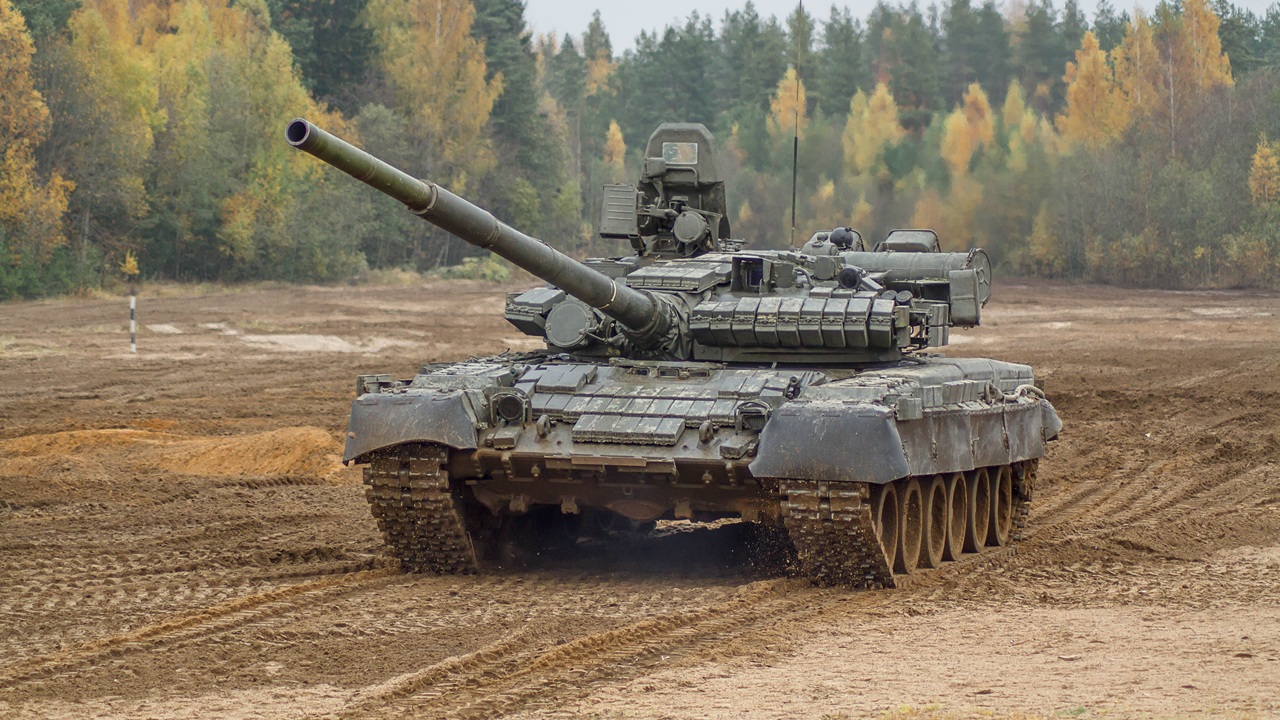
The T-80BVM tank is a relic of the Cold War—and, though still effective on the battlefield, has required up-armoring to keep it relevant in the modern era of warfare.
According to open source military intelligence analysts, Ukraine’s military has captured as many as 500 Russian tanks during the first year of the ongoing war. That included some of the Kremlin’s most modern tanks, many of which were quickly repaired or refurbished and then returned to frontline duty to face the invader. As Russian forces have adapted their tactics on the battlefield, the number of vehicles captured by the Ukrainians has diminished considerably; however, Kyiv has still succeeded in seizing some competent platforms.
On Tuesday, the Ukrainian Army’s 92nd Assault Brigade announced that it had succeeded in capturing a Russian T-80BVM after the Russian main battle tank (MBT) was disabled and “taken as a war trophy,” United24Media reported. The unit shared images of its latest prize on the Telegram social messaging app.
“Servicemen of the tank battalion, in cooperation with fighters of the 1st assault battalion of the 92nd separate assault brigade, captured a Russian T-80 tank,” the unit wrote in the post, adding, “The capture of enemy equipment is another confirmation of the effective interaction of the units and the professional training of the brigade’s personnel.”
A Unique Trophy for Ukraine’s Defenders
Data from Oryx, a Dutch-based open-source intelligence group that tracks combat losses on the front lines using photos and videos, indicate that 35 Russian T-80BVM tanks have been captured since 2022. However, this latest MBT is unique: it is one of the so-called “Hedgehog” or “Porcupine” tanks, equipped with a large anti-drone cage with a mesh frame. The ad hoc armor is fitted over nearly the entire chassis and turret and is designed to protect critical areas, such as the engine and transmission compartments. Both Russian and Ukrainian troops have dubbed the armor “Mangal,” meaning “BBQ Grill.”
Such armor has proven quite effective against drones and loitering munitions, but it comes with a massive trade-off. In addition to its considerable weight, the anti-drone cage—sometimes derisively referred to by online commentators as a “cope cage” due to doubts over its effectiveness—reduces crew situational awareness and limits where the turret can be aimed. It also dramatically increases the tank’s profile on open ground, making it more conspicuous to the enemy and possibly negating the advantage conferred by the extra armor.
This particular T-80BVM, the latest upgrade of the Cold War-era MBT, was also outfitted with Kontakt-1 explosive reactive armor blocks, positioned on its hull and turret sides, as well as Relikt armor modules fixed to the front of the turret.
That extra protection could save the crew during a firefight, but it is unclear what led to the situation in which the Russians were forced to abandon the vehicle.
Russia’s T-80BVM Tanks Aren’t Cutting-Edge—but They Still Work
The T-80BVM is a modernized version of the T-80, the last MBT developed by the Soviet Union. It was designed for speed, with a goal of leading a vanguard to break through enemy lines during an invasion. However, the tanks did meet expectations.
During the First Chechen War (1994-96), the T-80 proved especially vulnerable to man-portable anti-tank weapons, and the losses were so significant that it was even sidelined during the Second Chechen War in 1999 and then again in the 2008 Russo-Georgian conflict.
The T-80 likely wouldn’t have seen service in the ongoing conflict in Ukraine had the Kremlin’s forces reached Kyiv within the planned three days. As Russia’s tank losses mounted, hundreds of Cold War tanks were pulled from storage and upgraded. In reality, though, they remain flawed MBTs that a bette army would not send into frontline combat. Hundreds have reportedly been lost in the fighting, and as noted, three dozen have been captured.
The added armor almost certainly impacts its speed. That fact could explain why most have been employed as self-propelled artillery and fitted with the anti-drone armor. This particular T-80BVM may simply have been in the wrong place at the wrong time.
About the Author: Peter Suciu
Peter Suciu has contributed over 3,200 published pieces to more than four dozen magazines and websites over a 30-year career in journalism. He regularly writes about military hardware, firearms history, cybersecurity, politics, and international affairs. Peter is also a contributing writer for Forbes and Clearance Jobs. He is based in Michigan. You can follow him on Twitter: @PeterSuciu. You can email the author: [email protected].
Image: Shutterstock / Timofey_Kormilizyn.