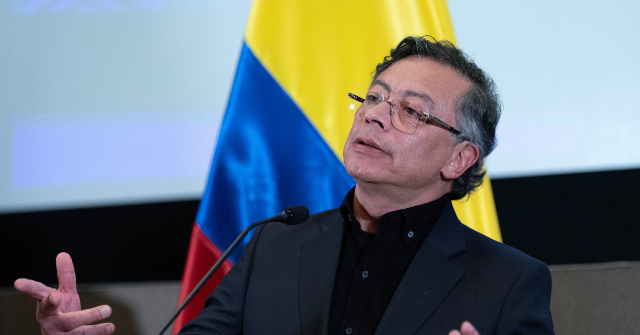
Far-left President of Colombia Gustavo Petro is the subject of several ongoing probes by U.S. federal prosecutors over his alleged ties to drug traffickers, several outlets reported over the weekend.
The left-wing New York Times, citing three unnamed sources, first reported on Friday that Petro was being investigated by U.S. attorney’s offices in Manhattan and Brooklyn to determine if Petro met with drug traffickers and if his presidential campaign solicited donations from them.
The separate investigations, according to the Times, are in the early stages and have involved the participation of agents from the Drug Enforcement Administration (DEA) and Homeland Security Investigations (HSI). The outlet further stated that there “was nothing” in the investigations indicating that the White House had any role in initiating them.
The Associated Press (AP), CBS News, and Reuters, all citing unnamed sources, issued similar reports over the weekend.
Upon reviewing DEA records, the AP reported that Petro has surfaced in multiple investigations since 2022, many of which are based on interviews with confidential informants. Some of the allegations investigated by the DEA reportedly include possible dealings with Mexico’s Sinaloa Cartel involving Petro’s “total peace” plan to benefit traffickers who contributed to his campaign.
“The ‘priority target’ label is reserved for suspects DEA deems to have a ‘significant impact’ on the drug trade. It’s unclear when the DEA gave Petro that designation,” AP reported.
One of the sources cited by CBS News detailed that the investigations did not initially target Petro but that his name came up. Reuters reported that Petro is “not the focus” of the investigations, but that his conduct has surfaced in narco-terrorism and drug trafficking investigations. An unnamed source told Reuters, “There are not ongoing investigations that are squarely focused on him.”
President Petro, who is in the final months of his administration, denied the allegations presented by the reports in a social media post in which, responding to the Colombian newspaper El Espectator, he asserted that in Colombia “there isn’t a single investigation into my ties to drug traffickers, for one simple reason: I have never in my life spoken to a drug trafficker.”
“On the contrary, I dedicated ten years of my life — at the risk of my own existence and at the cost of my family’s well-being — to exposing the ties between the most powerful drug traffickers and politicians in the National Congress, as well as local and national governments, during what was known as the era of paramilitary governance,” Petro’s message read.
“Regarding my campaigns, I have always told managers that donations from neither bankers nor drug traffickers are accepted. The thorough and intense investigation into my presidential campaign did not uncover a single peso from drug traffickers because that is my rule and my personal principle as a political leader,” he wrote.
“So the evidence in the U.S. will help me refute the accusations from Colombia’s far right — which is, in fact, deeply entangled with Colombia’s drug traffickers,” he concluded.
The Colombian government formally rejected the reports in an official statement issued by the Colombian embassy in Washington. The embassy asserted that no competent authority has issued any formal determination or notification, nor has it confirmed the allegations referred to in that report.
“The insinuations contained therein lack any legal or factual basis,” the statement read in part. The embassy noted that the reporting is “based on anonymous sources and lacks concrete evidence,” and added that it “should be read in its full context and approached with the caution that such unverified reports require.”
Petro is presently under U.S. sanctions after U.S. Department of the Treasury’s Office of Foreign Assets Control (OFAC) sanctioned him in October for having engaged in, or attempted to engage in, “activities or transactions that have materially contributed to, or pose a significant risk of materially contributing to, the international proliferation of illicit drugs or their means of production.” OFAC also sanctioned Petro’s wife Veronica Alcocer and his son Nicolás Petro Burgos.
Speaking to Telemundo over the weekend, American lawyer Daniel Kovalik, who is currently representing Petro over his inclusion in the U.S. Specially Designated Nationals (SDN) list, rejected the reports published by U.S. outlets and asserted that the investigations do not directly target Petro. He stressed, “There is no evidence whatsoever; he is completely free of any kind of corruption, including anything related to drug trafficking.”
“In fact, he has done more than any other president in Colombia’s history to eradicate coca production, seize cocaine, and fight corruption. So we are confident that he will be fully exonerated,” Kovalik reportedly said.
Kovalik asserted to Telemundo that Petro’s relationship with President Donald Trump is “very good” and detailed that both heads of state spoke over the phone last week in what he described as a “very positive conversation.”
“President Trump said he [Petro] is welcome in the United States at any time,” Kovalik said.
Petro’s son, Nicolás Petro Burgos, is presently facing trial at a Colombian court on allegations that he took large sums of money from drug traffickers during his father’s 2022 presidential campaign. The trial, which officially resumed in late February, sees Petro Burgos facing charges of money laundering and illicit enrichment of a public official. In October, Petro Burgos admitted that he took the money, but argued that it was a “mistake” and not a crime.
Petro met with Trump at the White House in early February, an encounter that followed a year’s worth of accusations and hostilities espoused by Petro against Trump — most notably, the meeting was arranged after Trump spoke with Petro over the phone in January minutes before the Colombian president was slated to issue an anti-Trump speech at a rally in Bogotá, which prompted Petro to change the contents of his speech.
Christian K. Caruzo is a Venezuelan writer and documents life under socialism. You can follow him on Twitter here.