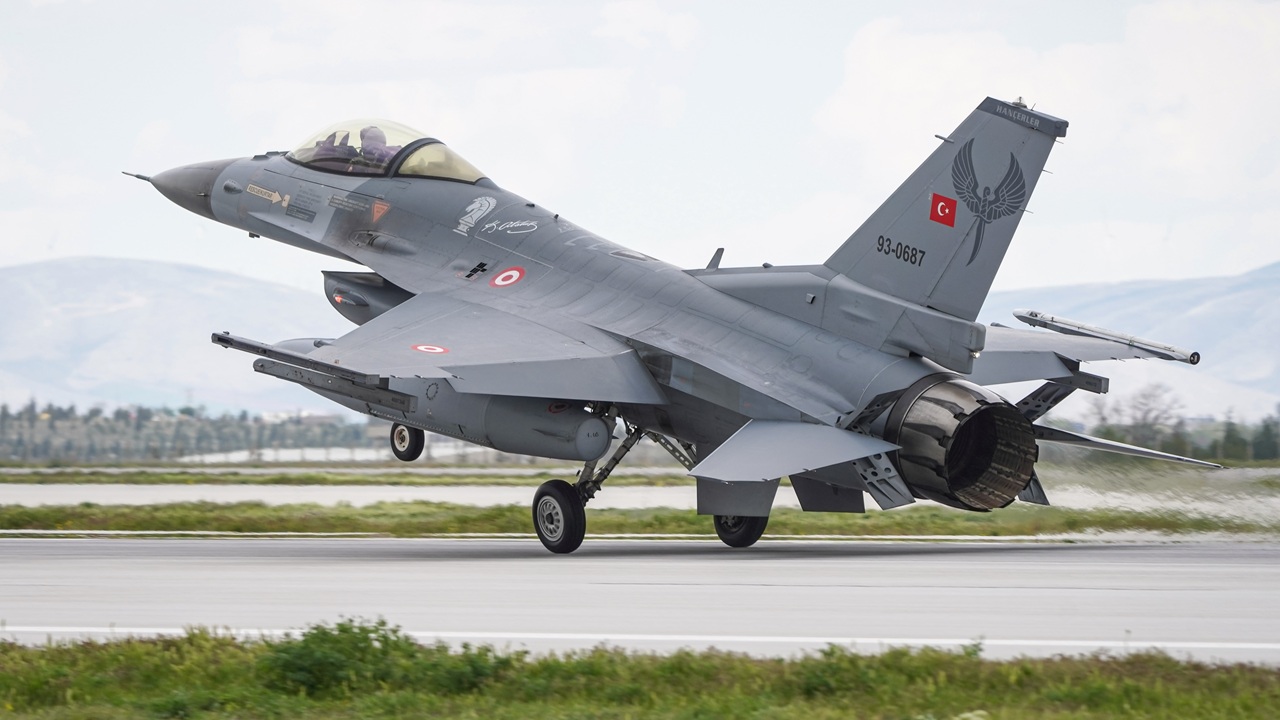
As a member of NATO, Turkey could contribute fighter jets to air policing missions along NATO’s eastern frontier—although there is little hard evidence that it will actually do so.
NATO member Turkey could soon be the latest alliance nation to deploy combat aircraft to the Baltic countries, to help monitor Russia’s activity in the region, Bloomberg first reported. Since 2004, various member nations have provided continuous air defense for Estonia, Latvia, and Lithuania—the year those three states joined NATO—as none have significant aerial assets to protect the airspace. Belgium launched its first mission 21 years ago, in March 2004, with F-16 Fighting Falcons operating from Lithuania.
It is fitting that the future deployment could include Fighting Falcons in service with the Turkish Air Force. NATO leadership requested that Turkey provide the aircraft to support the ongoing patrols to counter Russian aggression.
There were several incidents of Russian aircraft violating NATO airspace in the final half of 2025, including three Mikoyan MiG-31K (NATO reporting name “Foxhound”) fighters that crossed into Estonian airspace in September, and a Mil Mi-8 (NATO reporting name “Hip”) twin-turbine helicopter that breached the Baltic nation’s territory just days earlier. Multiple Russian drones entered Polish airspace that same month, and Dutch aircraft deployed to secure NATO’s eastern flank shot down one of the unmanned systems. It was the first time since the end of the Cold War that NATO had downed a Russian aircraft in Europe.
Turkey Has Kept Quiet on the Russian Incursions
Ankara announced it would deploy aircraft to Romania from December 2026 to March 2027, but has not clarified whether it will support the Baltic Air Policing (BAP) mission, which is now slated to begin in August and last until December.
It was just last month that a Turkish F-16 Fighting Falcon shot down a drone that was operating over the Black Sea and headed towards Turkish airspace. A crashed drone, believed to be the one that was shot down, was discovered in the northwest part of Turkey. It is also suspected of being Russian in origin.
About NATO’s Baltic Air Policing Missions
“NATO Air Policing is carried out using the NATO Integrated Air and Missile Defence System (NATINAMDS). The Supreme Allied Commander Europe (SACEUR) has the overall responsibility for the conduct of NATO Air Policing,” the alliance explained in its command structure.
Various units, with their respective aircraft, take part in rotating deployments and operate from either Šiauliai Air Base, Lithuania, or Ämari Air Base, Estonia. Since 2014, the missions have evolved in scale to counter increased Russian air activity and to serve as a potent symbol of the alliance’s collective defense. The rotating nation-led deployments last approximately four months.
Additional NATO missions include “Enhanced Air Policing” on the eastern flank with additional alliance aircraft deployed to Poland, and to augment the national patrols carried out by the air forces of Bulgaria and Romania. Hungary and Italy have also protected Slovenia’s airspace since Slovenia joined the alliance in 2004, and Greece, along with Italy, has covered the southern Balkan states of Albania (since 2009), Montenegro (beginning in 2017), and North Macedonia.
Allied nations are also “periodically deployed” to Keflavík Air Base in Iceland, but with deployments lasting three to four weeks at a time, three times a year.
About the Author: Peter Suciu
Peter Suciu has contributed over 3,200 published pieces to more than four dozen magazines and websites over a 30-year career in journalism. He regularly writes about military hardware, firearms history, cybersecurity, politics, and international affairs. Peter is also a contributing writer for Forbes and Clearance Jobs. He is based in Michigan. You can follow him on Twitter: @PeterSuciu. You can email the author: [email protected].
Image: Shutterstock / EvrenKalinbacak.