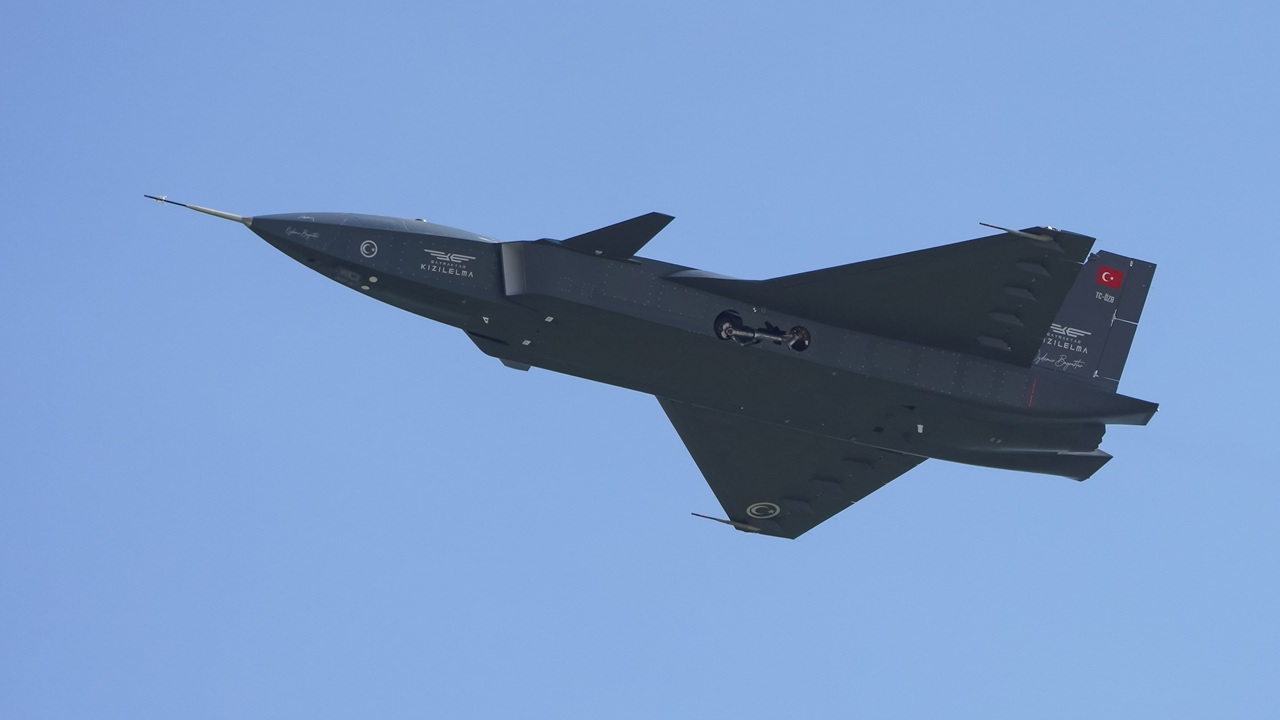
Although many nations are investing in “loyal wingman” drones, none of these drones had yet demonstrated an air-to-air kill in a realistic aerial test—until now.
Turkey’s first unmanned combat aircraft, the Bayraktar Kızılelma, has achieved a significant breakthrough: last week, the system successfully shot down a jet-powered aerial target using beyond-visual-range (BVR) air-to-air missiles. More than a test event, the incident is a signal that Turkey is moving toward a world in which unmanned fighters operate like manned 4.5-generation and possibly even fifth-generation manned warplanes.
The development of the Kızılelma into an air-to-air fighter also proves that Ankara is serious about becoming a dominant regional power—with a serious defense industrial base that can churn out the weapons of the future today.
The Kızılelma Robo-Fighter’s Specifications
- Year Introduced: Not yet introduced (anticipated 2026)
- Number Built: 6 (prototypes)
- Length: 14.7 m (48 ft 3 in)
- Wingspan: 10 m (32 ft 10 in)
- Weight (MTOW): 5,987 kg (13,200 lb)
- Engines: One Ivchenko-Progress AI turbofan engine (3,790–5,510 lbf, depending on variant)
- Top Speed: 1,100 km/h (680 mph, 590 kn) / Mach 0.9
- Combat Radius: 930 km (580 mi, 500 nmi) on internal fuel
- Service Ceiling: 14,000 m (45,000 ft)
- Loadout: Two internal hardpoints; six external hardpoints; 1,500 kg (3,300 lb) payload capacity
- Aircrew: 0
Why Is the Kızılelma Drone So Impressive?
Kızılelma engaged a high-speed, jet-powered target drone, not a slow propeller-driven unmanned aerial vehicle (UAV). The Turkish drone executed the engagement autonomously, receiving target data and launching a BVR air-to-air missile—a variant of Turkey’s Gökdoğan (Peregrine) homegrown missile. That missile scored a direct hit, proving Kızılelma can prosecute targets BVR—something that, up until now, only a handful of unmanned combat aerial vehicles (UCAVs) could do.
To be clear, the Kızılelma completed an end-to-end, air-to-air kill chain. With the data collected from this test, the Turkish military and drone designers can now scale this capability for the Kızılelma.
Currently, the United States has sophisticated unmanned air-to-air combat research, such as the DARPA Ace, Skyborg, and XQ-58 Valkyrie prototypes. But no country has publicly demonstrated a UCAV actually shooting down a jet target with a BVR weapon… until now.
Much like America’s Collaborative Combat Aircraft (CCA) program, Turkey intends for its Kızılelma to accompany manned fighters in manned-unmanned teaming (MUMT) profiles. These systems can swarm enemy air defenses without risking Turkish pilots and their expensive, complex manned warplanes. The Kızılelma can operate in contested airspace, too. What’s more, it can carry indigenous missiles, sensors, and EW suites. All this means is that Turkey is pioneering the world of unmanned air dominance.
Turkey Is Emerging as a Great Drone Power
Ankara is intent on crafting for itself an entirely new pathway in terms of reducing Turkey’s reliance on foreign powers for military supplies and support. Essentially, Turkey is letting both its partners and rivals around the world that it is entering the next generation of air warfare on its own terms.
Further, Ankara plans to leverage these advances in unmanned weapons systems and create for itself an entirely new export market before many other great powers can beat them here (this would undoubtedly ensure that Turkey’s arms industry remains dynamic in an increasingly challenging world).
A brief comparison of some of the other major UCAVs being developed globally is in order. America’s XQ-58 Valkyrie, Russia’s S-70 Okhotnik-B, and China’s GJ-11 Sharp Sword all seem to be good comparisons.
The American XQ-58 Valkyrie is a loyal wingman/attritable UCAV for MUMT mission sets. Its signature strength is that it possesses the most advanced autonomy stack in the world (thanks the DARPA ACE). It has deep integration with US fifth-generation warplane kill webs belonging to both the F-35 Lightning II and the F-22 Raptor (no one else has this sensor fusion ecosystem).
XQ-58’s design is modular. It can carry air-to-air missiles, electronic warfare (EW) pods, decoys, and even small glide bombs. These systems are much cheaper by US standards than other more conventional systems. What’s more, they can be scaled into swarms. DARPA’s Air Combat Evolution Program has also reported significant headway in the artificial intelligence-driven dogfighting program they’ve been developing for this system.
Of course, no system is without its setbacks.
But the Valkyrie is beset by typical bureaucratic inertia in Washington—namely the fact that the Pentagon refuses to field UCAVs at scale. There is no public evidence of a real-world BVR missile engagement by this system. And there is significant political reluctance to let autonomous platforms perform lethal decisions.
So, technologically, the United States is still the leader in AI and teaming. But America is not deploying these systems the way that either Turkey or China are. The Americans are, in typical fashion, letting their lead drastically erode.
Russia and China Are Building Sophisticated Drones, Too
The Russians have become famous (or infamous, perhaps) for their increasing use of unmanned combat systems in Ukraine. One such system they’re developing to compete with these other systems being developed is the S-70 Okhotnik-B.
Described as a heavy stealth strike UCAV and a wingman for Russia’s much-ballyhooed Su-57 “Felon” fifth-generation warplane, this unmanned system has a large payload and high stealth capabilities.
The problem is that Russia can’t build enough Su-57s or S-70s at the moment. The S-70 has a slow testing cycle, and only a handful of prototypes exist. Because of these real limitations, the S-70’s combat autonomy is unclear meaning that Russia might rely heavily on ground control links. Thus, until significant headway is made by Moscow in the development of the S-70, it will remain a theoretically dangerous platform that has yet to materialize into a real threat.
Then there is China’s GJ-11 “Sharp Sword” UCAV that is specifically intended for penetrating Taiwanese airspace and dominating the First Island Chain. It is believed that the GJ-11 might have the best stealth shaping and materials after the United States. And the design seems optimized for dominating the stealth domain.
China’s GJ-11 has a delta flying-wing, extremely low observable (from all angles) configuration. It is meant to conduct deep-strike, suppression of enemy air defenses (SEAD) and destruction of enemy air defenses (DEAD), carrier interdiction, and suppression of other US Navy assets. It is probable that this system is already in low-rate production (China scales fast). There’s also the high-end sensor fusion and datalink integration with J-20 and KJ-500 AWACS.
Whereas it is likely that China’s GJ-11 would lead any strategic ranking of these four UCAVs only because of Beijing’s incredible scaling capabilities (quantity plus stealth equals a real strategic shift), Turkey’sKızılelma is both the first functioning UCAV that can take down jet-powered systems in combat and it is the only UCAV around right now that can be seriously described as a “drone fighter.”
China and Turkey Are the Only Real Contenders for Drone Dominance
In other words, Turkey broke the symbolic barrier when it achieved air-to-air kills with the Kızılelma. China is scaling stealth strike UCAVs for a potential Taiwan campaign. On the other side, the Americans are stuck in development hell, and the Russians are not serious about building a sufficient number of these systems—despite their demonstrated effectiveness in utilizing unmanned combat systems in the Ukraine War.
This is the moment that global airpower doctrine shifts. Right now, China and Turkey are leading the pack. And Turkey is the only country with a demonstrated air-to-air UCAV dogfighter.
About the Author: Brandon J. Weichert
Brandon J. Weichert is a senior national security editor at The National Interest. Recently, Weichert became the host of The National Security Hour on America Outloud News and iHeartRadio, where he discusses national security policy every Wednesday at 8pm Eastern. Weichert hosts a companion book talk series on Rumble entitled “National Security Talk.” He is also a contributor at Popular Mechanics and has consulted regularly with various government institutions and private organizations on geopolitical issues. Weichert’s writings have appeared in multiple publications, including The Washington Times, National Review, The American Spectator, MSN, and the Asia Times. His books include Winning Space: How America Remains a Superpower, Biohacked: China’s Race to Control Life, and The Shadow War: Iran’s Quest for Supremacy. His newest book, A Disaster of Our Own Making: How the West Lost Ukraine is available for purchase wherever books are sold. He can be followed via Twitter @WeTheBrandon.
Image: Shutterstock / Evren Kalinbacek.