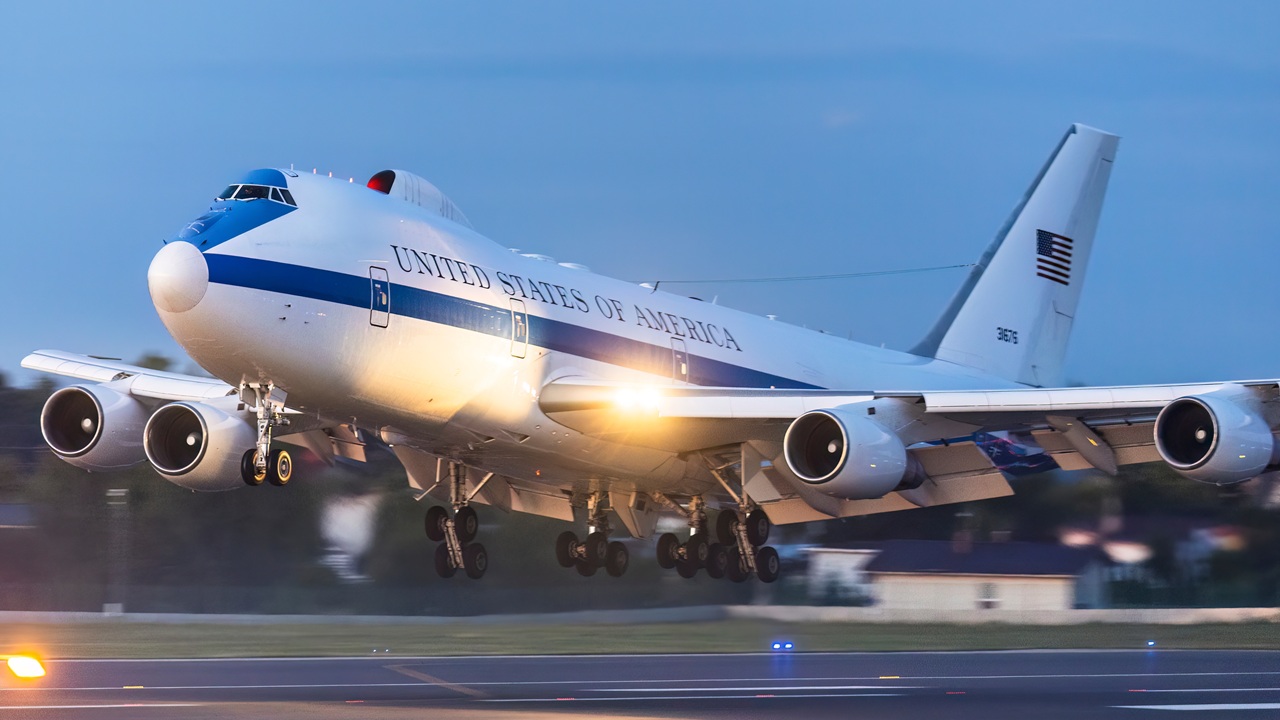
The E-4B Nightwatch’s visit to Los Angeles came amid Secretary of Defense Pete Hegseth’s “Arsenal of Freedom” tour—intended to display America’s military might both to its citizens and its adversaries.
The Boeing E-4B Nightwatch—colloquially known as the “Doomsday Plane”—was spotted landing and leaving Los Angeles International Airport (LAX). According to The Business Standard, the sighting went viral on social media and in the press because of the rarity of glimpsing this plane in public.
Of course, this isn’t the first time in the last year that the Doomsday Plane has taken to the skies. But the fact that it landed at a major civilian airport raised some eyebrows—especially in the context of larger geopolitical events in the Caribbean, in Europe, and with the ongoing collapse of the Islamist regime of Iran.
Just what is the “Doomsday Plane”?
Meet the E-4B Nightwatch
- Year Introduced: 1974 for the original E-4A and 1980 for the E-4B models (with 1985 being the year they were fully upgraded into a flying command center)
- Number Built: 4
- Length: 231 feet, 4 inches (70.5 meters)
- Wingspan: 195 feet, 8 inches (59.7 meters)
- Weight: 800,000-833,000 pounds (360,000-377,800 kilograms)
- Engines: General Electric 50E2 Turbofan Engines
- Top Speed: 602 mph (969 km/h)
- Range: 6,200 nautical miles (11,500 kilometers)
- Service Ceiling: ~30,000 ft (9,091 m)
- Loadout: Specialized sensor / comms equipment
- Aircrew: ~111 people max
The E-4B Nightwatch is a heavily modified Boeing 747-200 that is operated by the United States Air Force (USAF). The bird serves as the “National Airborne Operations Center.”
In essence, the plane lives up to its moniker as the “Doomsday Plane”; it is designed as a nuclear war-survivable aircraft where senior defense leaders and the president of the United States can gather safely (and, of course, conduct counterstrikes against a rival nations’ first nuclear strike against the United States).
The National Airborne Operations Center is a modern marvel of engineering in that it is hardened against nuclear blasts and electromagnetic pulses (EMPs). This plane has the world’s most secure airborne communications, allowing for the president to direct any military action from anywhere in the world from that plane. The idea is that, if ground systems are destroyed by enemy attack, the Americans could reliably manage a counterattack.
NDTV reported last week that there were only a handful of these planes in existence, which is why its appearance—at a civilian airport no less—raised eyebrows in the press and on social media. Interestingly, the Los Angeles Times reported that the plane was not being deployed to LAX in response to geopolitical crises. Instead, according to the Times, Secretary of Defense Pete Hegseth was using the plane as part of his “Arsenal of Freedom” Tour.
Why the E-4B Nightwatch Is So Dangerous
The plane is not conventionally armed. Instead, its armament is its advanced communications suite, which is actually the backbone of the entire bird. It possesses systems, like a five-mile trailing wire for Very Low-Frequency/Low-Frequency (VLF/LF) communications. There’s the MILSTAR and AEHF satellite communications systems, too. The entire system focuses on the aforementioned VLF, SHF, UHF, and EHF bands—which allows the Nightwatch to contact America’s nuclear arsenals and issue the order to end the world as we know it.
So any time this plane is deployed in a visible way, it puts America’s foes on guard. While Secretary Hegseth was using it for his tour of America’s faltering defense industrial base, it is obvious that the Trump administration intended to put America’s adversaries on notice in the wake of the successful Caracas raid and the ongoing tensions in Europe and the Middle East.
For the Trump Administration, Deterrence Is Performance
Since taking office last year, both Hegseth and the Trump administration writ large have been trying to reinforce the narrative in public that America’s military is unstoppable. Indeed, the capabilities demonstrated in Caracas have certainly made potential rivals reassess their optimistic projections of America’s military decline.
And the snap arrival of the Doomsday Plane at LAX has not gone unnoticed in the capitals of many rival states—and even some allies, given the row between the United States and Europe over Greenland’s fate.
Hegseth’s “Arsenal of Freedom” tour which has swept across the nation from the East to the West Coast—and everywhere in between—is part of the Trump administration reassurance campaign. Nevertheless, the appearance of this plane in public in the midst of these geopolitical crises did spark a bit of concern among the public who saw the reports and images.
About the Author: Brandon J. Weichert
Brandon J. Weichert is a senior national security editor at The National Interest. Recently, Weichert became the host of The National Security Hour on America Outloud News and iHeartRadio, where he discusses national security policy every Wednesday at 8pm Eastern. Weichert hosts a companion book talk series on Rumble entitled “National Security Talk.” He is also a contributor at Popular Mechanics and has consulted regularly with various government institutions and private organizations on geopolitical issues. Weichert’s writings have appeared in multiple publications, including The Washington Times, National Review, The American Spectator, MSN, and the Asia Times. His books include Winning Space: How America Remains a Superpower, Biohacked: China’s Race to Control Life, and The Shadow War: Iran’s Quest for Supremacy. His newest book, A Disaster of Our Own Making: How the West Lost Ukraine is available for purchase wherever books are sold. He can be followed via Twitter @WeTheBrandon.
Image: Shutterstock / Karolis Kavolelis.