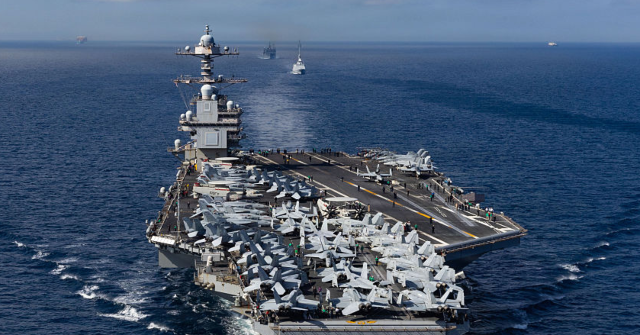
President Donald Trump told reporters aboard Air Force One on Thursday that an “armada” of American warships is heading for Iran and implied that military force could be on the table if the regime in Tehran continues murdering its own people to stay in power.
“We have a big flotilla going in that direction. We have a big force going toward Iran. I’d rather not see anything happen, but we’re watching them very closely,” Trump said on his flight back from the World Economic Forum (WEF) in Davos, Switzerland.
Trump said the regime in Tehran refrained from hanging 837 of its prisoners on Thursday due to pressure from the United States.
“I said if you hang those people, you’re going to be hit harder than you’ve ever been hit. They actually said they canceled it. They didn’t postpone it, they canceled it. So that was a good sign,” he told the reporters on Air Force One.
“But we have an armada. We have a massive fleet heading in that direction and maybe we won’t have to use it, we’ll see,” he added.
“We’re watching Iran. I’d rather not see anything happen, but we’re watching them very closely,” he warned.
Trump also said during a CNBC interview from Davos on Thursday that Iran must “stop with the nuclear,” and implied American airstrikes similar to those that destroyed Iran’s uranium enrichment facilities in June 2025 could “happen again” if they do not desist.
Two U.S. officials told Reuters on Thursday that the aircraft carrier USS Abraham Lincoln and its battle group will arrive in the Middle East within the next few days.
Iran’s chief prosecutor, Mohammad Movahedi, on Friday denied that his regime was planning over 800 hangings on Thursday, or that those executions were canceled due to pressure from Trump.
“This claim is completely false; no such number exists, nor has the judiciary made any such decision,” he said.
“We have a separation of powers, the responsibilities of each institution are clearly defined, and we do not, under any circumstances, take instructions from foreign powers,” he insisted.
The Associated Press (AP) noted on Friday that contrary to Movahedi’s claims, members of the Iranian judiciary have referred to the captive protesters as mohareb or “enemies of God,” an accusation that is generally punishable by death in Iran. At least 5,000 Iranians were executed on the mohareb charge in 1988, for example.
Mohammad Javad Haji Ali Akbari, the cleric holding the prestigious position of Friday prayer leader in Tehran this week, mocked Trump as a “yellow-faced, yellow-haired, and disgraced man,” a “dog that only barks,” and threatened reprisals against Americans in the region if Trump takes action against the Iranian regime.
“That foolish man has resorted to threatening the nation, especially over what he said about Iran’s leader. If any harm were to occur, all your interests and bases in the region would become clear and precise targets of Iranian forces,” he said.
U.N. High Commissioner for Human Rights Volker Turk said at a briefing on Friday that “the killing on the streets of Iran may have subsided, but the brutality continues.”
“We have indications that the security forces made mass arrests in several cities, even pursuing injured people into hospitals, and detaining lawyers, human rights defenders, activists, and ordinary civilians,” he said.
Turk noted Iran’s penchant for executions — at least 1,500 of them last year, a 50-percent increase over 2024 — and said there was good reason to fear that many of the captive dissidents could face the death penalty.
“I am deeply concerned by contradictory statements from the Iranian authorities about whether those detained in connection with the protests may be executed. While the Foreign Minister said executions were not under consideration, senior judicial officials continued to threaten protestors with charges that carry a mandatory death sentence,” he said.
“The Iranian authorities have sought to delegitimize the protesters by labelling them ‘terrorists’, ‘enemies of the state’ and ‘foreign agents.’ They accused rioters of infiltrating peaceful protests to attack security officers and public property,” he noted.
“None of this would justify the resort to excessive, unnecessary, and disproportionate use of force, or reduce the Government’s obligations to ensure due process and transparent investigations,” he insisted.
Turk called on Iranian authorities to “reconsider, to pull back, and to end their brutal repression, including summary trials and disproportionate sentences,” free the people they have arbitrarily detained, lift their Internet blackout, and institute a “complete moratorium on the death penalty.”