The earliest synthesis of St. Louis de Montfort’s Marian and Christocentric spirituality is most clearly discovered in his little-known masterpiece, The Love of Eternal Wisdom.
At the heart of this short treatise, written just prior to his priestly ordination in the early 1700s, de Montfort distills the very essence of what he would later expand upon in True Devotion to Mary, The Secret of the Rosary, and elsewhere. It is here that the core of his very spirituality is presented: do everything necessary to possess and keep the love of Jesus Christ.
Quoting from Wisdom 7:24, he writes, “Nothing is more active than Wisdom.” For de Montfort, Wisdom—Eternal Wisdom—is none other than Jesus Christ, the Word made flesh. Long before His Incarnation, Christ contemplated our existence; now, in glory, He continues to consider our lives with the same tireless love.
But if Eternal Wisdom is constantly active, endlessly seeking the good of our eternal salvation, why is He so often silent in our lives?
It took me nearly fifty years to realize that God rarely reveals His will through loud, unmistakable signs (as I would prefer). Instead, the Creator most often works in silence, through quiet actions so ordinary that we tend to overlook them. I’m often humbled by reminders that it took me nearly a lifetime to see what had been there all along.
Hearing God’s Voice
My favorite example of this active Wisdom comes from 1 Kings, when Elijah sought refuge in a cave. There, Elijah looked for the Lord in “a great and strong wind [that] rent the mountains.” He then searched for God in a mighty earthquake that followed. In neither event—nor in the fire that came after—could the presence of God be found.
It wasn’t until after these calamities that God spoke to Elijah in “a still, small voice.”
Still today, this whisper—this silence—is how God most often speaks to each of us. This is why, when we receive Him in the Eucharist, in our silent acceptance of taking Christ into our hearts as living tabernacles, He powerfully acts in silence to purify and heal us through His loving sacrifice.
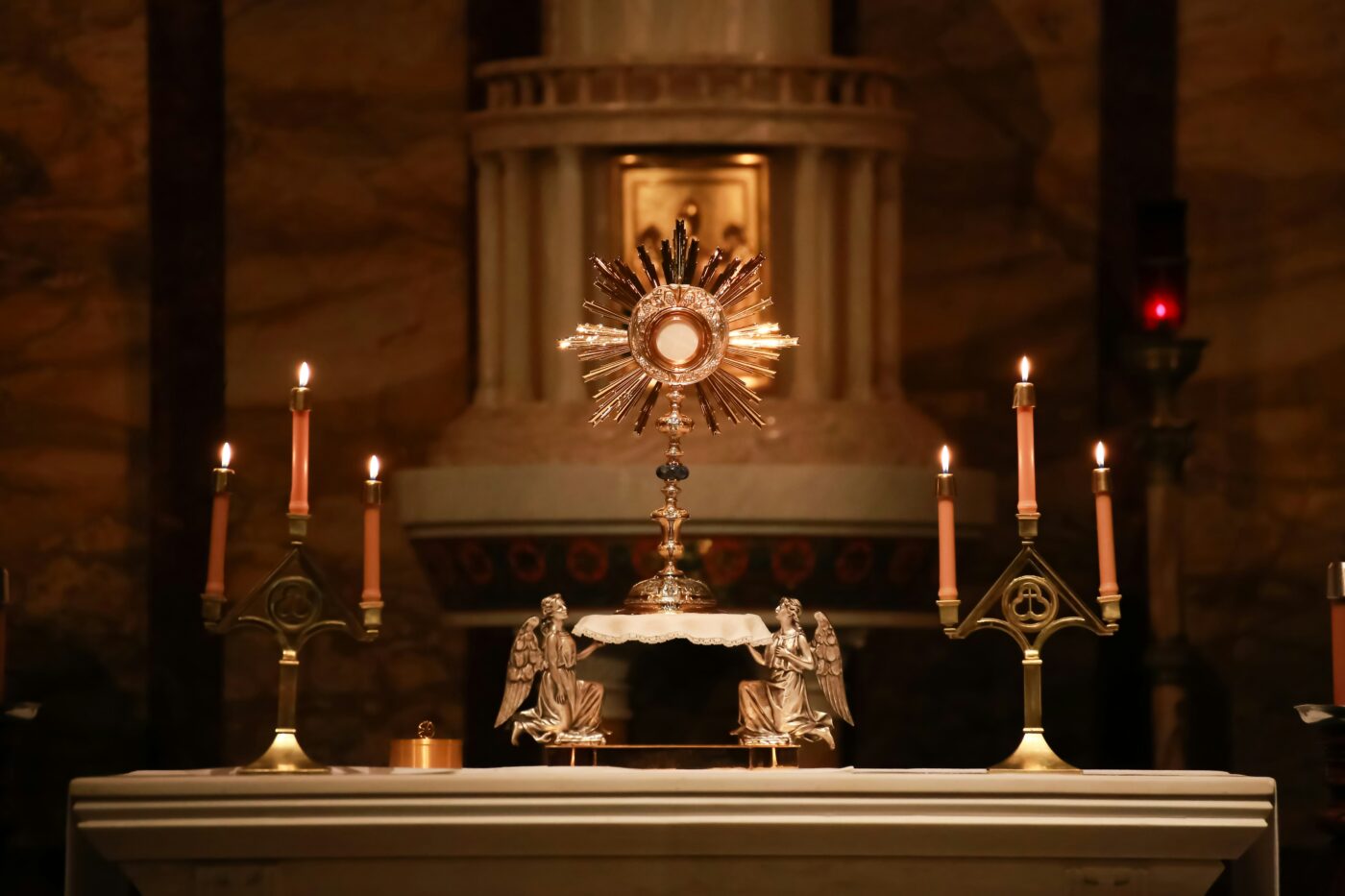
And this is why, when we quiet ourselves before His Real Presence in Eucharistic Adoration, His abundant love comes to us through the simple act of gazing upon Him—and allowing Him to gaze back at us in all our weakness, pain, joy, and heartache.
In silence, He acts the loudest.
Conversely, it’s in loud and ever-present noise that the evil one most often commands our attention. Rarely does Eternal Wisdom make Himself known in the clatter of notifications and playlists that clamor for our eyes, ears, and minds through our perpetually plugged-in lives. Where in those places is there room for the silent whisper of Eternal Wisdom? Our world tells us that he who shouts the loudest wins. Eternal Wisdom claims victory merely through a breath.
Engaging with God’s Love
But even when we manage to dampen the noise, silence alone isn’t enough.
Because if Wisdom is active, then so is His love—and that love, while gentle, is never passive. It purifies.
In the same section of The Love of Eternal Wisdom, de Montfort reminds us that Eternal Wisdom “tests them like gold in a furnace” and “makes them more worthy of Himself.”
Too often, I’ve expected God to make Himself known to me through loud, clear signs of affirmation.
“If I’m worthy of your love, then please show me a sign.”
When those signs never came, I misinterpreted His silence as rejection—as proof of my unworthiness of His love.
Ironically, multiple times while attending Mass, the words we pray during the Liturgy of the Eucharist deepened that misconception: Lord, I am not worthy that You should enter under my roof, but only say the word and my soul shall be healed.
I’d listen for that Word to heal my soul in dramatic ways, and again walk away disappointed when nothing in my heart, mind, or life seemed changed in any obvious way.
But de Montfort encourages us:
[Eternal Wisdom] does not leave those who enjoy his friendship to languish in mediocrity and negligence. He sets them on fire, inspiring them to undertake great things for the glory of God and the salvation of souls.
To become worthy of such Wisdom doesn’t mean earning His affection; it means allowing Him to strip away what prevents us from receiving it. Love that is forcefully given is not true love. In the furnace of contradiction, delay, disappointment, or even humiliation, Eternal Wisdom is still active, still loving us, refining the soul until it reflects His image.
Actively Surrendering to God
This is the paradox of the Christian life: we are never truly “worthy” of God, yet He constantly works to make us so. As Eternal Wisdom, He is constantly active. Every suffering borne with faith, every moment of silence accepted in trust, becomes a small act of consent to His transforming love, which is a consuming, purifying fire.
As de Montfort writes, “Only a few look for Him in a manner worthy of Him.” Perhaps that “manner” is less about doing and more about silent acceptance—allowing Wisdom to do the deep work within our souls that we cannot.
If this is the case, then here is what it means to seek Eternal Wisdom: to remain still long enough to let His love do its hidden work. Worthiness is not an accomplishment but a grace—one that grows in the soil of surrender to His love. We are not worthy, but Eternal Wisdom makes us so.
When we whisper at Mass, Lord, I am not worthy, we are not confessing defeat but consenting to be truly remade in the image and likeness of God, as witnessed by His Incarnate Son. In that moment of humility, the Word Himself enters under our roof—not because we have earned Him, but because His mercy wills it. We become worthy because Eternal Wisdom is worthy.
In silence, we become what we could never become on our own: souls purified by the quiet fire of Eternal Wisdom’s love.
Silence is not God ignoring us—it’s His invitation to be fully present within His love. And when we enter that stillness, Eternal Wisdom can most clearly be heard.
Editor’s Note: For more on Louis de Montfort and his reflections on Eternal Wisdom, check out Greg Willits’ new book, God Doesn’t Hate Me After All: Discovering Louis de Montfort’s Love of Eternal Wisdom, available from Sophia Institute Press. Read the first two chapters here!
Photo by Saint John’s Seminary on Unsplash