The Christmas season has many associations within the culture and the Church. For most of us, though, none of these would include genuflecting.
Genuflecting is something normative in the Catholic life that we associate with visiting a church, going to Mass, and attending Eucharistic adoration. At first glance, and perhaps even a second or third, this liturgical gesture doesn’t seem to have any direct relation with Christmas. Yet, since there is a special relationship between Christmas and the act of genuflecting, we need to add to our Christmas preparations a renewed understanding of its significance—and an intention to prepare our kneelers for a special moment at Christmas Mass when we all genuflect together.
One of the Church’s documents governing the celebration of Mass is the General Instruction of the Roman Missal. In it we find:
The Symbol or Creed is sung or recited by the Priest together with the people with everyone standing. At the words et incarnatus est, etc. (and by the Holy Spirit…and became man) all make a profound bow; but on the Solemnities of the Annunciation and of the Nativity of the Lord, all genuflect. (GIRM 137)
While it is not uncommon for the Church to add acts of reverence unique to particular liturgical celebrations or seasons, the direction to genuflect during the Nicene Creed on Christmas and the Annunciation expresses a beautiful truth.
First, consider what both Christmas and the Annunciation have in common. Christmas is the celebration of baby Jesus, who is truly God and truly man. Nine months prior to a birth is the conception of a child. So nine months prior to Christmas, on March 25th, is the celebration of the Annunciation (see Luke 1:26-38). The Church explains in the Catechism that the Annunciation, when St. Gabriel visits Mary, is the moment when her “yes” to God’s plan is the “consent to the Incarnation” (CCC 973), when she conceived Him by the power of the Holy Spirit (CCC 484).
While Christmas is often associated with the Incarnation, it began at the Annunciation and that is why the genuflection at this moment in the Creed occurs on both March 25th and December 25th. To fully appreciate the symbolism in these genuflections, let us explore a bit more about the Incarnation.
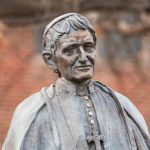
Looking at the Church Fathers and later figures, we see a very common image of motion to describe the Incarnation, when “the Word became flesh and made his dwelling among us” (Jn. 1:14). St. Irenaeus, who had a link to John the Apostle through St. Polycarp, describes Jesus as the one who saved us by descending and ascending (Against Heresies, III.6.2). In a sermon on the ascension, St. Augustine describes Jesus as the one who descended so that in grace we may be lifted up with Him. In St. John Henry Newman’s writings, we see this motion imagery, but he explains that by this descent Jesus demonstrated the possibility for sanctification, to be made holy (On the Development of Christian Doctrine, 401-402). Pope Benedict XVI describes the Incarnation as a radical act of humility, and that in imitating and entering into His humility, we can partake of His divinity.
So what does this all have to do with genuflecting? The days when the genuflection occurs in the Creed at Mass are celebrations of the Incarnation when God came down in order to lift us up. The part of the Creed where the genuflection occurs is when we profess our belief in the Incarnation. The gesture of genuflecting is literally going down and rising back up. It is a liturgical gesture that imitates the humility of Christ in the Incarnation and our desired participation in His glory. We are recalling bodily the event of the Incarnation and its purpose, what God desires for each of us, when we genuflect during the Creed. With this bodily gesture, we are called to lift up our minds and hearts to God in thanksgiving for His coming and petition for holiness.
Not only is this a profound moment in the Mass to help us better enter into the Mystery of the Nativity this Christmas, but it also has the potential to remain with us for every genuflection throughout the year. Whether entering a church pew or approaching the tabernacle in Eucharistic adoration, or some other moment of Eucharistic worship, each and every genuflection is a reminder of the God who came, comes now in the Eucharist, and will come again.
Whenever we encounter the Lord’s humility, whether in remembrance of Christmas or the Annunciation, or in every Eucharist of the year when the Lord comes to us in the humble appearance of bread and wine, we recall that His humility and “His goodness creates the true feast” (Benedict XVI).
Photo by Daria Kraplak on Unsplash