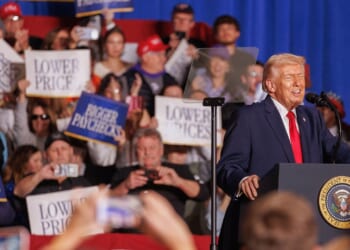
President Donald Trump on Saturday warned Iran that “time is running out” and gave the regime 48 hours to either “MAKE A DEAL or OPEN UP THE HORMUZ STRAIT” before “all Hell” would rain down, escalating his pressure campaign on the 36th day of Operation Epic Fury as the White House signaled that Tehran is rapidly running out of time to avoid even harsher consequences.
Writing on Truth Social Saturday morning, Trump recalled the ten-day ultimatum he had previously given Tehran after allowing space for negotiations to play out.
“Remember when I gave Iran ten days to MAKE A DEAL or OPEN UP THE HORMUZ STRAIT,” Trump wrote. “Time is running out – 48 hours before all Hell will reign [sic] down on them. Glory be to GOD!”
The post amounted to a renewed warning that Trump is prepared to follow through if Iran continues choking off the vital waterway while dragging its feet on a diplomatic resolution.
Trump had previously warned that if Tehran refused to reopen the Strait of Hormuz and failed to reach terms, the United States could strike major regime infrastructure, including electric generating plants, oil wells, and Kharg Island — the country’s main oil export hub.
The renewed ultimatum came as the administration appeared increasingly skeptical that indirect diplomacy would produce a breakthrough before Monday’s deadline. Iranian Foreign Minister Abbas Araghchi claimed Saturday that Tehran’s position was being “misrepresented by U.S. media” and insisted the regime had “never refused to go to Islamabad,” while saying what Iran cared about were the terms of a “conclusive and lasting END to the illegal war that is imposed on us.”
His statement, however, did little to suggest any real concession from Tehran, which has continued to posture publicly even as mediators reportedly struggle to move the two sides toward direct talks.
At the center of the standoff is the Strait of Hormuz, the narrow shipping lane through which roughly a fifth of the world’s oil and liquefied natural gas ordinarily passes. Traffic through the chokepoint has collapsed since the operation began, with reports describing a dramatic plunge in commercial shipping after repeated tanker strikes, Iranian threats, and Tehran’s effort to leverage the strait for political and economic gain.
War Secretary Pete Hegseth amplified Trump’s message by reposting the president’s Truth Social warning on X, while Sen. Lindsey Graham (R-SC) made clear after speaking with Trump that he believes the president is fully prepared to act.
“I just had a great conversation with @POTUS,” Graham wrote. “I totally support his ultimatum to the Iranian regime to open up the Strait of Hormuz and to do a peace deal.”
“A massive military operation awaits Iran if they choose poorly,” Graham added. “After speaking with President Trump this morning, I am completely convinced that he will use overwhelming military force against the regime if they continue to impede the Strait of Hormuz and refuse a diplomatic solution to achieve our military objectives.”
Trump’s latest warning also came as the U.S. military continued a frantic search for the missing weapons systems officer from the F-15E Strike Eagle that was shot down over Iran on Friday — a major and still-unfolding development in the conflict.
Both crew members aboard the F-15E ejected after the aircraft went down. One was rescued, while the second remained missing Saturday as U.S. forces continued search-and-rescue operations over rugged terrain in southwestern Iran. Iranian state media, meanwhile, urged residents to turn over any “enemy pilot” to authorities and promised a reward.
The downing marked the first known loss of a U.S. aircraft in Iranian territory during the current operation and came just two days after Trump said in a national address that the United States had “beaten and completely decimated Iran” and was moving to finish the job quickly.
In that Wednesday evening address, Trump said Operation Epic Fury was nearing completion of its core military objectives, while warning that Iran would be hit “extremely hard” over the next two to three weeks if it refused to accept terms. He also warned the regime could be sent “back to the stone ages” if it continued to resist.
That warning was reinforced Thursday when Trump posted video of the U.S. strike on the B1 bridge west of Tehran, a major transit corridor that officials said had been used by Iranian forces to move missile and drone components from the capital toward launch sites in western Iran.
“The biggest bridge in Iran comes tumbling down, never to be used again — Much more to follow!” Trump wrote at the time. “IT IS TIME FOR IRAN TO MAKE A DEAL BEFORE IT IS TOO LATE, AND THERE IS NOTHING LEFT OF WHAT STILL COULD BECOME A GREAT COUNTRY!”
As pressure on Tehran has intensified, signs have also emerged that the regime and its terror proxies could seek to widen the maritime crisis beyond Hormuz.
Iranian parliament speaker Mohammad Bagher Ghalibaf appeared Friday to threaten the Bab el-Mandeb Strait, another major global shipping chokepoint, when he posted a series of pointed questions on X about how much global oil, LNG, wheat, rice, and fertilizer transit the waterway and which countries and companies rely on it most.
That threat was echoed more explicitly by Houthi Deputy Information Minister Mohammed Mansour, who warned that the Iran-backed Yemeni terror group could move to close the Bab el-Mandeb if Gulf states joined the U.S.-Israeli campaign.
“The option of closing the Bab el-Mandeb Strait is a Yemeni option that can be implemented should the aggression against Iran and Lebanon escalate savagely, or if any Gulf state becomes directly involved in military operations in support of the [Zionist] entity or the United States,” Mansour told Al-Monitor.
Together, the developments sharpen the stakes behind Trump’s 48-hour warning: Tehran is not only being pressed to end its stranglehold on Hormuz and engage seriously, but is now signaling — through both regime officials and terrorist proxies — that it could seek to trigger an even broader maritime and economic crisis if pressure continues to build.
Joshua Klein is a reporter for Breitbart News. Email him at jklein@breitbart.com. Follow him on Twitter @JoshuaKlein.