Three vessels were reportedly struck by “unknown projectiles” in the Strait of Hormuz on Wednesday, and Iran’s terrorist Islamic Revolutionary Guard Corps (IRGC) claims it fired on a fourth to underline its threats against global shipping through the strategically vital passage.
Reuters quoted maritime risk analysts and ship owners for information about the three attacks, which began when the Japanese-flagged container ship ONE Majesty suffered “minor damage” from a projectile strike while it was anchored near the United Arab Emirates (UAE).
The damage was reportedly above the waterline and posed no danger to the ship’s operation. No injuries were reported from the incident.
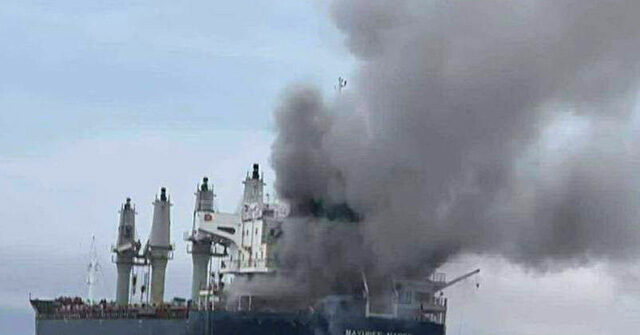
Next, a Thai-flagged dry bulk vessel called Mayuree Naree was hit by “two projectiles of unknown origin” on Wednesday. The impacts caused a fire in the engine room of the ship, and its owner, Precious Shipping, said that “three crew members are reported missing and believed to be trapped in the engine room.” The other 20 crewmembers were evacuated to Oman.
The third target was a Marshall Islands-flagged bulk carrier named Star Gwyneth, which was struck about 50 miles north of Dubai. The projectile impacted near the ship’s hold and reportedly caused no severe damage or injuries.
The IRGC issued a statement taking responsibility for the attack on the Mayuree Naree, and claimed it struck another ship with drones, but there was no independent verification of that attack.
The IRGC said the Mayuree Naree and the other vessel they claimed to have struck, the “Express Room,” made the mistake of “trusting in empty promises, ignored the warnings and intended to cross the strait but got caught.”
“Every vessel intending to pass must obtain permission from Iran,” the statement warned.
Iranian state media on Wednesday ran images of burning ships to illustrate “the consequences of unauthorized passage through the Strait of Hormuz.” It was not clear if any of this footage was new or included the ships that were actually attacked.
Energy Secretary Chris Wright’s account on social media platform X included a post on Tuesday that said the U.S. Navy had “successfully escorted an oil tanker through the Strait of Hormuz to ensure oil remains flowing to global markets.” The post was followed by an almost immediate drop in worldwide oil prices.
Wright’s office later deleted the post, and Iranian state media denied there had been any successful tanker escort. White House Press Secretary Karoline Leavitt said on Tuesday there have been no escorts as of yet, while the Energy Department blamed staffers for “incorrectly captioning” a video shared by Wright.
“I was made aware of this post. I haven’t had a chance to talk to the Energy secretary about it directly, however, I know the post was taken down pretty quickly and I can confirm that the U.S. Navy has not escorted a tanker or a vessel at this time,” Leavitt said.
“President Trump, Secretary Wright, and the rest of the President’s energy team are closely monitoring the situation, speaking with industry leaders, and having the U.S. military draw up additional options to keep the Strait of Hormuz open, including the potential for our Navy to escort tankers,” said a spokesperson for the Energy Department.
The International Energy Agency (IEA) on Wednesday said it would address the closure of the Strait of Hormuz by authorizing its largest release of oil reserves in history, amounting to roughly 400 million barrels.
The IEA said the release was unanimously approved by all 32 of its member nations, in light of the “unprecedented” challenges to the oil market.
“The emergency stocks will be made available to the market over a timeframe that is appropriate to the national circumstances of each member country,” the agency said.
Interior Secretary Doug Burgum applauded the release as a wise response to “a temporary transit problem that we’re resolving militarily and diplomatically, which we can resolve and will resolve.”
Reports this week of ships sailing “dark” through the Strait of Hormuz, with their transponders turned off, led some observers to believe tanker captains were defying Iran’s blockade, but TankerTrackers.com cofounder Samir Madani told CNBC on Thursday that most of the dark tankers were actually Iranian ships, carrying some 11.7 million barrels of crude oil to China.
TankerTrackers data showed Iran has resumed using its Jask oil and gas terminal on the coast of the Gulf of Oman, which it largely stopped using about five years ago, to get more crude oil seaborne for China.