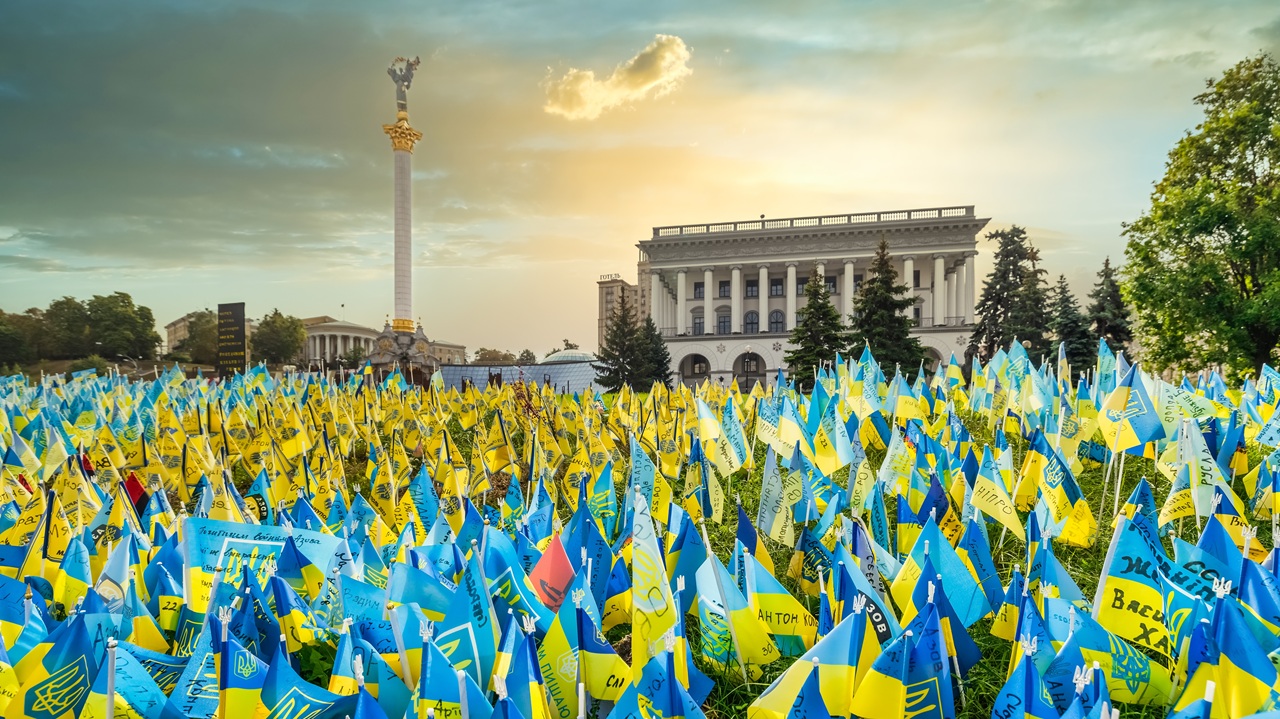
The Ukraine War is the largest war between two sovereign states of the 21st century.
Four years ago today, the fate of Europe changed. In the early morning hours of February 24, 2022, Russian tanks and armored personnel carriers brimming with eager troops crossed the Ukrainian border in numerous places.
Despite the steady military buildup around Ukraine and America’s aggressive declassification of intelligence indicating that President Vladimir Putin was seriously considering invading Ukraine for the second time in eight years, the full-scale invasion came as a shock to many. Within a few hours, Russian forces were steaming through their neighboring country. Russian airborne forces captured an airport right next to Kyiv, intending to establish a crucial air assault link next to the Russian capital. The Kremlin’s prediction for a “special military operation” that would last from three days to two weeks seems accurate.
As the first day of the war ended, Russian forces had captured more than 40 percent of Ukraine. It would be the best day of the war for the Russian military.
Four Years On, the Ukraine Invasion Has Backfired on Russia
Today, four years later, the Russian forces have lost nearly 1.3 million troops, including nearly 350,000 dead, and control approximately 19 percent of Ukraine. Russia maintains the strategic initiative on the battlefield, choosing when and where to launch offensives, but has been unable to field the necessary operational strength to break through the Ukrainian defenses.
On a geopolitical level, the large-scale invasion of Ukraine had the exact opposite result than the Kremlin wished. A quick Russian victory in Ukraine was intended to demonstrate European institutions’ inability to protect themselves, and Russia’s military mastery of Eastern Europe. Instead of fracturing Europe and NATO, however, the invasion reinforced bonds of mutual trust, especially among European nations. Today, Europe is much stronger and united, and the European defense industry has been largely revitalized by the threat of Russia.
NATO is also stronger. Sweden and Finland, two countries with a centuries-long history of neutrality, decided to join the transatlantic alliance. Meanwhile, Russia has been targeted by onerous international sanctions and has increasingly been forced to deal with other pariah nations outside of the existing international trade order, particularly Iran and North Korea.
Lessons Learned from the Battlefield in Ukraine
The past four years have provided a litany of battlefield lessons for both parties to the conflict. The Ukraine War is the largest conventional military conflict between two nation-states in the 21st century, and many modern war planners are looking to Ukraine for how to prepare for future conflicts.
First, artillery remains “king” of the battlefield. Artillery is the most lethal weapon in Ukraine, at times accounting for over 80 percent of casualties. Artillery guns, especially 155mm howitzers, are wreaking havoc on the battlefield and are essential to the offensive and defensive operations of both combatants. During the height of fighting, Russian and Ukrainian guns can fire thousands of artillery rounds per day.
Second, unmanned aerial systems are a viable weapon system in modern warfare. Both sides have been using drones for kinetic, intelligence, surveillance, and reconnaissance (ISR), and resupply purposes. ISR drones are cheap and disposable, and have done much to lift the “fog of war” along the line of contact, making it very difficult for either side to prepare a major offensive without the other side knowing and reacting to it. And kamikaze drones in particular account for a large portion of casualties. They have also enabled long-range strategic strikes.
Third, air superiority can be the tiebreaker in a balanced conflict. However, neither Russia nor Ukraine has managed to wrestle control of the skies and establish air superiority. The slow fighting on the ground is largely due to this fact. And although no one expected Ukraine to win the skies with its small and old fighter jet fleet, Russia’s inability to assert its qualitative and numerical air advantage is shocking. The Russian Aerospace Forces have failed to dismantle Ukraine’s air defenses and cannot operate freely over the battlefield. Thus, there are no close air support and air-launched precision strike missions of the kind necessary to break a robust defensive line.
The future of the conflict remains unclear—but peace efforts have stalled, and appear no closer to success than they were four years ago. It is likely, then, that the fighting in Ukraine will continue for some time longer.
About the Author: Stavros Atlamazoglou
Stavros Atlamazoglou is a seasoned defense journalist specializing in special operations and a Hellenic Army veteran (national service with the 575th Marine Battalion and Army HQ). He holds a BA from the Johns Hopkins University and an MA from the Johns Hopkins’ School of Advanced International Studies (SAIS). His work has been featured in Business Insider, Sandboxx, and SOFREP.