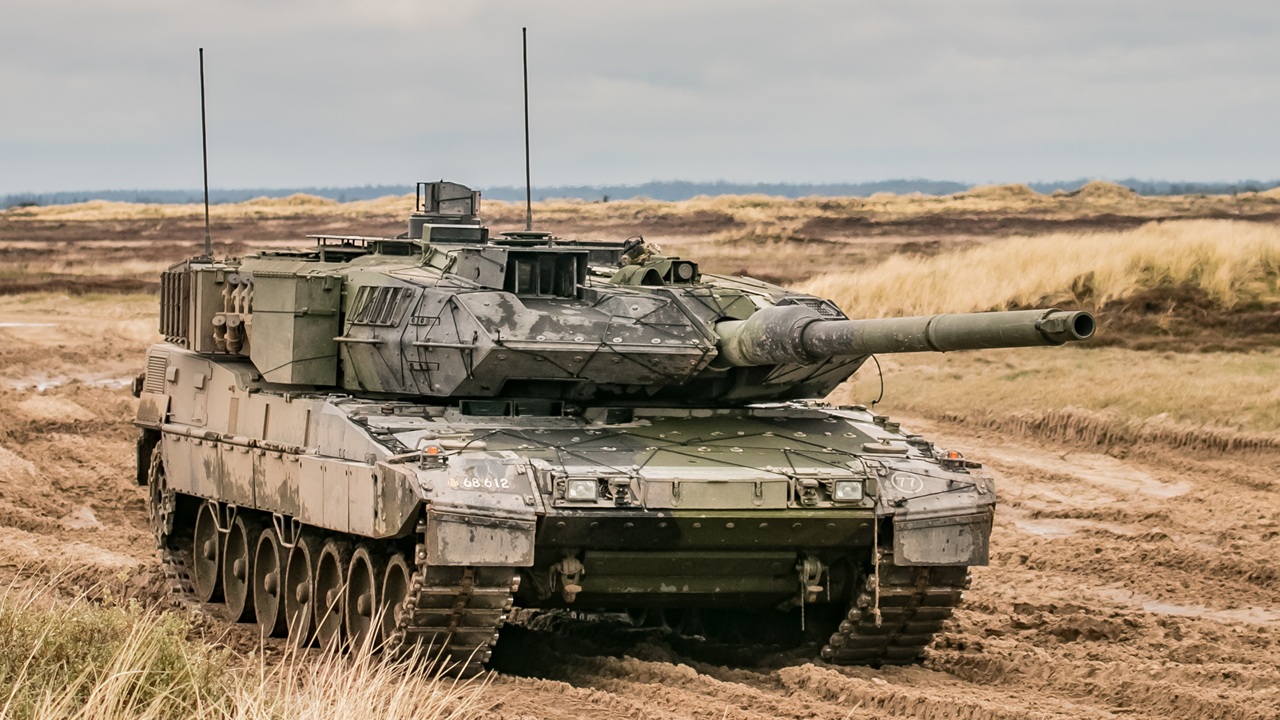
Hungary’s Leopard 2 tanks are intended to replace its existing T-72s—but there is little chance that it will donate the older tanks to Ukraine, as other NATO nations have.
This month, the Hungarian Defense Forces (HDF) confirmed receipt of its final Leopard 2A7HU main battle tanks (MBTs). The HDF’s Klapka György 1st Armored Brigade, based at Tata in the country’s northwest, now operates 44 of the German-made variant MBTs.
In addition, the HDF received 12 “second-hand” Leopard 2A4s that Budapest acquired from Berlin for use in crew training for the more advanced 2A7HU models.
Present at the handover ceremony last Friday were Hungarian Defense Minister Kristóf Szalay-Bobrovniczky and Chief of the Hungarian Armed Forces General Gábor Böröndi, as well as Ralf Ketzel, CEO of KNDS Deutschland (KNDS), who attended to witness the formal transfer of the MBTs. The Hungarian Minister of Defense presented KNDS with a special award marking the close ties of the Hungarian military and the German arms company.
“We have been able to play a key role in supporting Hungary in the modernization of its armed forces,” said Ralf Ketzel. “As a full systems provider, KNDS has demonstrated that it is capable of successfully delivering complete solutions from a single source, ranging from training and logistical support to various vehicle systems.”
Budapest concluded the €500 million ($585 million) deal for the 44 MBTs in December 2018, and delivery began in August 2023. It was part of a larger €1.5 billion package for 24 Panzerhaubitze (PzH) 2000 self-propelled howitzers, three Leguan armored vehicle-launched bridges, five Wisent armored recovery vehicles, a simulation center, comprehensive training, spares, and a logistics package.
The German-made Leopard 2A7HU will replace the HDF’s aging fleet of Soviet-era T-72 MBTs, while the PzH 2000s will supplant the D-20 152mm towed howitzers.
The Leopard 2A7HU in the Crosshairs
- Year Introduced: 2023 (Hungary)
- Number Built: 44+
- Length: 7.7 m (25.3 ft)
- Total weight, battle ready: ~66.5 tonnes
- Suspensions: Reinforced torsion bar
- Engine: MTU MB 783 Ka-501 V12 1,500 hp diesel engine
- Armament: 120mm smoothbore cannon; 12.7mm heavy machine gun; coaxial 7.62mm machine gun; smoke grenades
- Top Speed: ~72 km/h (45 mph) on road
- Range: ~400–450 km (250–280 mi)
- Crew: 3 (commander, gunner/loader, driver)
Based on the Leopard 2A7, the Hungarian variant features armor enhancements, an advanced digital system, improved roof protection, and an enhanced fire control system (FCS). Its main armament, a Rheinmetall L55A1 120mm tank gun, capable of engaging targets at ranges up to 5,000 meters (16,400 ft). According to Army Recognition, the gun is compatible with “modern high-pressure ammunition and extended-range kinetic energy rounds.”
“The tank is capable of crossing wet gaps up to 1.2 meters, fording deliberately to 2.25 meters, and conducting deep wading operations to depths of 4 meters with appropriate preparation,” Army Recognition added, noting that the MBT is able to support engineering assets, notably the Leguan Bridge layers that the HDF has also received.
What About Hungary’s Older T-72s?
There has been no word on what Budapest will do with its fleet of aging, but still combat-ready, Soviet-era T-72s tanks. The Central European nation and NATO member currently operates approximately 34 T-72M1 models, with approximately 130 more in storage.
Other NATO nations have donated older Soviet-era hardware to Ukraine for use on the battlefield. This hardware is particularly useful for Kyiv, as Ukrainian tank crews are already intimately familiar with T-72s and do not require retraining, as they have with Western platforms such as the Leopard 2 and the M1 Abrams.
However, it seems unlikely that Kyiv will receive any of the much-needed MBTs. Budapest has so far refused to contribute arms shipments to Ukraine, and earlier this year also announced it would not help to finance US weapons for Ukraine.
About the Author: Peter Suciu
Peter Suciu has contributed over 3,200 published pieces to more than four dozen magazines and websites over a 30-year career in journalism. He regularly writes about military hardware, firearms history, cybersecurity, politics, and international affairs. Peter is also a contributing writer for Forbes and Clearance Jobs. He is based in Michigan. You can follow him on Twitter: @PeterSuciu. You can email the author: [email protected].
Image: Shutterstock / Rasmus Christopher Franck.