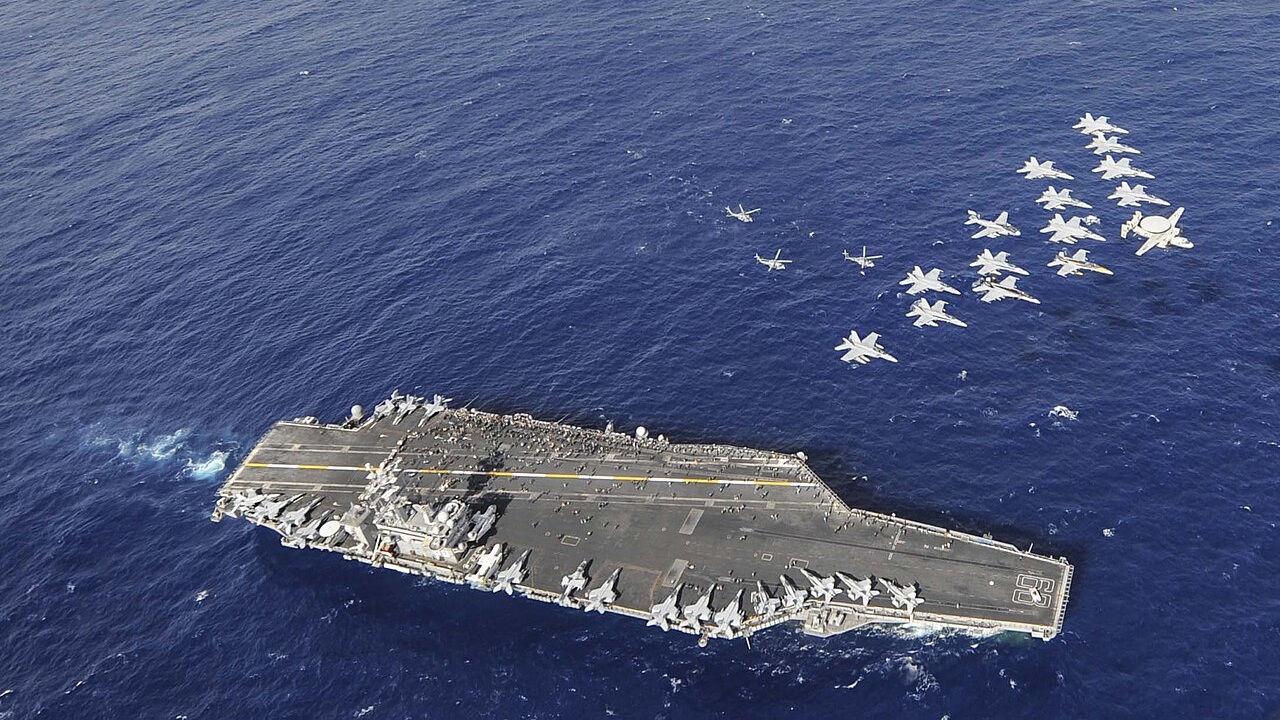
Although the Nimitz’ scheduled decommissioning has been delayed for a year, the ship will probably remain in port until then.
The United States Navy’s oldest active nuclear-powered supercarrier, the USS Nimitz (CVN-68), departed Naval Base Kitsap in Bremerton, Washington, earlier this month, beginning a homeport shift to Naval Station Norfolk, Virginia. It was expected that CVN-68 would be decommissioned in May, before beginning the lengthy recycling process, which could take as long as a decade to complete.
However, the plans have changed. The decommissioning of the USS Nimitz won’t take place in May—nor anytime this year.
“The US Navy plans to inactivate the ship in 2027,” a US Navy official told USNI News on Saturday.
The Navy Will Keep 11 Carriers in Service—At Least on Paper
The United States Navy hasn’t explained what this means for the USS Nimitz, which ostensibly completed her “final deployment” in December after operating in the Middle East and the Indo-Pacific.
Preparations are already underway for CVN-68’s eventual recycling, with HII Newport News Shipbuilding being awarded a $96 million contract to cover advanced planning and procurement of the “long-lead materials” that will be needed to inactivate the ship next year.
Breaking Defense first reported on Saturday that the US Navy has changed course on the decommissioning of USS Nimitz, as the service is now expecting to accept delivery of the future USS John F. Kennedy (CVN-79) in March 2027. The second Gerald R. Ford-class supercarrier is delayed, with its previously planned July 2026 handover pushed back to next year.
Delaying the decommissioning of USS Nimitz to next year will allow the US Navy to retain 11 nuclear-powered supercarriers in the fleet, even if CVN-68 remains in Newport News and doesn’t deploy again for the remainder of its service life. In other words, the one-year delay may simply be a matter of satisfying US lawmakers by keeping 11 carriers on paper. Title 10 of the US Code, specifically 10 U.S.C. § 8062, mandates that the US Navy maintain at least 11 operational aircraft carriers in its fleet.
“The naval combat forces of the Navy shall include not less than 11 operational aircraft carriers. For purposes of this subsection, an operational aircraft carrier includes an aircraft carrier that is temporarily unavailable for worldwide deployment due to routine or scheduled maintenance or repair,” the code explains.
But “operational” is a loose term to say the least!
No Future Deployment for the Nimitz, but a Long Goodbye
As the US Navy’s supercarriers are too large to pass through the Panama Canal, the carrier’s homeport shift from Naval Base Kitsap to Naval Station Norfolk requires that the warship take the long way around South America, transiting from the Pacific to the Atlantic at Cape Horn. The homeport shift is also a goodbye tour for the US Navy’s second nuclear-powered flattop. CVN-68 made a port visit to San Diego, her former homeport, and departed on Saturday.
The USS Nimitz is currently in the Pacific Ocean off the coast of Baja California.
Once USS Nimitz arrives in Norfolk, it likely won’t head to sea again. At issue is the low level of its nuclear fuel. CVN-68 completed its midlife refueling in 2001, a quarter of a century ago, and may simply not be capable of deploying even if needed.
“The Navy closely guards the level of nuclear fuel in its carriers. In the past, carriers waiting for midlife refueling served as training platforms for aviators and sailed in local exercises,” USNI News explained.
Whether CVN-68 is used for stationary training has yet to be seen. Still, by delaying the decommissioning of the oldest active flattop, the US Navy will at least nominally retain 11 carriers in its fleet, satisfying Title 10.
About the Author: Peter Suciu
Peter Suciu has contributed to dozens of newspapers, magazines and websites over a 30-year career in journalism. He regularly writes about military hardware, firearms history, cybersecurity, politics, and international affairs. Peter is also a contributing writer for Forbes and Clearance Jobs. He is based in Michigan. You can follow him on Twitter: @PeterSuciu. You can email the author: [email protected].