The Gravely had previously been deployed in the Caribbean—and before that in the Middle East, where it saw active combat against the Houthis.
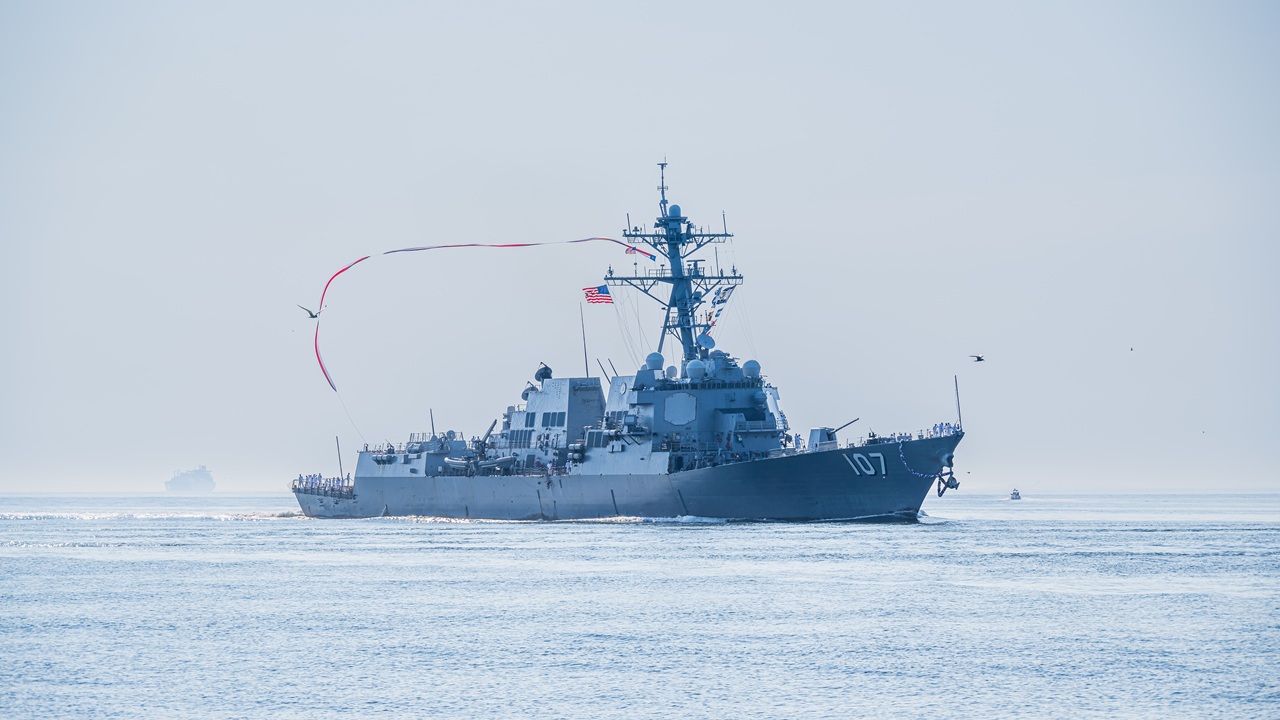
The United States Navy’s Arleigh Burke-class Flight IIA upgraded guided-missile destroyer USS Gravely (DDG-107) returned to her homeport of Naval Station Norfolk, Va., last weekend, following a four-month deployment supporting the US Southern Command (USSOUTHCOM).
Anytime a warship is home for the holidays, it is likely welcomed by the crew, but for the guided-missile destroyer, it follows yet another lengthy mission. From March to June this year, the warship operated in the Gulf of Mexico and the Caribbean Sea in support of the US Northern Command (USNORTHCOM) mission, and from August to December, it was part of the buildup of US forces to counter drug smuggling from South America.
“Gravely worked alongside both the USS Iwo Jima Amphibious Readiness Group and the USS Gerald R. Ford Carrier Strike Group while supporting USSOUTHCOM missions,” the US Navy announced.
The USS Gravely has one of the most active warships in the region, first searching for boats carrying migrants and carrying out drug interdiction operations with an embarked United States Coast Guard law enforcement team, before deploying in the ongoing mission to counter alleged narco-terrorists operating from Venezuela.
“Team Gravely takes pride in our continued service to maritime homeland defense,” stated Cmdr. Greg Piorun, commanding officer, USS Gravely. “This team has worked hard in the precision execution of a wide variety of missions aimed to underpin American security and economic prosperity in the Western Hemisphere. This upcoming return home is well deserved and comes with some much-needed downtime!”
About the USS Gravely
- Year Commissioned: 2010
- Length: 509.5 ft (155.3 m)
- Beam (Width): 66 ft (20 m)
- Displacement: 9,500 long tons (9,700 metric tons)
- Engines: Four General Electric LM2500-30 gas turbine engines
- Top Speed: 30 knots (34.5 mph, 55.6 km/h)
- Range: 4,400 nmi (5,063 mi, 8,148 km)
- Armaments:
- Mk 41 Vertical Launch System (VLS): A 96-cell system that can launch a variety of missiles, including BGM-109 Tomahawk cruise missiles, RIM-66M, RIM-156, and RIM-174A Standard Missiles (surface-to-air and anti-ballistic missile versions), RIM-162 Evolved Sea Sparrow Missiles (ESSM), RUM-139 Vertical Launch ASROC (VLA)
- Mk 45 5-inch Gun: A single gun mount on the bow for surface and shore bombardment
- Mk 15 Phalanx CIWS: A close-in weapon system for last-ditch defense against incoming missiles and aircraft
- Mk 38 Machine Gun Systems (two 25mm cannons)
- Crew: ~329, including officers and sailors
The Flight IIA destroyers serve as a multi-mission surface combatant and, like other Arleigh Burke-class warships, can be employed in anti-air warfare (AAW), anti-submarine warfare (ASW), and anti-surface warfare (ASuW) roles.
Commissioned in Wilmington, N.C., on November 20, 2010, DDG-107 is named for Vice Admiral Samuel L. Gravely, Jr., the first African-American to command a US Navy warship and the first to rise to vice admiral. Her motto is “First to Conquer.”
The Caribbean Was a Welcome Change for the Gravely
Even as DDG-107 has been operating as part of a military buildup that could result in an armed conflict with Venezuela, as the Trump administration seeks to remove President Nicolas Maduro from power, the warship has seen much worse.
The guided-missile destroyer previously deployed to the Middle East with the Dwight D. Eisenhower Carrier Strike Group (DDECSG)—and took part in what the US Navy has described as the most active conflicts for a CSG since World War II.
In January 2024, a Houthi anti-ship cruise missile came within a mile of DDG-107 and was only shot down by the vessel’s Phalanx Close-in Weapons System (CIWS). It remains unclear why the warship’s RIM-162 Evolved SeaSparrow Missile (ESSM) or other longer-range air defense systems weren’t employed during the January 30, 2024, Houthi strike, or if the interceptor missiles missed their target. However, the Phalanx successfully countered the threat, as it was designed to do.
About the Author: Peter Suciu
Peter Suciu has contributed over 3,200 published pieces to more than four dozen magazines and websites over a 30-year career in journalism. He regularly writes about military hardware, firearms history, cybersecurity, politics, and international affairs. Peter is also a contributing writer for Forbes and Clearance Jobs. He is based in Michigan. You can follow him on Twitter: @PeterSuciu. You can email the author: [email protected].
Image: Shutterstock / Greg Meland.