
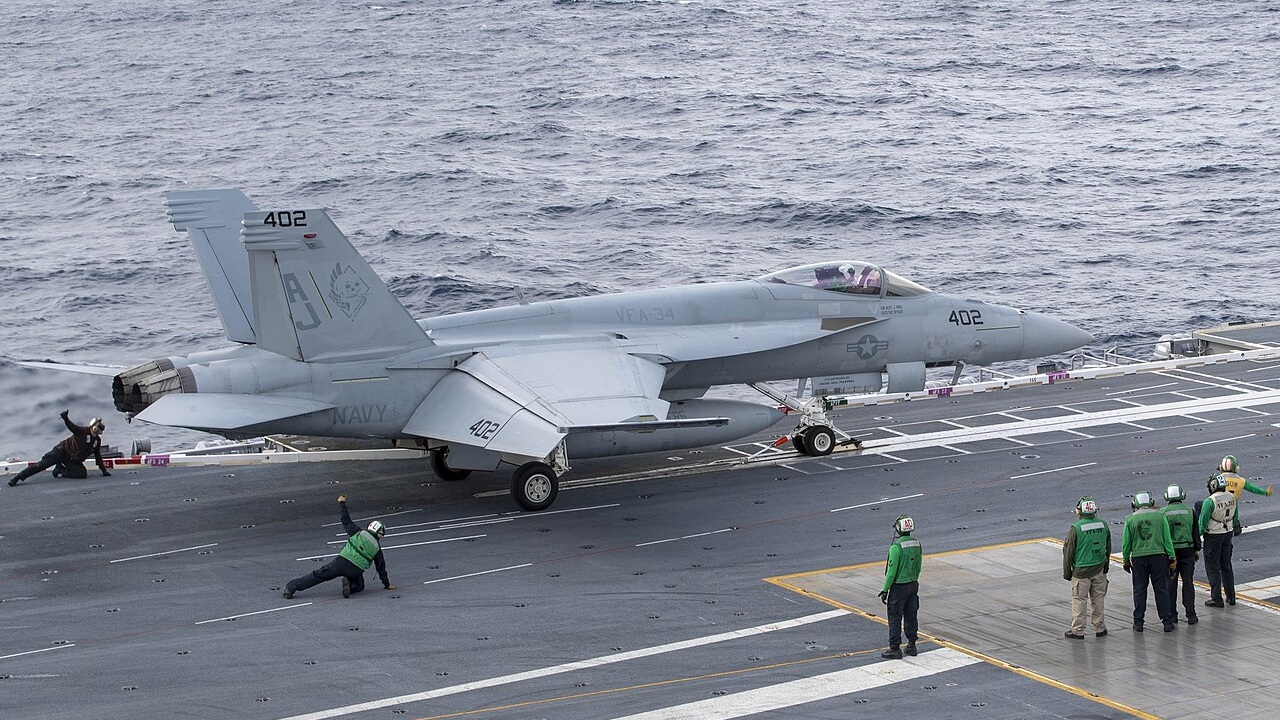
It was well past time for the US Navy to replace its aging steam catapults with electromagnetic ones—but the new EMALS system has seen significant challenges of its own.
The EMALS, or Electromagnetic Aircraft Launch System, is a ground-breaking new aircraft carrier catapult system. First operationally deployed on the USS Gerald R. Ford, the EMALS will also be included on all future Ford class carriers, representing the first major technological leap in carrier catapult systems since steam catapults debuted in the 1950s. As the name implies, the EMALS relies on electromagnets to propel an aircraft, in principle resulting in improved launch reliability, efficiency, and energy management. In practice, though, the catapults’ record has been far from perfect.
How an EMALS Catapult Works
EMALS launchers use linear induction motors to generate a strong electromagnetic field that can accelerate aircraft along the flight deck. This system replaces the steam pressure system found on earlier carriers, with a much more precisely controlled electrical pulse.
The launch energy generated through EMALS varies by aircraft, but is typically around 122 megajoules, creating an acceleration stroke of 300 feet. The system’s power is drawn from the Ford’s A1B nuclear reactors and can be used to launch everything from F/A-18s to F-35Cs to UAVs—and, critically, future aircraft not currently suited for steam launches.
During the EMALS catapult’s operation, a shuttle connects the aircraft’s launch bar to the EMALS power track beneath the deck. Then, instead of releasing steam, the system sends a controlled electromagnetic pulse, pulling the shuttle forward. Acceleration can be finely tuned as needed for the particular aircraft; light UAVs can undergo gentle launches, while heavier fighters need the full force of the catapult. In general, the result is smoother acceleration and, critically, less stress on airframes, extending the aircraft’s service life.
EMALS Is a Far Better System than a Steam Catapult
In spite of the technical problems seen in the EMALS system, it has been well past time for the US Navy to replace the steam catapult. Dating back to the early Cold War, steam catapults were rugged and reliable, but highly maintenance-intensive. Steam systems waste enormous amounts of energy, hit the aircraft with abrupt, uneven forces, require massive plumbing and high-pressure components, and are hard to adapt to future lightweight or unmanned aircraft. The Navy wanted an alternative that could produce higher sortie generation rates and better energy efficiency, with increased aircraft compatibility—all while lowering the crew’s workload. EMALS was the answer.
The operational advantages of EMALS are numerous. Smoother acceleration reduces structural loads on the aircraft, increasing airframe life. Higher launch precision allows for safer operations in marginal conditions. Heavy and light aircraft are supported equally well—ideal for the UAVs and next-gen aircraft that are likely to play the primary role in the next major conflict. EMALS also allows for operations with fewer crew, thanks to less plumbing, fewer pressure vessels, and modular components—which reduces naval operational costs significantly. And, with EMALS, the Ford has a 30 percent higher sortie generation rate than the preceding Nimitz class, which is ultimately the core purpose of carrier operations.
While reliability issues have been widely reported—the EMALS’ software tuning, integration, and use have taken years of refinement—EMALS reliability metrics are improving. The strategic implications of a working EMALS system are profound. Because of the launchers, the Ford will be able to sustain a greater operational tempo (more aircraft launched per hour in high-intensity conflict). EMALS enjoys broader aviation compatibility, which is critical for integrating stealth drones, loyal wingmen, and future UAV strike systems. And the Ford will benefit from a reduced flight-deck logistics burden, which improves survivability and efficiency.
About the Author: Harrison Kass
Harrison Kass is a senior defense and national security writer at The National Interest. Kass is an attorney and former political candidate who joined the US Air Force as a pilot trainee before being medically discharged. He focuses on military strategy, aerospace, and global security affairs. He holds a JD from the University of Oregon and a master’s in Global Journalism and International Relations from NYU.
Image: Wikimedia Commons.

















_in_the_Atlantic_Ocean,_24_March_2020_(200324-N-OH637-1315).JPG)