Despite lifting sanctions, Washington has failed to arrest radicalization within the Syrian government.
The terrorist attack that killed two US servicemembers and a civilian interpreter in Syria last weekend exposed dangerous flaws in US Syria policy that have festered since the Assad regime’s collapse a year ago. The perpetrator of the attack was a member of Syria’s General Security Force, who Syrian authorities say held extremist views.
He was slated to be dismissed on December 10, three days before the attack, but remained on duty due to an administrative weekend.
President Donald Trump absolved Syrian president Ahmed al-Shara of responsibility, claiming that the assailant was a member of the Islamic State (ISIS) and asserting that the attack took place in an area beyond the Syrian government’s control, which is unfortunately not the case.
This attack was the foreseeable outcome of the American bet on Shara’s fragile government. Lifting sanctions on Syria without preconditions and conferring external legitimacy to the new regime, even as Syria’s internal dynamics remain dire, was a step too far, too fast. It was a gamble meant to draw Damascus closer to US interests, but it is failing. The Syrian government has yet to take even the most basic steps to reform its institutions or stabilize the country.
Syria’s decision to join the 90-member anti-ISIS coalition in November was, on its face, a notable milestone for a former Al Qaeda leader like Shara. While he has fought ISIS since 2012, less out of differing ideologies than rivalry, ISIS retains a foothold in Syria, giving Shara an opportunity to further align himself with Washington by casting his government as a counterterrorism partner.
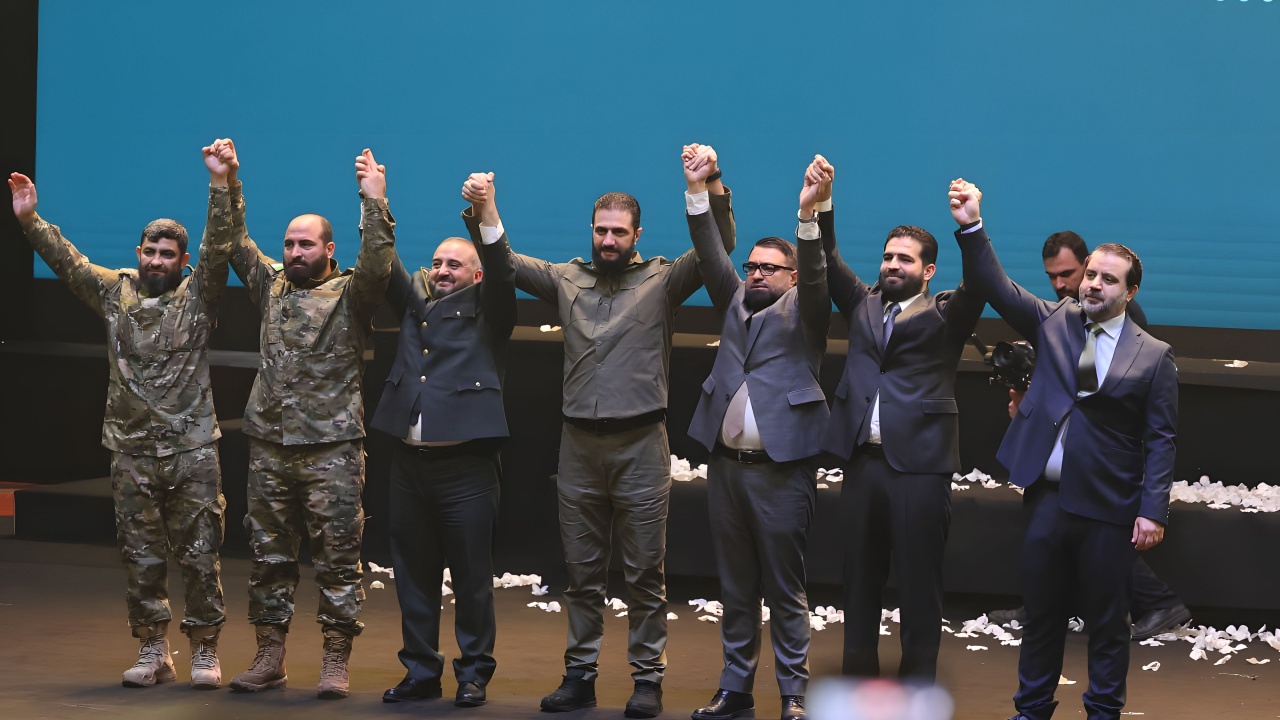
But how can Shara credibly present himself as a counterterrorism partner when his military is filled with jihadists, including former ISIS fighters, foreign terrorists, ex-Iranian militia recruits, and individuals implicated in serious human rights abuses? Syrian officials argue that necessity has overridden vetting, that the dire security environment required a rapid expansion of the ranks rather than scrutinizing recruits’ backgrounds. It comes as no surprise then that less than a month after launching joint patrols with US forces, a member of this unvetted security apparatus carried out an attack that killed American citizens.
Syrian officials will likely assure their US counterparts that they will revisit their vetting procedures and attempt to purge the security forces. It’s a necessary move, but one that comes far too late. This same body has been implicated in two sectarian massacres over the past year, against the Alawites in March and the Druze in July.
After each massacre, Syrian authorities pledged accountability, promising to prosecute those responsible and reform the security apparatus to purge rogue elements. Yet progress has been negligible. To date, only one court hearing related to the March Alawite massacre has been held. That was in November and involved just seven security personnel, despite reports identifying roughly 300 members of the security forces as participants.
The lack of accountability has deepened fears across Syria’s diverse communities about the country’s trajectory under its new leadership. This is evident in the Kurdish-led Syrian Democratic Forces’ (SDF) resistance to integration with the state; SDF leaders fear that disarmament would leave them vulnerable to the same fate suffered by Alawite and Druze communities.
Religious minorities harbor similar anxieties, particularly as members of the Syrian security forces are required to undergo religious training rooted in Shara’s conservative Sunni ideology. At the same time, questions about whether religious and ethnic minorities will be welcome in the new military remain unanswered. According to The New York Times, a Syrian defense official acknowledged that the government has yet to decide whether religious minorities will even be permitted to enlist.
While these developments should alarm Washington, they resonate more sharply in Jerusalem. Israel views Syria’s security apparatus and its ideological orientation with caution. For this reason, Israeli leaders have been reluctant to withdraw their troops from Syrian territory that they have occupied since December 2024, or to sign a security agreement with the Syrian leadership. Additionally, Israel is unmoved by Damascus’ non-escalatory rhetoric towards Israel and Shara’s professed disinterest in war.
During celebrations marking the first anniversary of Assad’s fall, videos from Damascus showed Syrian soldiers marching through the streets chanting, “Gaza, we are with you until death,” along with other slogans previously used by Hamas, which raised fresh alarms in Israel.
Washington is right to see engagement with Syria’s new leadership as a strategic opportunity to pull Damascus into the American orbit after decades of alignment with Russia and Iran. But giving the Syrian leadership carte blanche will lead to more instability, one that the United States does not want to see. Washington should make clear to Shara that without domestic stability and a serious reckoning with Syria’s internal dynamics, the country will slide back into violence, creating a vacuum that would invite Iran and Russia to return.
That is precisely the outcome that both Washington and Damascus want to avoid.
About the Author: Ahmad Sharawi
Ahmad Sharawi is a research analyst at the Foundation for Defense of Democracies, focusing on Middle East affairs and the Levant. Previously, Sharawi worked at the Washington Institute for Near East Policy, where he focused mainly on Hezbollah. Ahmad previously worked at the International Finance Corporation and S&P Global. He holds a BA in international relations from King’s College London and an MA from Georgetown University’s School of Foreign Service.
Image: Mohammad Bash / Shutterstock.com.