
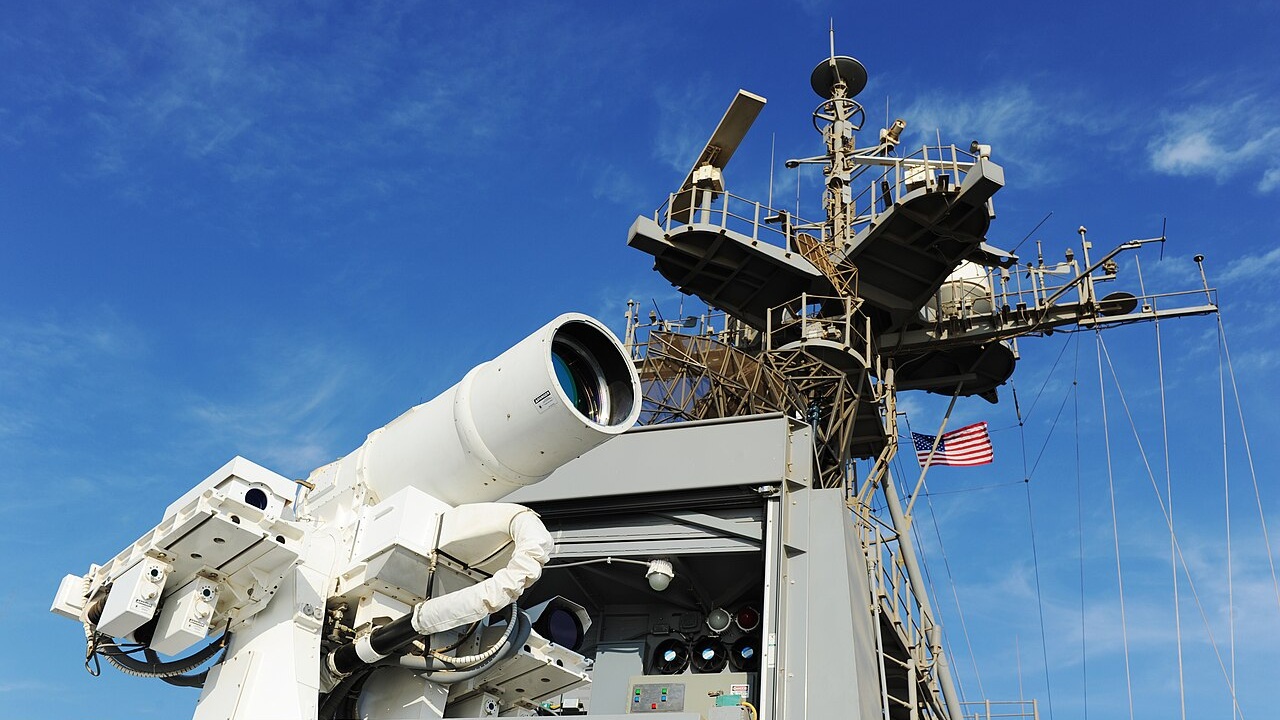
Lockheed Martin’s “HELIOS” anti-drone laser passed a recent test with flying colors, according to CEO Jim Taiclet.
Last week, Lockheed Martin announced that a US Navy guided-missile destroyer had used one of its experimental laser weapons to shoot down four drones during a demonstration last year—a positive sign for the weapon’s viability in the near future.
Lockheed Martin’s HELIOS directed energy weapon on board the USS Preble, an Arleigh Burke-class missile-guided destroyer, managed to shoot down four drones.
We Now Know Lockheed Martin’s HELIOS Laser Works
In the fall, the USS Preble successfully engaged several incoming kamikaze drones using the High-Energy Laser with Integrated Optical Dazzler and Surveillance (HELIOS) laser weapon.
“Speaking of amazing technology, we successfully used a shipboard laser system, Lockheed Martin’s HELIOS, to knock an incoming UAV [uncrewed aerial vehicle] right out of the sky,” Lockheed Martin CEO Jim Taiclet announced during a quarterly earnings call last week.
The HELIOS is a directed energy weapon designed to shoot incoming drone threats, including unmanned aerial systems and other munitions. Helios is the Greek name for the sun.
“The HELIOS weapon system successfully neutralized four drone threats in a US Navy-operated counter-UAS [uncrewed aerial systems] demonstration at sea, showcasing an opportunity to eliminate drone attacks using lasers, and saving US and allied air defense missiles for more advanced threats,” the Lockheed Martin senior executive added.
The Navy has been experimenting with various directed energy systems to shoot down incoming threats. Earlier in 2025, the HELIOS had shot down a single drone while at sea.
“Last fall, successful at-sea testing paved the way for future laser weapons systems,” Navy Vice Admiral Brendan McLane said at the Surface Navy Association’s (SNA) annual symposium in January. “We need to continue on this path. I am committed to advancing laser technology to the fleet. The dream of a laser on every ship can become a real one.”
McLane is the commander of Naval Surface Force, US Pacific Fleet, and the most senior surface warfare officer in the Navy.
Laser Weapons Help Level the Playing Field Against Drones
Ever since the emergence of small first-person-view (FPV) drones on the battlefields of Ukraine, the US military has been looking for ways to counter the asymmetrical threat they pose.
Despite their small size, one-way attack unmanned aerial systems, also known as loitering munitions or kamikaze drones, can cause significant damage to heavy ground weapon systems, aircraft, and even warships if caught off-guard. Ukraine’s “Operation Spiderweb” drone attack against Russia in June 2025 was characteristic in this regard; a handful of small drones were able to destroy numerous Russian bomber aircraft that were far more expensive and harder to replace.
Even larger drones are often relatively cheap compared to the conventional methods of interception, such as air defense missiles. For example, a standard Shahed-type drone of Iranian or Russian origin costs approximately $35,000. But interceptor missiles can cost in the hundreds of thousands of dollars, creating an economic imbalance that does not make sense, especially in scale.
One of the solutions the US military, and indeed other militaries, have been looking into is directed energy weapons such as the HELIOS system.
The Royal Navy has also been testing a directed energy weapon, the DragonFire. Designed and built by MBDA, the DragonFire can shoot down incoming kamikaze drones flying up to 400 miles per hour. Indeed, according to the British military, the DragonFire directed energy weapon can hit a £1 coin from around 1,100 yards away.
The laser weapon system has shown such promise that the Royal Navy recently awarded a $430 million contract to MBDA to equip its Type 45 Daring-class missile-guided destroyers with the DragonFire.
The US Navy is seeking to replicate these results on its own warships with the HELIOS laser weapon, thereby increasing the air defense capabilities of the fleet and ensuring that it is prepared to deal with sustained kamikaze drone attacks in a near-peer conflict.
About the Author: Stavros Atlamazoglou
Stavros Atlamazoglou is a seasoned defense journalist specializing in special operations and a Hellenic Army veteran (national service with the 575th Marine Battalion and Army HQ). He holds a BA from the Johns Hopkins University and an MA from the Johns Hopkins’ School of Advanced International Studies (SAIS). His work has been featured in Business Insider, Sandboxx, and SOFREP.
Image: Wikimedia Commons.
















-15)_in_November_2014_(02).JPG)