
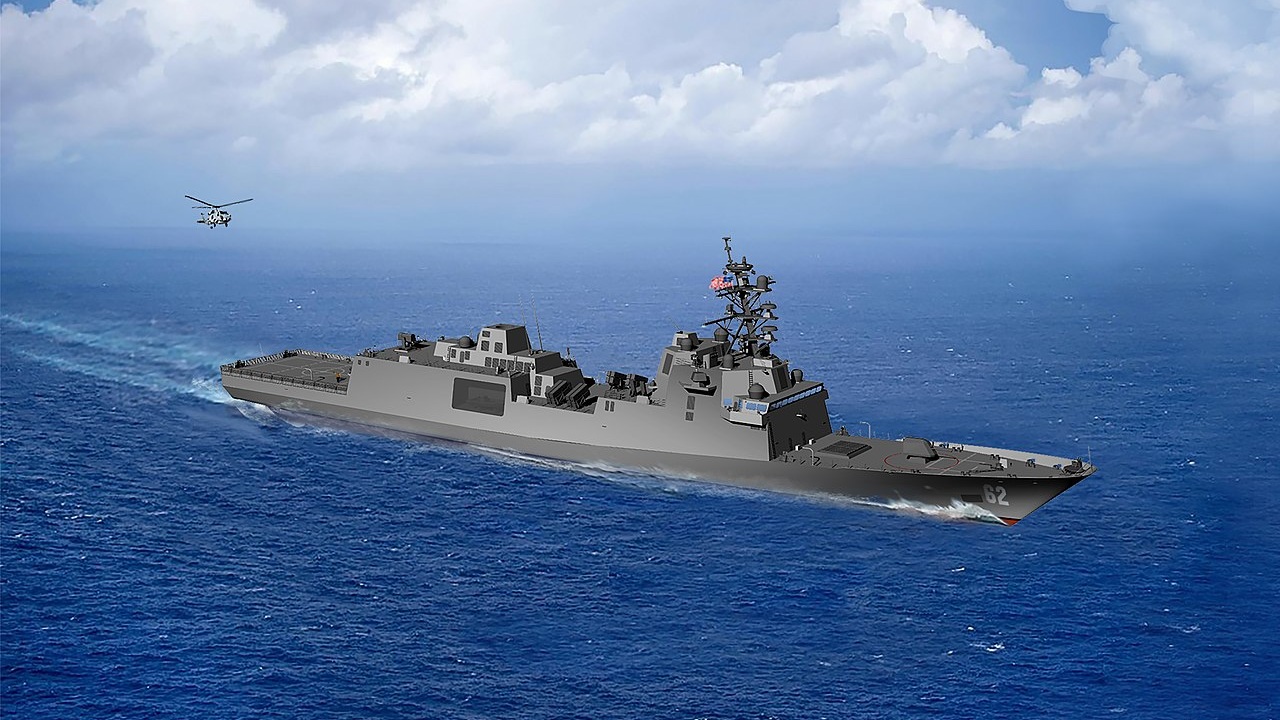
The Constellation-class frigate will now go the same way as the Zumwalt-class destroyer and the Littoral Combat Ship—expensive programs canceled well before their time, at great cost to the taxpayer.
The United States Navy abruptly cancelled the Constellation-class this week, citing repeated cost overruns and delays. However, the service will accept delivery of the two vessels that are currently under construction at Fincantieri Marine Group’s (FMG’s) Wisconsin shipyards.
“I won’t spend a dollar if it doesn’t strengthen readiness or our ability to win,” Navy Secretary John C. Phelan said in a post on X. “To keep that promise, we’re reshaping how we build and field the Fleet, working with industry to deliver warfighting advantage, beginning with a strategic shift away from the Constellation-class frigate program.”
The Constellation-Class Frigate’s (Projected) Specifications
- Year Introduced: Not yet introduced (commissioning expected circa 2029)
- Number Built: 0 (2 under construction; 20 planned, 18 canceled)
- Length: 496 ft (151.2 m)
- Beam (Width): 65 ft (19.8 m)
- Displacement: 7,291 tons, fully loaded
- Engines: Combined diesel-electric / gas (CODLAG) propulsion; one General Electric LM2500+G4 gas turbine, two electric propulsion motors, four diesel generators, two fixed-pitch propellers, one auxiliary propulsion unit
- Top Speed: ~26 knots (30 mph, 48 km/h)
- Range: 6,000 nmi (6,900 mi, 11,000 km)
- Armaments:
- 32 Mark 41 VLS cells
- Planned RIM-66 Standard SM-2 Block 3C missile launcher
- 16 canister-launched over-the-horizon anti-ship weapons (likely Naval Strike Missile)
- RIM-116 Rolling Airframe Missile launched from Mk 49 Guided Missile Launching System (21 cell)
- Mk 110 57mm gun
- Various machine guns (M240, M2)
- Crew: 200 (24 officers, 176 crew)
The Latest “Hole in the Water” for the US Navy
Displacing approximately 7,200 tons, the Constellation-class frigate was developed to replace the aging Oliver Hazard Perry-class frigate. Each would be smaller than the 10,000-ton Arleigh Burke-class guided-missile destroyers, which now are seen as the “backbone of the US fleet,” and the 3,500-ton littoral combat ships (LCS).
The US Navy retired its last Oliver Hazard Perry-class frigate, the USS Simpson (FFG-56), in September 2015.
Between the retirement of the older frigates and the LCS program’s failure to meet its planned goals, the US Navy faced a gap that the new frigates were meant to fill.
Italian shipbuilder Fincantieri was awarded the contract for the Constellation-class frigates in 2020, whereby the warships would be built at its Marinette Marine subsidiary in Wisconsin. The vessels were based on the Franco-Italian designed Frégate Européenne Multi-Mission/Fregata Europea Multi-Missione (FREMM). Those multi-purpose frigates are in service with the navies of France and Italy, designated as the Aquitaine class and Bergamini class, respectively.
The United States Navy selected the FREMM as the basis for the Constellation-class frigates, viewing it as a quick, low-risk adaptation. Instead, the program office overseeing the design opted to alter about 85 percent of the vessel. That includes a significant lengthening of the ship and major changes to its internal arrangements. Even worse, as noted, the design is incomplete.
Last year, the US Navy confirmed that the program was running up to 36 months behind schedule. The lead vessel was initially scheduled for delivery in April 2026, but in November 2024, it was announced that the USS Constellation wouldn’t be handed over until sometime in 2029.
The Government Accountability Office (GAO) had warned earlier this year that recent design changes had resulted in the warships being up to 13 percent heavier than expected, negatively affecting the frigates’ top speed. The changes could also affect what systems can be outfitted on the warship.
“As a result of these changes, in part, the frigate now bears little resemblance to the parent design that the Navy touted as a built-in, risk reduction measure for the program in 2020,” the report stated. “Now, in 2025, the ongoing redesign has driven weight growth at levels that exceed available tolerances. Already the Navy is considering a reduction in the frigate’s speed requirement as one potential way, among others, to resolve this weight growth.”
Critics have warned that the frigates are equally ill-suited for a major conflict with China or to confront regional powers like the Houthis.
“Just another in the string of bad government shipbuilding programs,” naval analyst Sal Mercogliano, a professor at Campbell University in North Carolina, told CNN.
Two Constellation-Class Frigates Will Be Completed
The US Navy—which had previously stated that it would need at least an additional 73 small surface combatants—is now in the “midst of a fleet design review that will shape how the service will develop new systems,” USNI News reported.
The fleet’s composition is unclear, but it will include two Constellation-class frigates. The Navy has said it will accept the ships now under construction, in part to keep operations running at Marinette Marine’s shipyard on Lake Michigan.
According to reports, the lead vessel is roughly 12 percent complete. Moving forward with the first two frigates will ensure that Marinette Marine’s 3,000 workers will remain on the job, keeping the shipyard open and allowing it to compete for future government contracts as they become available.
“The path forward defined on the Constellation-class program provides for the necessary stability for our teams and the entire Wisconsin System of Yards, allowing us to continue investing in innovation and skills,” said George Moutafis, CEO of Fincantieri Marine Group.
Marinette Marine has also built the Freedom-class LCS for the US Navy, with the final ship, the USS Cleveland (LCS-31), now in the final stages of construction. That warship suffered “limited” damage during its sideways launch after crashing into a tugboat. Repairs were completed, and commissioning is expected for spring 2026 in Cleveland, Ohio.
The LCS program suffered from practically legendary problems, including warships that routinely broke down and were inadequate for modern combat operations. The US Navy was only able to find a role for the Independence-class LCS variants by equipping the vessels with the Mine Countermeasures (MCM) Mission Package (MP).
However, the US Navy has a poor track record in determining what warships it needs for the 21st century. The failure of the Constellation-class follows the LCS program and the Zumwalt-class destroyers. Much like the new frigates, the US Navy was forced to scale back to just a handful of ships (three) after it was determined the ships were wrong for the slated mission.
History has repeated itself—and once again, the US Navy is left without a clear course.
About the Author: Peter Suciu
Peter Suciu has contributed over 3,200 published pieces to more than four dozen magazines and websites over a 30-year career in journalism. He regularly writes about military hardware, firearms history, cybersecurity, politics, and international affairs. Peter is also a contributing writer for Forbes and Clearance Jobs. He is based in Michigan. You can follow him on Twitter: @PeterSuciu. You can email the author: [email protected].
Image: Wikimedia Commons.
















_artist_rendering,_30_April_2020_(200430-N-NO101-150).JPG)