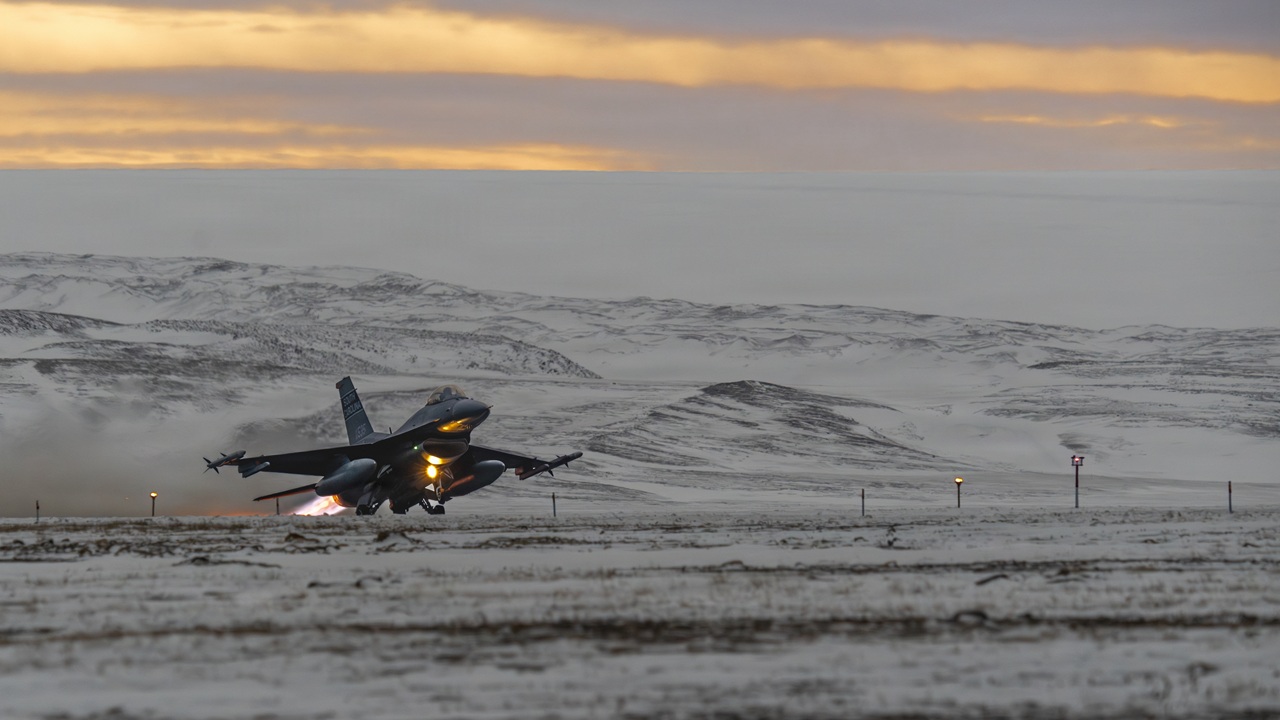
At its height, the United States operated 50 military installations in Greenland—and once had fantastical plans for an elaborate nuclear missile network underneath its ice.
Around 75 percent of Americans oppose the United States taking control of the semi-autonomous island of Greenland, according to a CNN report, even as President Donald Trump repeats the claim that it is needed for US security. In response to fears that Trump might try to annex the Danish territory by force, troops from several European countries have been deployed to Greenland—though there is little chance that they could prevent an outright military seizure of the island if Trump commanded it.
A far more practical block to Trump’s ambitions is likely to come from Congress, where there is bipartisan opposition to any effort to seize the territory—with some lawmakers suggesting Trump could face impeachment if he moves forward with his plans. Trump’s nearly-unprecedented political comeback could crash and burn over his ambitions for Greenland.
One fact lost in the cacophony surrounding Greenland is that Trump’s reasons for seizing the island are entirely moot. As previously reported, the US has tried to buy Greenland, but a 1951 treaty gave it the right to build and operate military bases there. If Trump wished to station additional troops on the island in order to prevent Russian or Chinese influence, he could do so almost immediately. Indeed, during the Cold War, the US military had a far larger presence in Greenland. If the issue of security is really what is behind Trump’s obsession with Greenland, he would be ordering the Department of Defense (DoD) to reopen the closed military bases there!
The US Military’s Long History in Greenland
During World War II, Denmark infamously didn’t put up much of a fight when Germany invaded on April 9, 1940. Danish military resistance to the Nazis lasted only around six hours, a point that supporters of Trump’s plan have mockingly noted on social media.
There are several differences between what happened nearly 86 years ago and today, of course. Denmark had remained neutral in World War I, and expected the same would hold when World War II broke out. It had previously signed a non-aggression pact with Germany—and was therefore understandably caught off-guard when Nazi forces rolled across the border without warning. In the modern era, Denmark is a member of NATO and is surrounded by allies, making another such invasion highly unlikely.
In World War II, the United States gained access to Greenland because of Germany’s occupation of Denmark. That included establishing air bases. During the war, the United States constructed 13 Army bases and four Navy bases on the island—with nearly 5,800 troops stationed there, accounting for roughly 25 percent of its population.
After the war, the Truman administration offered Denmark $100 million in gold (approximately $1.6 billion in 2026 dollars) in exchange for Greenland, which it rejected. The United States had previously obtained the Danish West Indies, now the US Virgin Islands, through a similar payment, so there is some precedent in Copenhagen showing willingness to sell territory.
Denmark was among the original 12 nations that formed the North Atlantic Treaty Organization (NATO), which, through Article 5, maintains that an attack on one is an attack on all. Washington and Copenhagen carefully considered the strategic importance.
“The 1951 Defense of Greenland agreement granted the US the right to expand its military presence in Greenland far beyond World War II levels,” History.com said.
The US Military Once Had Crazy Plans for Greenland
During the Cold War, there were more than 50 US military installations, including radar and communication sites, in northern Greenland. At its height, the island was manned by more than 10,000 US military personnel—an enormous proportion of the island’s comparatively small population. The largest US facility on the island was Thule Air Base—still in operation as Pituffik Space Base.
As History.com also noted, the US wasn’t going to take no for an answer, and planned to build the base even if Denmark disagreed. Copenhagen recognized this, and was willing to offer generous terms as a result.
“Denmark did not have much bargaining power in the negotiations over the future security of Greenland,” History.com added. “NATO’s ‘mutual defense’ orders were clear, and the US was the only country with the military resources to provide defense for the island.”
Trump is taking an even stronger position than the US had in 1951, but because of that former push, it does mean that Trump’s arguments look incredibly weak. “The US got everything it needed” at the time to build the base, and to expand its footprint as it saw fit, which it did. That included the construction of Camp Century, which was operated from 1959 to 1967. The underground base was powered by a nuclear reactor and served as a testament for “Project Iceworm,” which determined if the US Army could build a network of mobile nuclear missile launch sites under the Greenland ice sheet.
The US Army considered building hundreds of miles of rail lines under the ice, but the project was too ambitious. The troops fought a literal “cold war” against the ice and snow, which made tunnel construction impractical. The US military abandoned Camp Century and left behind tons of waste now buried just 30 meters (100 feet) below the ice sheet. There are fears that as the climate warms, the waste, which includes millions of gallons of frozen sewage, could resurface. Even more toxic materials, including asbestos-covered pipes and lead paint, might be unsealed as well.
Pituffik Space Base is the only US facility still in operation on Greenland, with the others from World War II and the Cold War shuttered. The remaining base is now focused on space surveillance and missile warning for NORAD.
Trump’s Pursuit of Greenland Is Absurd in the Modern Era
As has been widely observed during the discussion of Greenland annexation, the United States doesn’t really need Greenland to ensure its security.
Trump’s claim that if the United States did not take Greenland, Russia or China would is nonsensical. The island is a Danish territory and is already part of NATO, and an attack on it would be an attack on all alliance nations. And the 1951 treaty allows the United States military to do nearly anything it wants on the island.
Finally, Russia is already closer to Alaska than to Greenland—and China is so far away from the frozen territory that it is simply ridiculous to suggest that Beijing would move on it.
About the Author: Peter Suciu
Peter Suciu has contributed over 3,200 published pieces to more than four dozen magazines and websites over a 30-year career in journalism. He regularly writes about military hardware, firearms history, cybersecurity, politics, and international affairs. Peter is also a contributing writer for Forbes and Clearance Jobs. He is based in Michigan. You can follow him on Twitter: @PeterSuciu. You can email the author: [email protected].
Image: Shutterstock / wz94.