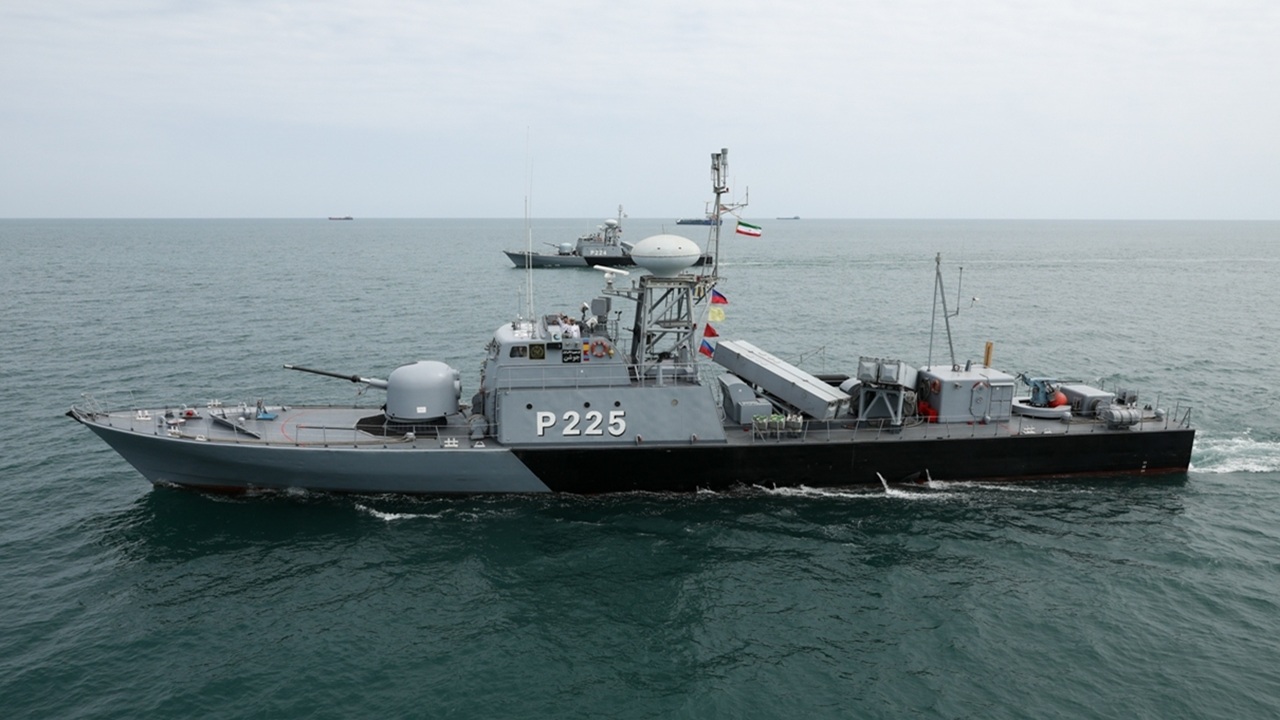
Iran does not need to secure the Strait of Hormuz. It only needs to make sure that no one else can, either.
Operation Epic Fury has led to the near-total destruction of Iran’s conventional navy. Dozens of its ships now lie at the bottom of the Persian Gulf, and those that remain are largely hidden in secluded bases along the coastline, with minimal ability to challenge the US Navy in any open confrontation.
Despite the sorry condition of its naval forces, however, Iran still maintains selective control of the Strait of Hormuz—resulting in 80 to 90 percent of the traffic being halted. How? Not through naval dominance, but rather through asymmetric disruption, which Iran uses to make travel through the Strait too dangerous to risk.
Iran Doesn’t Need to Close the Strait to Cut Off Shipping
Iran’s strategy is not to implement a total blockade of the Strait of Hormuz. Instead, it raises the risks and costs of passage, encouraging most to simply stay away. Through a combination of cheap weapons, geography, and cultivated uncertainty, Iran is able to achieve sufficient disruption to functionally close the strait.
Iran is aided in its efforts by the structure of the shipping business. Most seaborne commerce—particularly in hydrocarbons, the Gulf’s main export—takes place on enormous tankers, which often cost upwards of $100 million, not including the value of their cargo. These tankers are built to survive heavy seas, but are not military vessels and have virtually no defenses against missile and drone attacks. Given the vast cost involved in losing a tanker, no party involved is willing to take the risk of running the blockade. Indeed, seaborne insurance companies will often charge extremely high insurance rates—or refuse insurance altogether— to tankers traveling through the strait, giving shipping companies a strong incentive to avoid doing so.
Though the Trump administration has floated the possibility of using US Navy vessels to help protect ships while passing through Hormuz—an approach tried in the Red Sea by the Biden administration during “Operation Prosperity Guardian,” the post-October 7 fight against the Houthi rebels in Yemen—the risk remains high, and most tanker companies will simply refuse to transit altogether, despite the offer of protection.
How Iran Can Punch Above Its Weight in the Persian Gulf
Naval Mines: One of the primary asymmetric tools that Iran uses to strike at civilian shipping is naval mines. Iran is thought to possess an inventory of 3,000 to 4,000 mines, including contact, acoustic, and influence-triggered types. These mines are hard to detect and harder to clear, giving them a massive disproportionate value for Iran. Moreover, the mines can be deployed from fishing boats and civilian dhows, bypassing the need for a conventional navy. These vessels are extraordinarily hard to target; the last thing the US Navy wants is to blow up a civilian fishing vessel, creating instant anti-American propaganda.
Fast Attack Craft: For less deniable attacks, Iran has hundreds of fast-attack craft and explosive USVs accustomed to operating in tandem in “swarm” attacks. The concept here is to saturate the defenses of larger ships.
Submarines: Iran also deploys midget submarines, like the Ghadir class, that are quiet and optimized for use in shallow water. Through this collection of small, dispersed platforms, Iran is able to defeat large and expensive systems.
Missiles: In addition to mines, swarm tactics, and midget submarines, Iran has a vast arsenal of land-based anti-ship cruise missiles (ASCMs). Iran’s 1,000 miles of Persian Gulf coastline offers it a significant geographic advantage, particularly around the 21-mile-wide strait. Along the coastline, Iran can hide missile launch platforms in mountains and underground “missile cities,” fire them, then quickly relocate before the United States can retaliate.
Drones: Shahed-type drones are launched from deeper inland, giving Iran an autonomous layer for controlling the strait. Through missiles and drones, the coastline becomes an asset for area denial that more than compensates for the lack of a conventional navy.
Lots of Cheap Weapons Can Outperform a Few Great Ones
This relatively low-tech approach works because much of the tech is hard to detect. The launchers are mobile and many of the mine-laying ships look like civilian crafts. Saturation tactics also facilitate the low-tech approach; multiple threats are presented simultaneously—mines, missiles, and drones—which work in concert to deny access.
Ultimately, the strait is vulnerable because it is just extraordinarily narrow. Firepower can be concentrated in a narrow shipping lane that offers only limited room to maneuver; the geography itself amplifies small threats. As the US is learning, air dominance doesn’t equal maritime control. Clearing the strait is a slow and resource-intensive procedure that the Trump administration may not have the patience for.
The implications of Iran’s continued control are significant; 20 percent of global oil flow is affected and energy markets are destabilized. Control is maintained through denial and risk manipulation rather than physical presence—a lesson that China will likely heed as it constructs its own A2/AD system in the Indo-Pacific. While Iran’s navy may be broken, the country’s maritime strategy remains intact and effective.
About the Author: Harrison Kass
Harrison Kass is a writer and attorney focused on national security, technology, and political culture. His work has appeared in City Journal, The Hill, Quillette, The Spectator, and The Cipher Brief. He holds a JD from the University of Oregon and a master’s in Global & Joint Program Studies from NYU. More at harrisonkass.com.