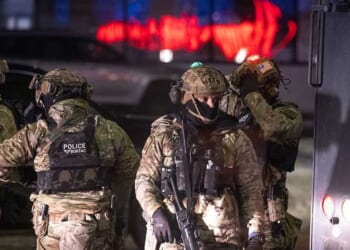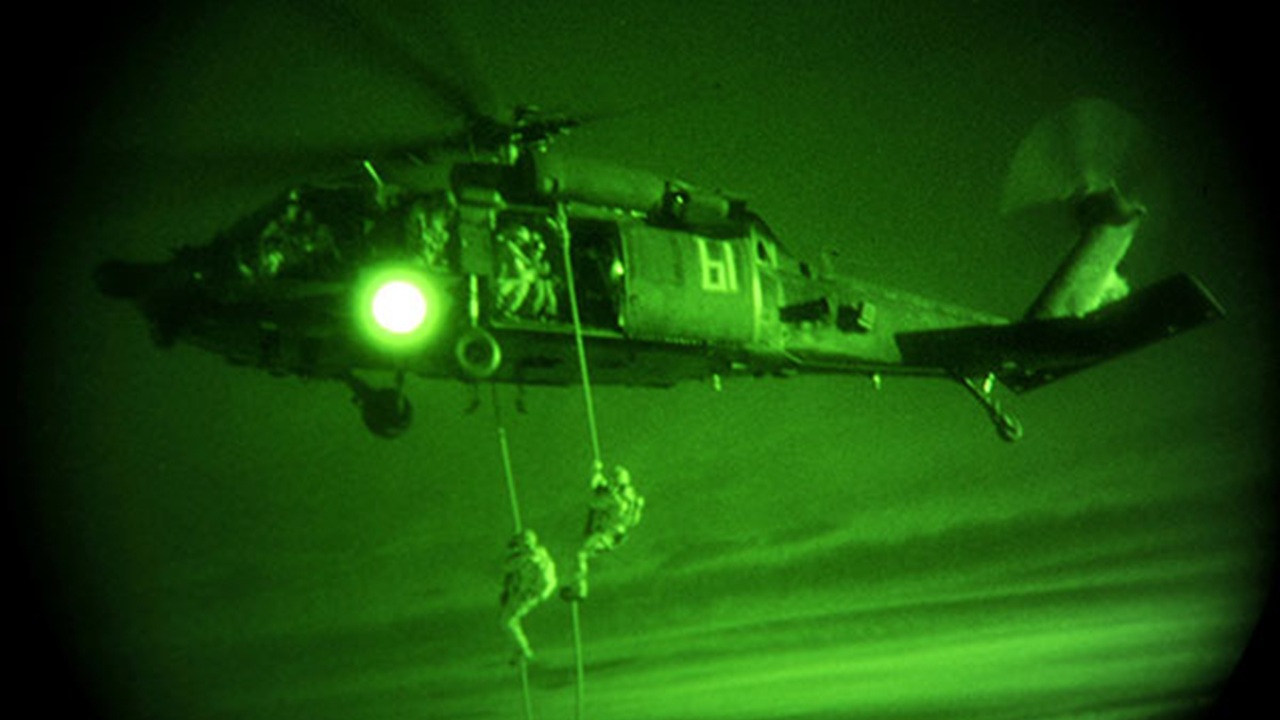
Delta Force is one of the US Army’s most elite units—a team used for high-profile insertion missions, most often at night.
The US Army’s Delta Force was integral to the recent extraction of Venezuelan dictator Nicolas Maduro from power. The US military’s premier counterterrorism and hostage rescue unit, the Delta Force was the ideal choice to spearhead the operation into Caracas.
What Is the Delta Force?
Formally known as the 1st Special Forces Operational Detachment-Delta, Delta Force operates under the US Army and Joint Special Operations Command (JSOC). Like the more widely known SEAL Team Six, Delta Force is a Tier 1 Special Mission Unit.
Other Tier 1 Special Mission Units include:
- The US Air Force’s 24th Special Tactics Squadron
- The US Army’s Intelligence Support Activity (ISA)
- The US Army Rangers’ Regimental Reconnaissance Company
Tier 1 Special Mission Units are the most elite of the elite special forces units. These units’ missions are rarely acknowledged publicly, and often remain classified for decades.
Delta core missions are counterterrorism, hostage rescue, and as the Maduro operation demonstrated, high-value target capture/kill. Secondary roles include direct action, special reconnaissance, and sensitive site exploitation.
Delta units are not designed for large-scale raids or prolonged combat, instead being optimized for short-duration, high-risk, and politically sensitive missions. Delta is often deployed where failure is unacceptable and deniability is ideal.
The History of Delta Force
Delta Force was the brainchild of Col. Charles Beckwith, a US Army officer who had seen the need for an elite direct action unit during his service with various special forces units in Vietnam. Beckwith’s recommendations were not initially acted on.
In 1977, the Pentagon formally established Delta, with Beckwith and Col. Thomas M. Henry as its first commanders. The unit was modeled partly on the British Special Air Service (SAS), a similar elite commando unit with a distinguished service history. The Pentagon established the unit in response to rising international terrorism—and particularly the Munich massacre at the Olympic Games in 1972, which German special forces units had been ill-equipped to handle.
Delta’s ambitious beginnings were overshadowed by the prominent failure of Operation Eagle Claw, a 1980 mission to rescue American hostages from the seized US embassy in Tehran. The failure of that mission led to substantial reforms and the creation of JSOC. Delta would mature after the reforms and engage in valuable service during the War on Terror, which included two decades of continuous combat operations.
Structurally, Delta is small and elite. The exact size is classified, but estimates hold that only a few hundred operators are involved.
What Hardware Does Delta Use?
Delta uses highly customized rifles and carbines. Suppressors are standard, and optics are prioritized over larger calibers.
Night fighting is integral to Delta’s operations. The unit’s soldiers are outfitted with advanced night vision and thermal imaging equipment. For mobility, Delta often relies on the 160th Special Operations Aviation Regiment, who flies the MH-60 and MH-47 helicopters, or ground vehicles that have been modified for urban and desert use. Delta is also outfitted with a variety of breaching tools, including explosive, mechanical, and ballistic options. In sum, the technological emphasis is on reliability, integration, and speed.
Delta missions are time-sensitive and intelligence-driven—as seen in the removal of Nicolas Maduro. The typical operational pattern includes ISR and target development, with rapid insertion leading to a violent but controlled action, with an immediate extraction. Delta typically operates at night with overwhelming surprise, often alongside CIA or other JSOC units. The focus is on precision and a minimal footprint, with strategic effects that are disproportionate to size.
Why Delta Force Matters
Strategically, Delta offers US leadership a surgical option short of conventional war, which enables counterterrorism without invasion and action in denied or sensitive environments. Delta has deterrent value, too; adversaries know that the unit exists, even if its precise specifications are classified.
In short, Delta Force is not about spectacle, but speed and precision. Delta is a relatively restrained option with relevance that endures with the demand for discreet force. The central use of Delta during the Maduro extraction shows that US leaders still value the abilities Delta offers. And after two decades of refinement through perpetual war, Delta is sharper now than ever, a condition the success of the Maduro extraction suggests.
About the Author: Harrison Kass
Harrison Kass is a senior defense and national security writer at The National Interest. Kass is an attorney and former political candidate who joined the US Air Force as a pilot trainee before being medically discharged. He focuses on military strategy, aerospace, and global security affairs. He holds a JD from the University of Oregon and a master’s in Global Journalism and International Relations from NYU.
Image: Wikimedia Commons.