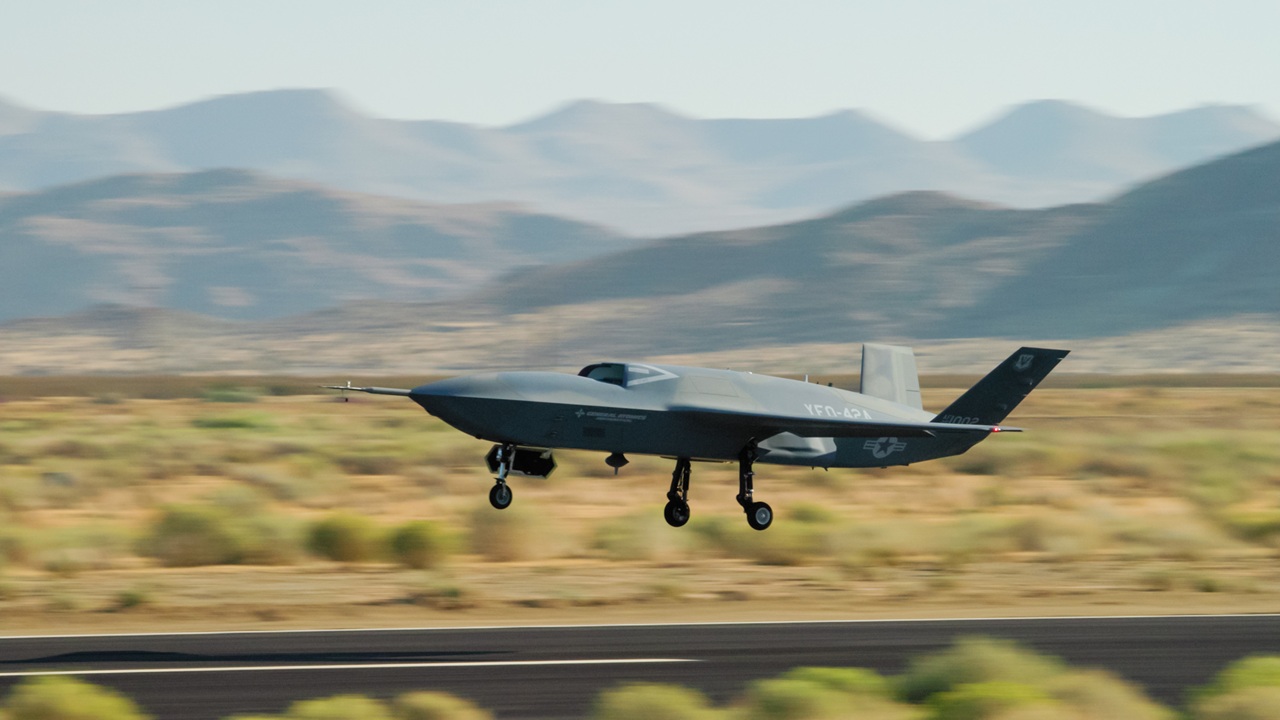
The Air Force’s YFQ-42A and YFQ-44 Collaborative Combat Aircraft drones are now being mounted with missiles for aerial flight tests. The weapons are inert—for now.
The United States Air Force announced this week that its program to develop a so-called “Loyal Wingmen” for manned fifth-generation and sixth-generation fighter aircraft has made progress and “entered the next phase of developmental testing.” It was just last summer that one of the prototype Collaborative Combat Aircraft (CCA) now under development took its maiden flight.
The air service explained that the CCA platforms have reached a new milestone, beginning “disciplined weapons integration and captive carry evaluations using inert test munitions to validate airworthiness, safety, and systems performance.”
The captive carry testing was conducted with inert weapons, which allowed for an evaluation of the unmanned aircraft’s ability to “carry external stores.” It further validates the structural integrity and aerodynamic performance of the unmanned aerial system (UAS). The testing further ensured compatibility between the CCA and the weapons systems it may carry before live ordnance is employed in future testing.
“We are following the same detailed approach used in every other aircraft developmental test program to validate structural performance, flight characteristics and safe separation,” explained Air Force Chief of Staff Gen. Ken Wilsbach. “This ensures the CCA can safely integrate inert weapons before future employment.”
The current testing remains focused on “safe system integration” rather than operational employment.” This will allow engineers and pilots to study and evaluate the aircraft’s performance before live ordnance is tested.
Training the “Collaborative Combat Aircraft”
The CCA took its proverbial flight in 2015 at the Defense Advanced Research Projects Agency (DARPA), as a key component of the US Air Force’s Next Generation Air Dominance (NGAD) program. Unmanned systems are being developed to extend the operational reach, increase the lethality of manned aircraft in contested environments, and enhance their survivability.
In 2024, Andurl’s Fury and General Atomics Aeronautical Systems’ (GA-ASI’s) “Gambit” each passed the critical design review, just months after both were awarded contracts to develop CCA prototypes. The designs from the two firms passed the critical design review (CDR) stage, clearing the way for the two companies to move to the production phase within Increment 1.
In March 2025, Fury and Gambit received the designations YFQ-44A and YFQ-42A, respectively. The YFQ-42A began its flight testing in August 2025, with the YFQ-44A following last fall, but both were delayed by the lengthy government shutdown. Each unmanned aircraft had previously completed ground testing.
Although the Air Force’s eventual goal is to have an autonomous aircraft that supports the manned fighter, during the development and testing, a human pilot will retain “authority” over any weapons release.”
This is to address concerns of armed autonomous systems, something that many tech leaders have spoken out against in recent years.
“CCA is designed to operate within established command structures and legal frameworks that govern all Air Force weapons systems,” the Air Force noted.
CCA Drones Are a Force Multiplier for Manned Aircraft
The Air Force’s timeline had called for a production contract to be awarded during fiscal year 2026 (FY26), which began on October 1, 2025, and for the CCA to enter service by 2030.
“The CCA program is designed to deliver affordable, risk-tolerant aircraft that operate as part of a human-machine team, extending the reach, survivability, and effectiveness of crewed platforms in contested environments,” the Air Force also explained.
The US Air Force has called for upwards of 2,000 CCA, which will be paired with the manned fighters in the coming decade. The service will initially order around 100 to 150 CCAs in the first 6 increments, but additional aircraft could be developed, with as many as nine vendors competing for Increment 2.
Each of these loyal wingmen drones could cost between $25 to $30 million; roughly one-third the cost of a manned fighter. These would serve as force multipliers, taking on duties that enhance the manned fighter and even keep it out of harm’s way as much as possible.
“CCA is a critical part of a larger, integrated system-of-systems that will give our warfighters the overwhelming advantage,” Wilsbach added. “This program is about delivering a network of effects that will sense, strike, and shield our forces in contested environments. We are empowering our teams to take smart risks and deliver this capability faster, ensuring we can deter and, if necessary, defeat any adversary.”
About the Author: Peter Suciu
Peter Suciu has contributed over 3,200 published pieces to more than four dozen magazines and websites over a 30-year career in journalism. He regularly writes about military hardware, firearms history, cybersecurity, politics, and international affairs. Peter is also a contributing writer for Forbes and Clearance Jobs. He is based in Michigan. You can follow him on Twitter: @PeterSuciu. You can email the author: [email protected].