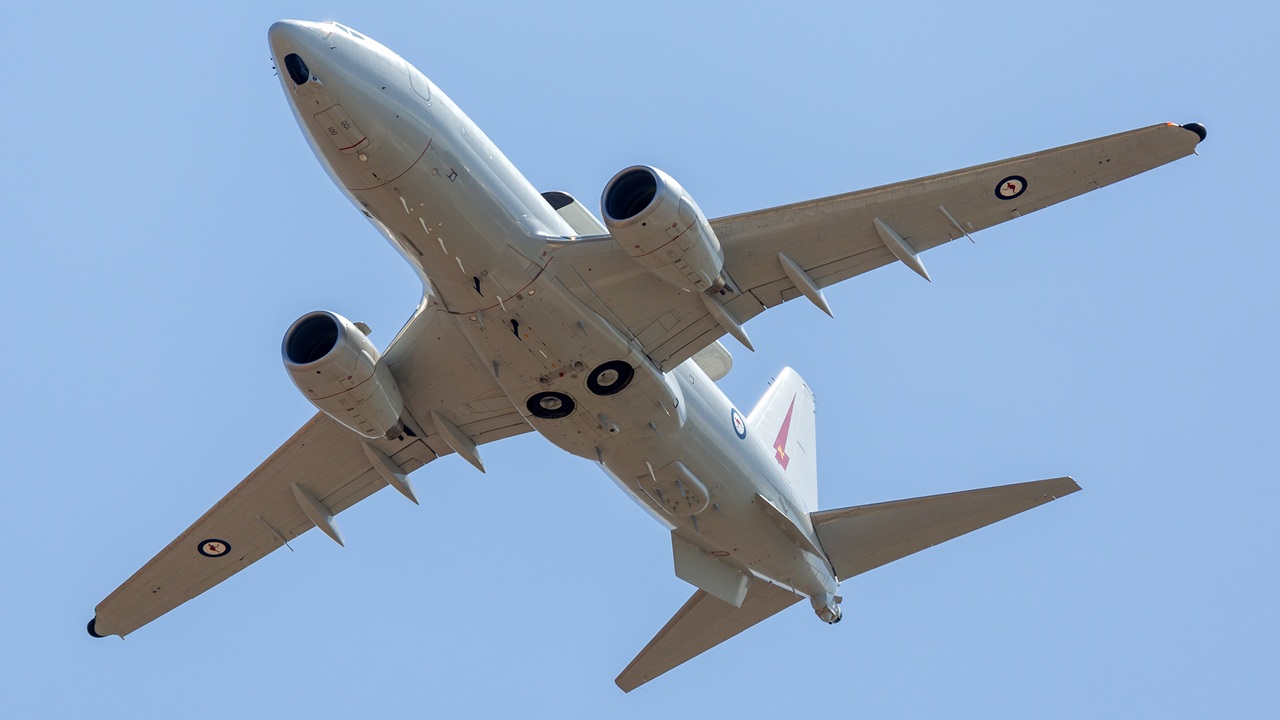
Secretary of Defense Pete Hegseth has repeatedly criticized the E-7 Wedgetail AWACS plane, claiming it is “not survivable in the modern battlefield.” Congress feels otherwise.
US lawmakers have officially stepped in and blocked the Air Force’s plan to cancel the E-7 Wedgetail program.
The Pentagon had put the advanced airborne early warning aircraft on the chopping block due to significant delays and rising costs. But Congress disagreed—and has preserved interim funding for the E-7 Wedgetail.
About the E-7 Wedgetail
- Year Introduced: 2009 (Royal Australian Air Force service)
- Number Built: ~14 delivered worldwide; >25 planned for the U.S. Air Force and other allies
- Length: 110 ft 4 in (33.6 m)
- Wingspan: 117 ft 5 in (35.8 m)
- Weight (MTOW): 171,000 lb (77,565 kg)
- Engines: Two CFM International CFM56-7B27A turbofans (~27,000 lbf thrust each)
- Top Speed: ~530 mph (460 knots, 850 km/h)
- Range: >3,500 nautical miles (~6,500 km); ~10 hours’ endurance (unrefueled)
- Service Ceiling: 41,000 ft (12,500 m)
- Loadout: No offensive weapons; Northrop Grumman Multi-role Electronically Scanned Array (MESA) radar—top-mounted “top hat” antenna, 360° coverage, multi-target tracking at ranges >200 nautical miles; IFF system, ESM suite, data links (LINK 16 and beyond), secure communications and battle-management consoles
- Crew: 2 (flight) + 10–12 mission operators (typical)
Why the Air Force Doesn’t Think It Needs the Wedgetail
The E-7 Wedgetail is an Airborne Warning and Control System (AWACS) aircraft. Its role on the battlefield is to be the eyes and ears of friendly aircraft and other assets, and provide early warning of incoming threats and direct assets to targets.
Due to repetitive delays and rising costs, the Air Force decided to cut the program in favor of an alternative airborne surveillance option, including space-based capabilities.
However, Congress has ensured that the program gets over $1 billion in funding in the next defense budget.
“The agreement emphasizes the importance of the E-7 Wedgetail platform and the airborne early warning and battle management mission for the Department of the Air Force. Therefore, $1,100,000,000 is included in Research, Development, Test and Evaluation, Air Force for fiscal year 2026 to continue E-7 rapid prototyping activities and transition to engineering and manufacturing development aircraft,” according to a Joint Explanatory Statement report the Senate Appropriations Committee released.
Built on the Boeing 737 NG platform, the E-7 Wedgetail is intended to replace the venerable E-3 Sentry, which has provided early airborne warning capabilities to the US military for decades.
The Air Force now has 90 days after the budget is passed to inform the congressional defense committees about the ongoing actions to streamline requirements and control costs for the E-7.
The E-7 Wedgetail can pair up with unmanned aerial systems to broaden its capabilities. For example, in recent tests, the Royal Australian Air Force paired the MQ-28 Ghost Bat unmanned aerial system with an E-7A Wedgetail as part of the loyal wingman concept. Under the concept, drones will share data with the E-7, thereby allowing the aircraft to cover a larger part of the battlefield.
“The agreement bolsters the E-7 Wedgetail aircraft program and includes a new general provision that prohibits the use of funds to pause, cancel, or terminate the E- 7,” the Joint Explanatory Statement added.
The E-7’s Long, Strange Procurement Saga
The acquisition process for the E-7 has gone through several steps.
In 2022, the Air Force announced that it was going to procure the E-7 in order to replace the aging E-3 Sentry. In 2023, the service awarded Boeing an initial contract worth $1.2 billion for the development of two new E-7 variants specifically tailored to the needs of the Air Force. The plan was to eventually procure as many as 26 aircraft with the first E-7 entering US service in 2027.
However, last June, the Air Force signaled its intention to cancel the program. During Congressional testimony, Secretary of Defense Pete Hegseth claimed that the early warning aircraft was an example of “systems and platforms that are not survivable in the modern battlefield, or they don’t give us an advantage in a future fight.” Later in 2025, the Pentagon made the decision to cut the E-7 from the next budget.
However, Congressional intervention seems to be saving the aircraft once again.
About the Author: Stavros Atlamazoglou
Stavros Atlamazoglou is a seasoned defense journalist specializing in special operations and a Hellenic Army veteran (national service with the 575th Marine Battalion and Army HQ). He holds a BA from the Johns Hopkins University and an MA from the Johns Hopkins’ School of Advanced International Studies (SAIS). His work has been featured in Business Insider, Sandboxx, and SOFREP.
Image: Shutterstock / Ryan Fletcher.