The bombers are headquartered at RAF Fairford in the western United Kingdom, roughly 3,500 miles from Iran.
The US Air Force has moved at least 21 strategic bombers to the United Kingdom as part of Operation Epic Fury against Iran.
The forward deployment of 15 B-1 Lancers and six B-52 Stratofortresses to the UK represents one of the largest deployments of strategic bombers in recent history.
Why Is America Putting So Many Bombers in the UK?
The Air Force has gathered one of the largest bomber strike forces in recent history in RAF Fairford, in southwest England, to support the ongoing strikes against Iran. Although the Air Force does not comment on aircraft movements, data available on open sources, including aircraft spotters, air traffic control communications, and flight-tracking data, reveal that these 21 strategic bombers are striking Iran from the UK.
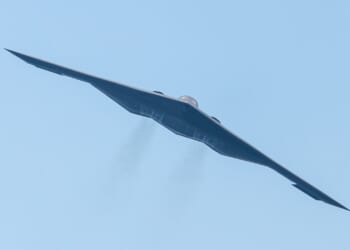
Several B-2 Spirit stealth bombers are also participating in the strikes against Iran, but these aircraft deploy from the continental United States and complete the nearly 14,000-mile round trip with every mission. In the run-up to last year’s “Operation Midnight Hammer,” several B-2s were instead based at Naval Support Facility Diego Garcia, a US-UK airbase located in the Chagos Islands roughly 2,500 miles southeast of Iran. However, since the beginning of the current conflict, the Diego Garcia base has come under Iranian missile attack—a development that may have led the US to station its bombers at a safer distance.
The UK appears to have been chosen for this reason. RAF Fairford is located roughly 3,500 miles from Tehran—close enough for the B-52 and B-1 to reach Iran with minimal aerial refueling, but well outside of range of retaliatory missiles.
The strategic bombers based in the UK are conducting precision strikes against Iran’s military and defense industrial base. Already a month into the war, the US military has destroyed over 9,000 targets in Iran.
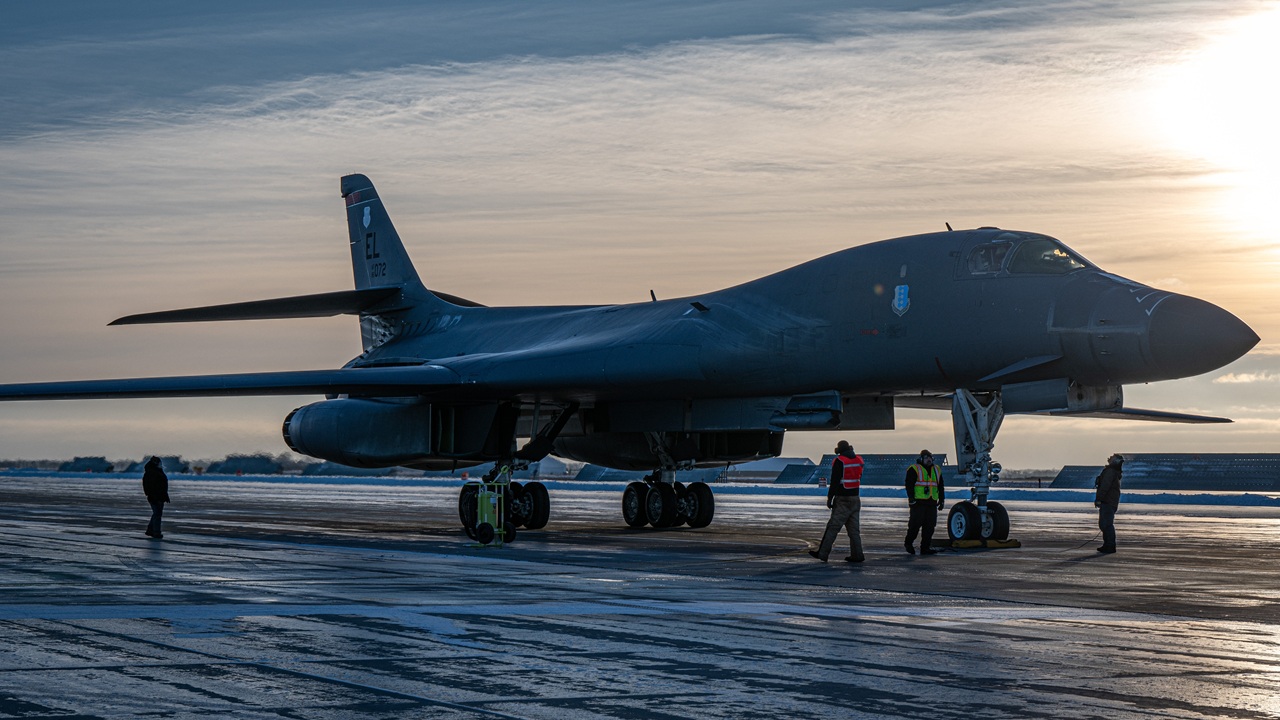
Besides being one of the largest concentrations of strategic bombers in recent history, the ongoing forward deployment in the UK represents a large portion of the active bomber forces. For example, according to some of the most recent mission capable rates, approximately 44 percent of the B-1 fleet was ready for operations. That would translate to roughly 20 aircraft. Thus, the 15 Lancers already spotted in the UK represent nearly all of the operational B-1 fleet.
The Air Force has lost around 12 B-1s over the years to training accidents and operational mishaps. The aircraft is notoriously demanding to maintain, and that poses a continuous challenge to the ground crews tasked with ensuring the Lancer fleet is ready for operations.
The B-1B Lancer’s Specifications
- Year Introduced: 1986
- Number Built: 104 (44 still in service)
- Length: ~146 ft (44.5 m)
- Wingspan: ~79 ft swept / ~137 ft extended (24 m / 41.8 m)
- Weight (MTOW): ~477,000 lbs (216,400 kg)
- Engines: 4× General Electric F101-GE-102 turbofans
- Top Speed: ~Mach 1.25 (~830 mph / ~1,335 km/h) at altitude
- Combat Radius: ~3,000 mi (4,800 km)
- Range (Unrefueled): ~7,500 mi (12,000 km)
- Service Ceiling: ~60,000 ft (18,300 m)
- Payload (Internal): ~75,000 lbs (34,000 kg), including 2,000-pound GBU-31 Joint Direct Attack Munitions (JDAM), GBU-72 Advanced 5K 5,000-pound guided bombs, and a host of other smart bombs and stand-off munitions. (B-1s used to be able to carry nuclear weapons.)
- Crew: 4
The Air Force’s “Global Strike Command” Determines Where Bombers Go
The Air Force’s Global Strike Command is responsible for the strategic bomber fleet and bomber operations around the world. Global Strike Command has a combination of conventional and stealth bombers that offer policymakers and military commanders a variety of conventional and nuclear global strike options. The Command has three aircraft in its inventory: the B-1 Lancer, B-2 Spirit, and B-52 Stratofortress. Soon, the Air Force will also have the B-21 Raider available for operations.
In total, the Global Strike Command has approximately 139 strategic bombers—44 B-1s, 76 B-52s, and 19 B-2s—on its roster, though not all are operational.
About the Author: Stavros Atlamazoglou
Stavros Atlamazoglouis a seasoned defense journalist specializing in special operationsand a Hellenic Army veteran (national service with the 575th Marine Battalion and Army HQ). He holds a BA from the Johns Hopkins University and an MA from the Johns Hopkins’ School of Advanced International Studies (SAIS). His work has been featured in Business Insider, Sandboxx, and SOFREP.