The additional Marines will give the United States the strength to carry out a number of amphibious assault missions against Iran.
The US military is expanding its deployment in the Middle East as the White House considers the option of a ground operation in Iran.
The Department of Defense ordered the 11th Marine Expeditionary Unit (11th MEU) to the field ahead of schedule.
More Marines Are on Their Way to the Persian Gulf
The Marine Corps is sending the 11th MEU from the West Coast as part of the surge in troops in the Middle East requested by the White House.
Tehran’s closure of the Strait of Hormuz, one of the most important seaways in the world with about 20 percent of the world’s oil supply sailing through every day, is causing considerable trouble in the global economy and, consequently, to the planning of Operation Epic Fury.
Nicknamed “The Pride of the Pacific,” the 11th MEU is a powerful unit that can operate independently, as well as in coordination with other forces. The Marine Corps unit will sail through the Indo-Pacific to the US Central Command’s (CENTCOM) area of responsibility.
CENTCOM, the combatant command responsible for running military operations against Iran, already requested the deployment of the 31st MEU to the region as it considers options to force open the Strait of Hormuz.
With the addition of the 11th MEU to the existing deployment, CENTCOM will have approximately 5,000 Marines with the organic assets ready to deploy.
What Is a “Marine Expeditionary Unit”?
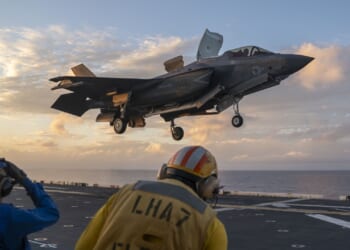
Marine expeditionary units are rapid reaction forces that can deploy relatively quickly around the world and bring considerable firepower to the equation. These units are self-sufficient and bring their own assets, including artillery, attack helicopters, transport helicopters, F-35B Lightning II stealth fighter jets, air defense units, reconnaissance assets, field hospital facilities, and mechanized infantry.
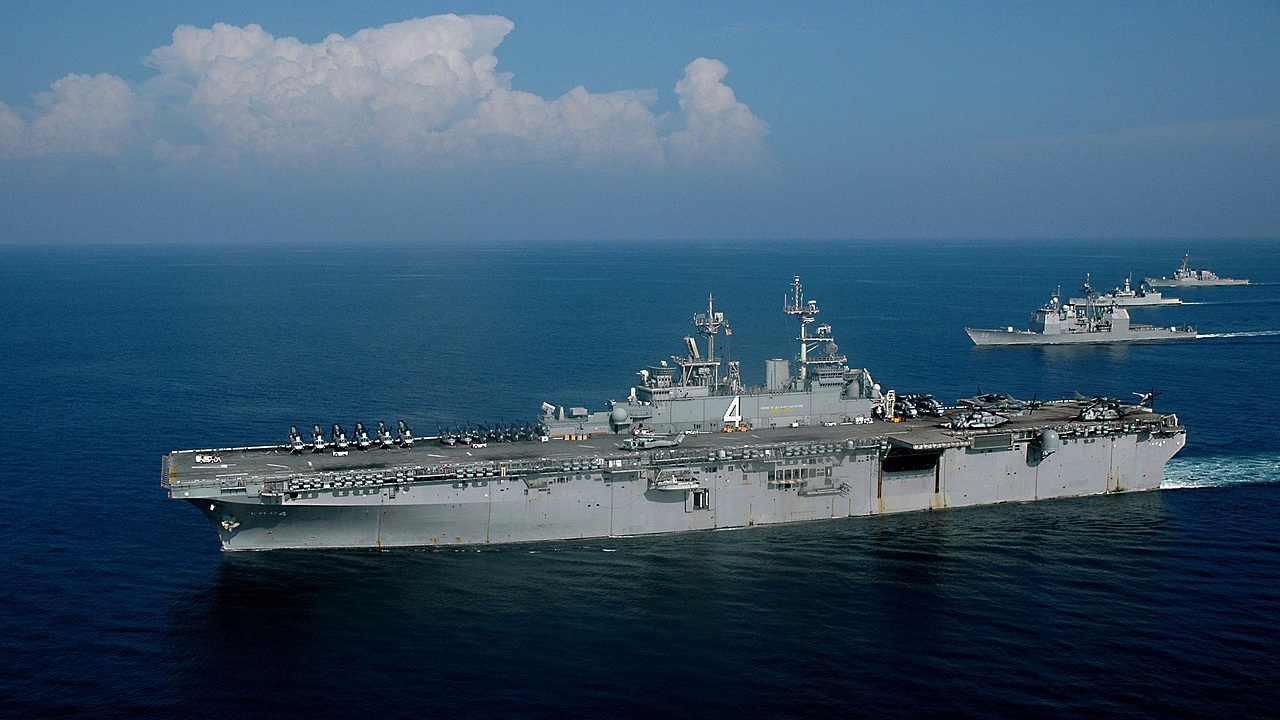
The 11th MEU sails on the USS Boxer amphibious assault ship, USS Comstock dock landing ship, and the USS Portland amphibious transport dock ship. The task force left port in Southern California last week, and will take approximately three weeks to arrive in the region.
Three Ways the Marines Could Be Used
With regard to the intended destination of the Marine rapid reaction unit, a ground operation in Iran could come in three realistic ways.
First, the unit could capture the strategic Kharg Island. Located about 16 miles off the coast of Iran, Kharg is the loading depot for Iran’s oil exports, with around 90 percent of the country’s oil passing through it. The US military had already destroyed military targets on the island, lessening local resistance to an occupation. A ground operation could secure the oil infrastructure and increase pressure on Tehran.
Second, the Marines could deploy on the southern coast of Iran and establish a physical presence to force open the Strait of Hormuz. This would be somewhat more challenging, as these areas are a part of Iran’s core territory and would be interpreted as an invasion, probably leading Iranian ground troops to counterattack.
Third, and most ambitiously, the Marines could deploy in support of a special operation to retrieve Iran’s nuclear weapons material from damaged facilities across Iran. The United States has a good understanding of where these facilities are, although many of them have been damaged—both from the ongoing war and from last year’s “Operation Midnight Hammer” round of airstrikes.
Of course, a ground operation in Iran will greatly increase the risk of more casualties. Although President Donald Trump and administration officials have not excluded the ground option, the possibility of flag-draped coffins arriving at Dover Air Force Base is a strong dissuading factor. Nevertheless, it is becoming increasingly clear that the air and naval campaign alone cannot, on their own, translate into a definite victory against Iran.
About the Author: Stavros Atlamazoglou
Stavros Atlamazoglou is a seasoned defense journalist specializing in special operations and a Hellenic Army veteran (national service with the 575th Marine Battalion and Army HQ). He holds a BA from the Johns Hopkins University and an MA from the Johns Hopkins’ School of Advanced International Studies (SAIS). His work has been featured in Business Insider, Sandboxx, and SOFREP.