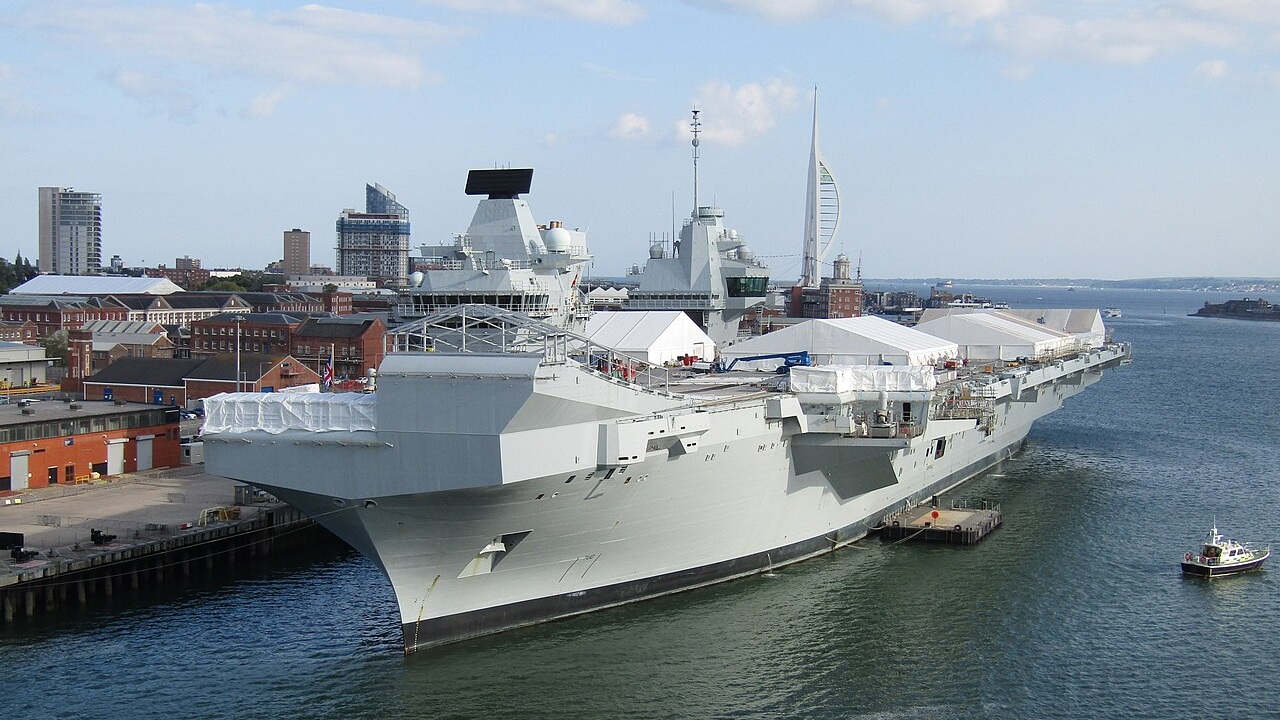
British Secretary of State for Defense Lord Coaker denied plans to install Mark 2 30mm cannons on the UK’s two aircraft carriers—but stressed that they had other countermeasures in place.
President Donald Trump recently drew incredulous headlines this week after referring to the British Royal Navy’s two Queen Elizabeth-class aircraft carriers as “toys” incapable of real combat. It is unclear if he actually knew the extent to which the Royal Navy has had difficulty installing effective weapons on them.
As the flagship HMS Queen Elizabeth was preparing for her operational deployment to the Indo-Pacific, the “30mm Automated Small Calibre Gun (ASCG) mounts … were originally specified for QEC carriers,” but “were not fitted when the ship was built,” Navy Lookout reported in 2021. At the time, it was assumed that the guns would be added during one of the Capability Insertion Periods, but they never were.
Given the threat posed by drones, cruise missiles, and other aerial threats, the question is why haven’t the weapons been installed, especially as there have been tests to use 30mm autocannons with special ordnance to counter small unmanned aerial systems (UAS), including loitering munitions and other suicide drones. The US Army has been testing “aviation proximity explosive” (APEX) rounds that can detonate near a target. Yet the Royal Navy has installed the DS30M Mark 2 30mm guns, which are already widely used across the fleet and could almost certainly fire such rounds.
Even more baffling is that, according to the UK Defence Journal, the stabilized 30mm cannon system (was) designed to counter fast attack craft and small surface threats.” It said the guns had already “adapted in some cases to engage aerial targets such as drones” when they had been installed aboard other warships.
The weapon system is remote-controlled and outfitted with an electro-optical director that allows operators to track and engage targets “without direct line-of-sight” from the mount.” It was initially developed to address swarms of fast-attack boats, but could easily be repurposed to counter aerial drones, which work according to the same principle.
However, the Mark 2 cannon isn’t installed on the largest and most vulnerable warships in the Royal Navy, and likely won’t be any time soon.
“There are no plans to fit a 30mm weapon system to HMS Queen Elizabeth or HMS Prince of Wales,” Minister of State for Defense Lord Vernon Coaker said in response to questions from Lord John Lee of Trafford last month. “The Queen Elizabeth-class carriers are equipped with a range of defensive systems, which along with escort vessels and wider force protection measures, provide a layered defensive system that is effective against a wide range of threats, including emerging uncrewed aerial threats.”
Lord Coaker’s further explanation was incorrect, or at least incomplete, on one key point. Modern carrier strike groups (CSGs) indeed include escorts such as guided-missile destroyers, intended to counter aerial threats. The US Navy’s carrier strike groups are extremely formidable, usually consisting of several destroyers and a wide array of support vessels. However, the Royal Navy lacks an adequate number of such vessels, and is currently in no shape to deploy either of its two conventionally powered flattops without foreign support.
For both of its Indo-Pacific deployments involving the carriers, NATO allies and other partners escorted the carriers.
The UK’s Aircraft Carriers Aren’t Defenseless
In lieu of the 30mm guns, the Royal Navy has been seeking to develop other means to counter drones—notably its DragonFire direct energy weapon, a laser that can strike targets up to a mile away, but that is far less than the 3.1-mile range of the Mark 2 30mm guns that could be fitted to the carriers.
About the only justification is that there had been concerns that the 30mm rounds could accidentally hit an escort, and that a 30mm high-explosive shell would penetrate the light steel of guided-missile frigates or other warships.
However, that seems like a lackluster excuse. Any weapon that is safe for friendly vessels can hardly be dangerous to unfriendly ones!
About the Author: Peter Suciu
Peter Suciu has contributed to dozens of newspapers, magazines and websites over a 30-year career in journalism. He regularly writes about military hardware, firearms history, cybersecurity, politics, and international affairs. Peter is also a contributing writer for Forbes and Clearance Jobs. He is based in Michigan. You can follow him on Twitter: @PeterSuciu. You can email the author: [email protected].