
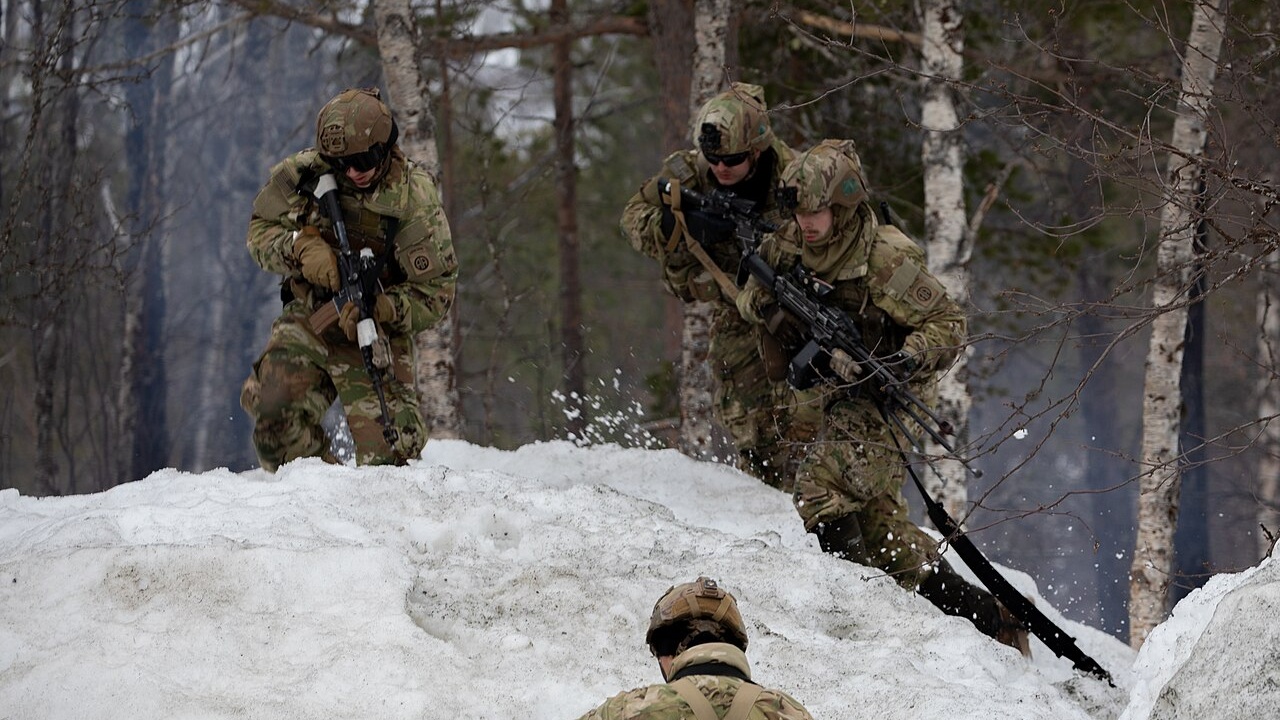
Following a new agreement between the United Kingdom and Norway, the presence of British commandos in the Arctic—formerly a periodic deployment for training exercises—will now be made permanent.
From 2026 onward, British commandos will be deployed to Russia’s far northern border with NATO year-round.
Under an agreement between Norway and the United Kingdom, Royal Marines Commandos will be stationed in the Scandinavian country all year round to train with local and allied forces, as well as deter Russian aggression in the region.
British Commandos Are Headed to Norway
In September, the UK and Norway reached a diplomatic agreement to deepen their military relationship. As part of the agreement, Norway will purchase five Type 26 frigates from the UK.
Moreover, under the agreement, the UK Commando Force will operate in Norway year-round. Up until now, Royal Marines Commandos, the premier amphibious and arctic warfare force of the British military, have deployed to Norway every winter for training and joint drills with the Norwegian military and other NATO forces. Under the terms of the new agreement, that presence will be made permanent.
“The new Lunna House agreement also further commits the UK to defending its close NATO ally and the requirement to be ready for potential combat in one of the world’s most inhospitable environments – the Norwegian Arctic,” the Royal Navy stated about the increased commitments of the Royal Marines under the agreement.
Similar to the US military, where the Marine Corps falls under the Department of the Navy, the Royal Marines Commandos fall under the Royal Navy.
“The UK Commando Force is stepping up readiness to war-fight alongside our allies in the High North,” Lieutenant Colonel Chris Armstrong, the commanding officer of 30 Commando Information Exploitation Group, said in a press release.
The Royal Marines have had a close relationship with Norway, first operating in the Scandinavian country during World War Two when they conducted commando raids and amphibious operations against the German occupation forces.
“As NATO’s cold-weather specialists, we are ruthlessly focused on mission rehearsals with our closest partners. Fusing intelligence, bold commando tactics, and cutting-edge technology – we remain poised for operations,” the Royal Marines officer added.
The Royal Marines Commandos are the UK military’s premier amphibious warfare unit. As a light infantry special operations force, the Royal Marines Commandos specialize in amphibious, mountain, and arctic warfare. In recent years, the British Ministry of Defence has reorganized and revolutionized the UK Command Force, creating a rapid reaction, special operations force that can deploy quickly to contingencies around the world and conduct amphibious operations.
The UK Is Expanding Its “Camp Viking”
The year-round deployment of British commandos in Norway will benefit from existing infrastructure.
In 2023, the Royal Marines established a forward operations base in Norway, codenamed Camp Viking. The camp is located close to the village of Øverbygd, near the border with Sweden and Finland, and about 225 miles from the Norway-Russia border. In the event of a conflict with Russia, Royal Marines stationed in Norway could use amphibious, ground, and air means to deploy quickly to the frontline.
In 2026, the Royal Marines will deploy approximately 1,500 troops to Camp Viking, as well as ground vehicles and helicopters to support the force.
The closer cooperation between the British and Norwegian armed forces is the direct result of Russia’s aggression in Ukraine.
About the Author: Stavros Atlamazoglou
Stavros Atlamazoglou is a seasoned defense journalist specializing in special operations and a Hellenic Army veteran (national service with the 575th Marine Battalion and Army HQ). He holds a BA from the Johns Hopkins University and an MA from the Johns Hopkins’ School of Advanced International Studies (SAIS). His work has been featured in Business Insider, Sandboxx, and SOFREP.
Image: Wikimedia Commons.
















.jpg)