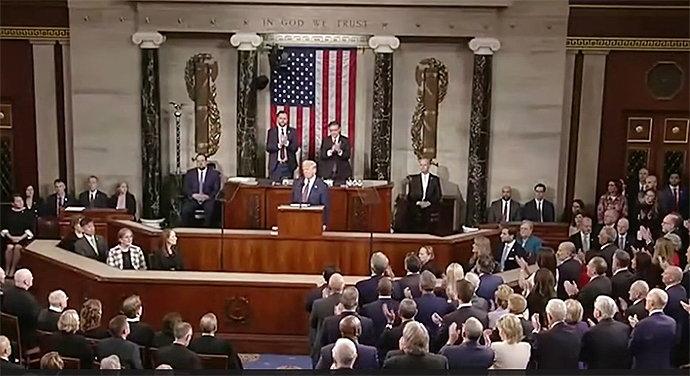
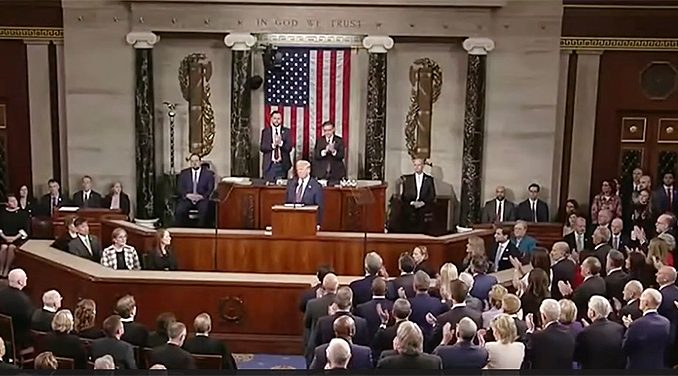
I was rather disappointed in the recent State of the Union address, but not for the reasons many readers might think. I believe that most Americans watched it the way one watches a meticulously overproduced halftime show, faintly aware that something once constitutionally serious has slowly mutated into a carefully choreographed spectacle. What was originally designed as a constitutional report has steadily evolved into a nationally televised performance in which political personality routinely outruns prudence and theatrical timing frequently eclipses thoughtful deliberation.
Article II, Section 3 of the Constitution states that the President “shall from time to time give to the Congress Information of the State of the Union, and recommend to their Consideration such Measures as he shall judge necessary and expedient.” That language is restrained, almost modest, and decidedly functional. The duty was prudential and informational. The President was to report, to recommend, and to unify the branches around the common good.
In short, the address existed to serve the Republic rather than to energize a base.
From George Washington to the present
Originally, it was precisely that. In 1790, George Washington delivered the first annual message in person before Congress in New York City, speaking with deliberate dignity and almost austere brevity. The tone was calm and composed, the content was administrative, and the atmosphere was constitutional. Then, in 1801, Thomas Jefferson discontinued the in-person address because he considered it monarchical in tone, preferring instead to send a written message to be read aloud by a clerk. That written practice endured for more than a century, and for good reason. The message was a report for the entire nation.
Then came 1913. Woodrow Wilson revived the in-person delivery, believing that executive presence could shape legislative priorities more forcefully and consolidate national leadership. From that point on, the modern rhetorical presidency began to take form. The speech gradually shifted from a communication to Congress into a broader appeal to the American public. The President increasingly spoke over the heads of legislators to the voters watching from their living rooms. Television accelerated this transformation dramatically. In 1965, Lyndon B. Johnson moved the address to prime time, ensuring maximum exposure and cementing its status as a national broadcast event.
The incentives changed accordingly and quickly. Reporting gave way to persuading. Persuading then drifted toward performing.
Don’t be mistaken: there have been undeniably serious moments. In 1941, Franklin D. Roosevelt articulated the Four Freedoms with solemn moral conviction. In 1982, Ronald Reagan introduced Lenny Skutnik, elevating a private citizen as an emblem of civic virtue and inaugurating a tradition that attempted, at least rhetorically, to highlight the civic character of the United States rather than partisan grievances. In 1996, Bill Clinton famously declared that “the era of big government is over.” That line that remains lodged in historical memory precisely because it transcended the annual churn of policy detail. At their best, these speeches aspired to bind the country together around a shared purpose.
However, a decisive cultural turn became unmistakable in 1995. That year, amid the aftermath of the 1994 Republican Revolution and a looming government shutdown, President Clinton delivered a State of the Union that deliberately read as a strategically calibrated campaign address aimed squarely at securing reelection in 1996. Policy disputes were framed in openly partisan terms. The opposing Congress was portrayed as obstructionist and extreme. The rhetorical contrasts were sharpened for maximum theatrical effect.
The speech succeeded politically, and Clinton won the reelection comfortably. Unfortunately, his template for the State of the Union also endured.
From partisan stagecraft to circus pageantry to brand management exercise
From that point forward, the annual address has increasingly resembled an extended campaign rally staged inside the House chamber. The President appears there as the head of a political coalition addressing adversaries across the aisle, instead of the head of a single republic union. The rhetorical center of gravity has shifted perceptibly from institutional stewardship toward political factional contest. The speech has become a catalog of partisan victories and partisan villains. One half of the chamber erupts in enthusiastic applause, while the other half sits in visible and performative televised disapproval.
The transformation did not arrive with a single candidate or a single party. Although Donald Trump recently became for many a vivid symbol of the phenomenon, the underlying trend gathered momentum earlier, especially during the Obama administration, when soaring rhetoric and almost messianic tones coexisted with increasingly hardened tribal identities. Partisan rhetoric began to outrank character. Viral social clips began to outrank substantive arguments. US politics gradually moved from a contest of competency to a parade of pageantry and then into a full-scale carnival in which theatrical provocation frequently served as a substitute for disciplined governance.
Our politics is now a circus where the clowns are in charge, and we celebrate the pies in the face.
Consequently, in circus pageantry, members of Congress coordinate wardrobe themes as if attending a gala. Representatives hold up signs, stage walkouts, wear badges, and choreograph disruptions carefully designed for social media circulation. In recent years, theatrical gestures have included the public tearing of a printed presidential speech behind the speaker, shouted interruptions during remarks, and symbolic protest attire arranged for maximum camera visibility. The chamber is a stage for the cameras.
Presidents then reciprocate in kind. References to the opposing party become more accusatory. Policy disagreements are framed as moral failures of the other side. The word “Democrats” or “Republicans” is nothing more than rhetorical foils at this juncture. The President speaks with heightened intensity toward supporters in the gallery while adversaries sit stone-faced. The speech is effectively an emotionally charged brand management exercise instead of a unifying constitutional opportunity.
What is disheartening is that earlier generations of Americans used to expect something more substantial from presidents and their speeches. George Washington’s Farewell Address warned with undeniable gravity that “the spirit of party… serves always to distract the public councils and enfeeble the public administration.” He cautioned that faction “agitates the community with ill-founded jealousies and false alarms.” His language assumed that we would remain a morally serious citizenry capable of self-restraint. Washington also wrote that “Religion and morality are indispensable supports” of political prosperity, articulating his hope in an anthropology rooted in transcendent natural and biblical truth.
Abraham Lincoln’s Second Inaugural Address compelled the whole nation to an awakening of conscience. “Both read the same Bible and pray to the same God,” Lincoln observed amid the carnage of civil war, refusing to indulge in triumphalism and instead calling the nation toward “malice toward none; with charity for all.” He situated the conflict within divine providence and summoned the nation to humility. His speech was meant to elevate the spirit of the entire nation.
Even in times of tragedy, serious leadership has occasionally reemerged. In January 1986, after the space shuttle Challenger exploded before the eyes of schoolchildren across the nation, President Reagan postponed the State of the Union and instead addressed the country from the Oval Office in a brief, solemn, and carefully crafted speech. He spoke directly to grieving families and stunned citizens. He invoked courage for all, and closed with lines from John Gillespie Magee’s poem “High Flight,” describing those who had “slipped the surly bonds of Earth” and “put out my hand, and touched the face of God.” The speech lifted the collective national gaze heavenward. It reminded citizens of who they were in the face of shared sorrow.
Those speeches are now rare. Contemporary State of the Union addresses consume immense energy for communications teams and then evaporate within days, reduced to curated clips and partisan talking points. Approval ratings rarely shift meaningfully, yet supporters cheer, and opponents react with visible disdain or tune out entirely. Instant polls reflect the predispositions of viewers already aligned with the President’s message. Millions of others simply stream entertainment programming and are completely disengaged from the constitutional ritual.
National division and cultural exhaustion
The evening that is designed to symbolize American unity now dramatizes our national division. Standing ovations alternate with conspicuous silence, and applause erupts from only one side of the aisle while the other side remains seated in protest. The Vice President and Speaker sit behind the President in carefully choreographed neutrality while the chamber vibrates with growing partisan tension. The ritual form affirms constitutional separation of powers, sure, but the tone suggests a decisively competitive and sometimes embarrassing political pageantry.
The founders understood faction as an enduring human reality. They also feared its excess. The State of the Union was intended for institutional cohesion, a reminder that despite disagreement, the branches shared responsibility for the common good of the same Republic. The annual address was meant to symbolize structural unity, even if there was an immense ideological contest. When the President frames the opposition as an existential threat, and legislators respond with open contempt, the symbolic message to the nation is unmistakable: we share a common territory, but we will never share a common purpose. And the American people pay the price for this.
Furthermore, the incentives of digital outrage reward this ludicrous spectacle. Representatives from heavily partisan constituencies face no electoral risk for dramatic gestures. Instead, they’re often rewarded. A member escorted from the chamber may receive fundraising emails before leaving Capitol grounds. Social outrage travels rapidly, but policy analysis moves slowly. Unfortunately, our modern incentives now favor and celebrate the clown.
A leader primarily concerned with viral clicks drifts steadily toward caricaturization of the office. The clown can entertain, provoke, and distract, but he cannot bind wounds or articulate a common good grounded in natural law and constitutional stewardship. Yet the crowd often rewards showmanship over sincerity and goodwill. The applause lines are louder, and the clips circulate faster. In the process, the discipline of governance is much duller by comparison.
This cultural exhaustion reveals something deeper. Our shared memories and aspirations have thinned. Even chances of national unity, such as the men’s Olympic hockey victory on the anniversary of the Miracle on Ice, are immediately filtered through political lenses. Sports once offered a temporary truce amid ideological conflicts. Now, even the athletes feel the onus of partisan commentary.
Nati
Nevertheless, we need not despair. The US constitutional structure is still the greatest political achievement in human history. The President addresses Congress, the Supreme Court justices attend, and the Cabinet fills the front rows. The ritual affirms the separation of powers, even if the speech doesn’t acknowledge it. The founding documents still appeal to “the Laws of Nature and of Nature’s God.”
Ours is still an objective moral order accessible through reason and illuminated by Christian religious conviction. Those words remain embedded in our national architecture.
What is the state of our Union? The answer is plain and undeniable: Divided, deeply divided, and increasingly habituated to that division. Yet division alone does not doom a republic. The American system was designed for vigorous conflict within constitutional bounds. The deeper problem arises when our political factions become the new identity and compromising one’s political loyalty is full-blown betrayal.
If we allow it, the State of the Union could function as a corrective reminder that the President speaks to the entire Congress on behalf of the entire country. It could lift the national gaze beyond polling numbers and partisan grievances. It could summon the citizenry toward virtue, sacrifice, shared destiny, and even divine providence. Instead, today, it frequently amplifies the very rivalries it was meant to transcend.
A nation that once heard lines about touching the face of God now often settles for punchlines about polling percentages. Consequently, the path forward requires citizens who are willing to demand more than performance from our leaders. And for leaders to be willing to risk honesty and virtue despite a political arena addicted to spectacle. The Republic can endure sharp debate, to be sure. But the State of the Union once symbolized shared responsibility for the common good of the union of our republic.
Are we a union of states? What is the state of our union? We have lost that cohesion for a while; hence, the question is whether we are willing to return to the better we once had.
If you value the news and views Catholic World Report provides, please consider donating to support our efforts. Your contribution will help us continue to make CWR available to all readers worldwide for free, without a subscription. Thank you for your generosity!
Click here for more information on donating to CWR. Click here to sign up for our newsletter.