In Matthew 23, Our Lord declares that the scribes and the Pharisees have taken their seat on the chair of Moses. Christ is addressing with a historical gravity the structure that every faithful Jew would have recognized with reverence. In that brief statement, Christ affirmed a visible, historical authority that stretches back through Sinai, through the wilderness, through the covenant that bound Israel to the living God. He acknowledged a real office, a genuine succession, a sacred stewardship of the Law that was entrusted to the Jewish people chosen by divine grace.
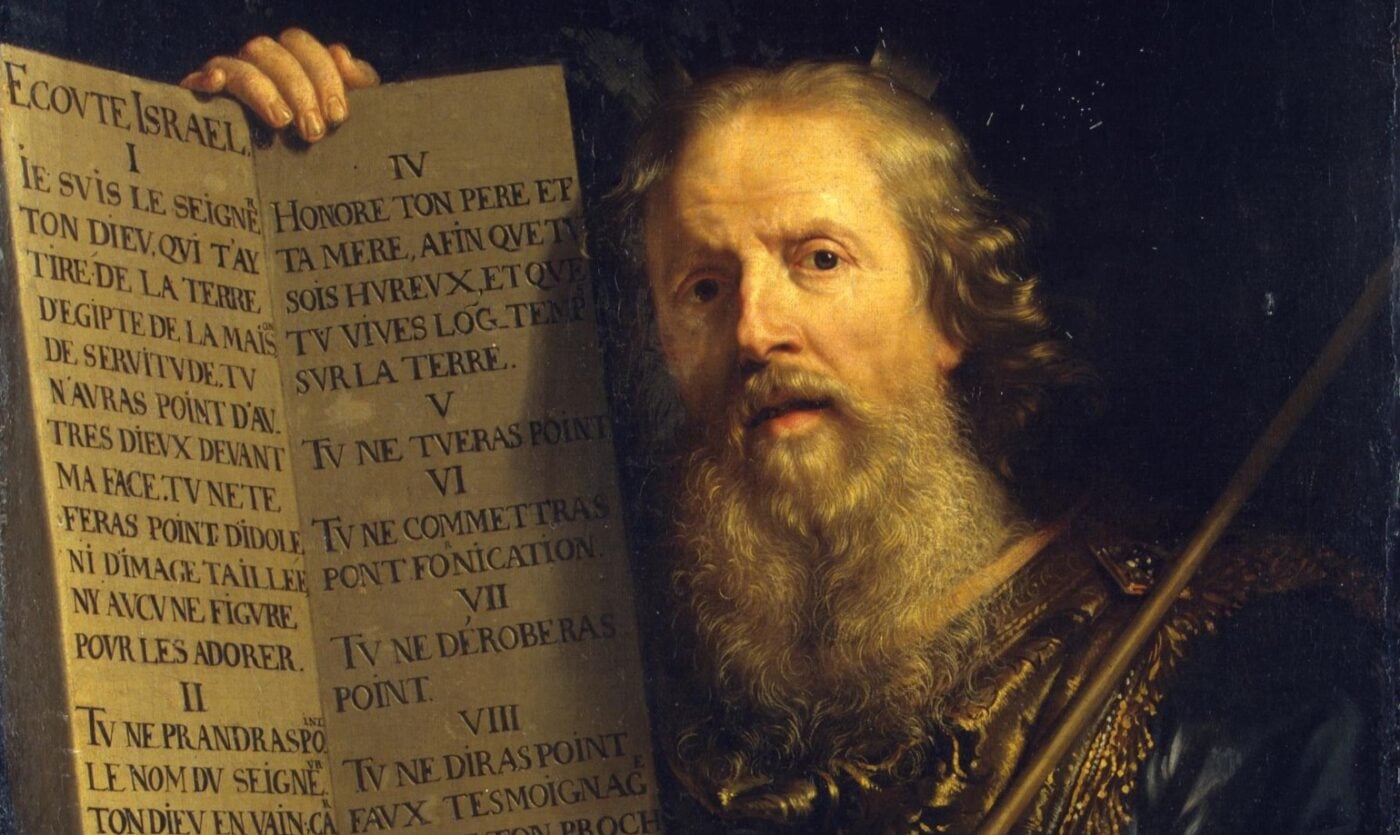
In Jewish tradition, Moses stands as the mediator of the covenant, the one through whom the Torah was given. Deuteronomy recounts how the Lord spoke face to face with him and entrusted to him statutes and ordinances for the life of the nation. The rabbinic memory held that Moses received the Torah at Sinai and handed it on to Joshua, Joshua to the elders, the elders to the prophets, and the prophets to the men of the Great Assembly. That chain of transmission shaped Israel’s consciousness. Authority did not arise from personal charisma. It flowed from covenantal succession. Therefore, the “seat of Moses” symbolized the interpretive authority to teach and apply the Law within the community of Israel.
Archaeological discoveries in ancient synagogues such as those in Chorazin and Magdala have uncovered stone seats set prominently at the front, understood as the place from which the Torah was expounded. These seats embodied continuity with Sinai. Consequently, when Jesus tells the people to observe what the scribes teach from that chair, He affirms that God works through ordered authority even when the human bearers are flawed.
The Catechism of the Catholic Church teaches that “the covenant with Noah remains in force during the times of the Gentiles, until the universal proclamation of the Gospel,” and that God’s covenants unfold progressively in history (CCC 56–58). Likewise, the Mosaic covenant carried a living authority that Christ Himself respected.
At the same time, Our Lord exposes a rupture between office and life. He says, “They preach and do not practice.” He describes burdens laid upon shoulders without compassionate assistance. He names the hunger for recognition, for honorific titles, for public admiration. The Lord does not dismantle the covenantal structure. He unmasks hypocrisy within it. This distinction matters profoundly for our own spiritual examination.
To understand how the Pharisees reached this condition, we must return to Israel’s painful history. The Babylonian exile shattered the nation. The temple burned. The Davidic throne collapsed. The prophets had warned repeatedly that infidelity to the covenant would bring devastation. Jeremiah proclaimed that the people had forsaken the fountain of living waters. Ezekiel spoke of a heart of stone that required divine surgery. The catastrophe of exile etched a lesson into the collective memory: disobedience leads to ruin.
After the return from Babylon, leaders such as Ezra and Nehemiah sought to rebuild a people through rigorous fidelity to the Law. The book of Nehemiah recounts public readings of the Torah that lasted for hours as Levites explained its meaning to the assembly. A profound seriousness entered Jewish religious life. Groups such as the Pharisees emerged with a passionate desire to prevent another descent into idolatry and covenantal betrayal. They built what later rabbinic language would call a fence around the Law, adding detailed interpretations and practices so that even approaching a transgression would be avoided.
This instinct grew from trauma and longing for holiness. Israel had suffered under foreign domination by Babylon, Persia, Greece, and Rome. The Maccabean revolt in the second century before Christ testified to the depth of Jewish commitment to fidelity, as many chose martyrdom rather than eating forbidden food or abandoning circumcision. The Pharisaic movement inherited that zeal. They treasured Sabbath observance, ritual purity, dietary discipline, and public prayer as safeguards of identity. Their strictness arose from historical wounds and covenantal devotion.
Yet zeal can harden into self-reliance. Over time, certain leaders began to measure righteousness through visible markers and minute regulations while neglecting the weightier matters of justice and mercy. In Matthew 23, Jesus later declares, “You tithe mint and dill and cummin, and have neglected the weightier matters of the law, justice and mercy and faith.” The prophetic tradition had already warned against this imbalance. Isaiah spoke for God when he said, “This people draw near with their mouth and honor me with their lips, while their hearts are far from me” (Is. 29:13). The danger lay in reducing covenant faithfulness to external conformity divorced from interior conversion.
Our Lord’s rebuke therefore draws from Israel’s own prophetic stream. He condemns infidelity, and He condemns sterile legalism. He calls for a righteousness that exceeds that of the scribes and Pharisees, a righteousness that springs from a renewed heart. The Catechism teaches that “the New Law is the grace of the Holy Spirit given to the faithful through faith in Christ” and that it fulfills and perfects the old law by interior transformation (CCC 1966–1968). Jesus does not abolish the Law. He fulfills it by engraving it upon the heart through His Spirit.
When Christ says, “Call no one on earth your father; you have one Father in heaven,” He does not abolish spiritual fatherhood within the covenant community, as St. Paul clearly speaks of himself as a father to the Corinthians (1 Cor. 4:15). Rather, He relativizes every human title before the absolute sovereignty of God. All authority derives from the Father. All teaching flows from the one Master, the Christ. This teaching prepares the Church to understand apostolic succession in humility. The bishop who occupies the chair of Peter does so as a servant of Christ’s authority, never as its source.
St. Augustine reflects on this passage by urging pastors to tremble at the office they hold. In his sermons, he insists that those who preach must first listen interiorly to the Word they proclaim. St. John Chrysostom likewise warns that teachers who demand strict observance while living indulgently harm both themselves and their flock. These Fathers understood that the chair of authority becomes a place of judgment for the one who sits upon it.
It remains essential to address another distortion that arises whenever this Gospel is proclaimed. Some have concluded that the Pharisees alone bear responsibility for the death of Jesus. Such thinking distorts the Gospel and fuels contempt. The Church has spoken unequivocally on this point. The Catechism states that “the Church does not hesitate to impute to Christians the gravest responsibility for the torments inflicted upon Jesus” and that “sinners were the authors and the ministers of all the sufferings that the divine Redeemer endured” (CCC 598). The Second Vatican Council affirms in Nostra Aetate that the Jews as a whole cannot be charged with the death of Christ.
Scripture itself testifies that Christ’s Passion unfolded according to divine providence. In the Acts of the Apostles, Peter proclaims that Jesus was “delivered up according to the definite plan and foreknowledge of God” (Acts 2:23). Our Lord declares in the Gospel of John, “No one takes my life from me, I lay it down of my own accord” (Jn. 10:18). He enters Jerusalem freely. He embraces the Cross willingly. He drinks the cup that James and John once desired to share.
Therefore, when we hear Jesus rebuke the Pharisees, we must resist the temptation to stand at a distance and assign blame to a historical group. Instead, we must look inward. Whenever we speak of devotion while harboring pride, whenever we demand moral rigor from others while excusing our own compromises, whenever we seek admiration in spiritual settings, we approach the very posture that Christ condemns. St. Gregory the Great warns pastors that “he who is raised to a place of authority must consider how much he owes for the sins of others if he fails to correct them.” That warning applies first to the heart of the preacher.
At the same time, the Lord’s final words in this passage shine with promise. “Whoever humbles himself will be exalted.” In the covenantal pattern of Scripture, exaltation follows descent. Joseph passes through betrayal and imprisonment before rising in Egypt. David endures years of persecution before ascending the throne. Above all, Christ embraces humiliation, suffering, and burial before resurrection glory. St. Paul writes in Philippians that Jesus “humbled himself and became obedient unto death, even death on a cross. Therefore God has highly exalted him” (Phil. 2:8–9).
In this light, the seat of Moses finds its fulfillment in the Cross. True authority in the Kingdom flows from self-giving love. The greatest becomes servant. The Teacher washes feet. The Master bears wounds. The covenant reaches its summit when the Son offers Himself to the Father for our salvation and pours out the Spirit who renews our hearts.
Thus, as we examine the Pharisees’ history and their sincere yet flawed response to Israel’s suffering, we must also examine our own responses to cultural confusion and moral decline. Some react with lax accommodation. Others retreat into brittle severity. Christ calls us to something deeper, a fidelity animated by charity, a discipline infused with mercy, an obedience sustained by grace. He invites us to receive authority with reverence and to exercise responsibility with humility.
Our sins pierced His hands. Our transgressions required His sacrifice. He entered the grave for our redemption and rose for our justification. Consequently, when we hear Him speak about the chair of Moses and the dangers of spiritual pride, we stand before Him as brothers and sisters under one Father, guided by one Teacher, redeemed by one Lord. In that humble posture, the covenant lives within us, and through the grace of the Spirit, we learn to serve with sincerity and to walk in the path that leads to exaltation in Him.
Image from Wikimedia Commons