
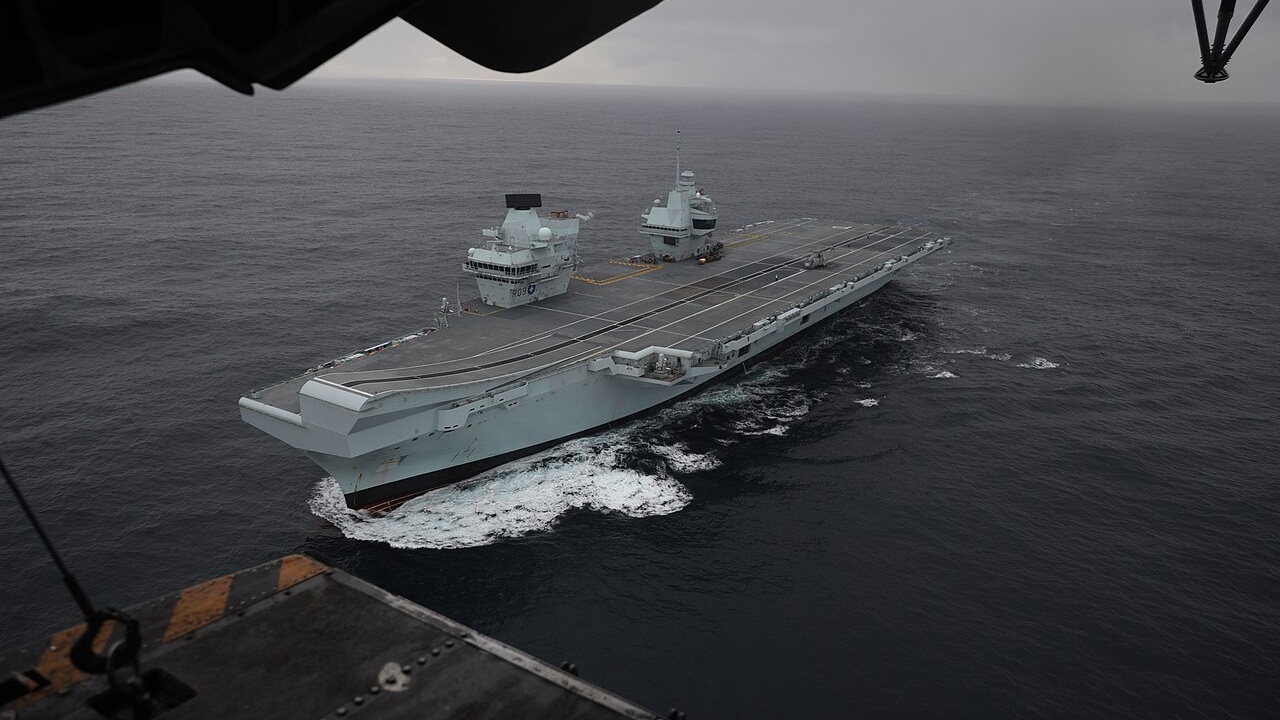
The HMS Prince of Wales has nearly returned from its months-long excursion to the Indo-Pacific—but British officials insist that the warship is still at full strength.
The Royal Navy’s flagship aircraft carrier, HMS Prince of Wales, is on the final leg of its Carrier Strike Group 2025 (CSG25) to the Indo-Pacific and is set to return to the UK in the coming weeks. The successful deployment mission highlighted the conventionally powered carrier’s capabilities as it conducted operations with multiple allies and partners, including the recent Exercise Falcon Strike, during which British and Italian F-35 fifth-generation fighters operated side-by-side.
This month, a full two dozen British F-35B Lightning fighters were embarked on the carrier, the largest number ever of the stealth aircraft on one of the Royal Navy’s Queen Elizabeth-class flattops. The F-35B is the short takeoff and vertical landing (STOVL) variant of the Joint Strike Fighter, and the aircraft were from the Royal Air Force’s (RAF’s) 617 Squadron “The Dambusters” and the Royal Navy Fleet Air Arm’s 809 Squadron “Immortal.”
During the exercises, three dozen F-35 sorties were conducted in a single day—the highest rate of aircraft launches and recoveries since the Falklands War in 1982.
A Proud Moment for the Royal Navy
On Monday, HMS Prince of Wales made a port visit to Naples, Italy, with the UK’s Defence Secretary John Healey and Secretary of State for Foreign, Commonwealth and Development Affairs Yvette Cooper hosting their Italian counterparts. During the visit to the southern Italian coastal city, Healey said that the carrier would be ready to deploy within five to 10 days’ notice in a crisis.
“This is a proud moment for Britain. The UK is stepping up for European security and delivering on our NATO-first plan,” stated Healey. “We are in a new era of threat that demands a new era for defence. Our strength comes from hard power and strong alliances, so it is fitting to mark this moment alongside one of our closest NATO allies in Italy. Their F-35s have been operating from the carrier to demonstrate the deep partnership between our militaries.”
HMS Prince of Wales departed Portsmouth, England, in April. It marked just the second deployment of a Royal Navy aircraft East of Suez this century.
One point that Healey didn’t state is that the Royal Navy’s largest and most expensive class of warships requires support from allies and partners.
A source in the British military told Sky News that the Queen Elizabeth-class aircraft carriers “can only support NATO if NATO provides escorts!” The source added, “It doesn’t come as a complete organic UK-only package – like the US could—not without turning off other UK commitments.”
That fact was notable by the Operation Highmast deployment this year, as the multinational task group included assets not only from NATO members Canada, Norway, and Spain, but also from New Zealand. The 2021 Indo-Pacific deployment of HMS Queen Elizabeth also required significant support from international partners, including the Netherlands and the United States.
Russia Isn’t Happy About the Prince of Wales’ Deployment
Although the Kremlin has said little about the Royal Navy’s deployment, its propaganda mouthpieces have been vocal. Among them was Andrey Lugovoy, the Russian politician wanted in the UK for his role in the poisoning of Putin critic Alexander Litvinenko in London in 2006. Lugovoy argued that the Royal Navy delayed the deployment of CSG25 to avoid sailing through the Suez Canal and Red Sea due to the Houthi militants targeting commercial shipping.
Russian political pundit Yakov Kedmi made a similar argument.
“This is the problem with the British fleet,” said Kedmi on Russian state television, per The Daily Express. “They do not have the ships to create an aircraft carrier group together with this Prince of Wales. And so now they are scrounging all over Europe [trying to] assemble an aircraft carrier group to make it formal. I don’t know how effective it will be or how they will operate [with] Portuguese destroyers [and] Italian submarines nearby.”
Kedmi also noted that a planned 2022 visit to the United States was canceled after HMS Prince of Wales broke down off the Isle of Wight.
“It didn’t even leave the English Channel, spending two months bobbing around, and then it was sent to the Scottish docks, where it was repaired for nine months,” added Kedmi.
HMS Queen Elizabeth suffered a similar mishap to the propeller shaft and was forced to head to Rosyth, Scotland, for repairs. The reliability issues have been resolved, but whether the Royal Navy’s carriers are as capable as the senior service has claimed has yet to be seen.
As for the Russian commentary, those pundits neglected to note that Russia no longer has an aircraft carrier, and even when it did, it wasn’t one that anyone took seriously.
About the Author: Peter Suciu
Peter Suciu has contributed over 3,200 published pieces to more than four dozen magazines and websites over a 30-year career in journalism. He regularly writes about military hardware, firearms history, cybersecurity, politics, and international affairs. Peter is also a contributing writer for Forbes and Clearance Jobs. He is based in Michigan. You can follow him on Twitter: @PeterSuciu. You can email the author: [email protected].
Image: Wikimedia Commons.

















.jpg)