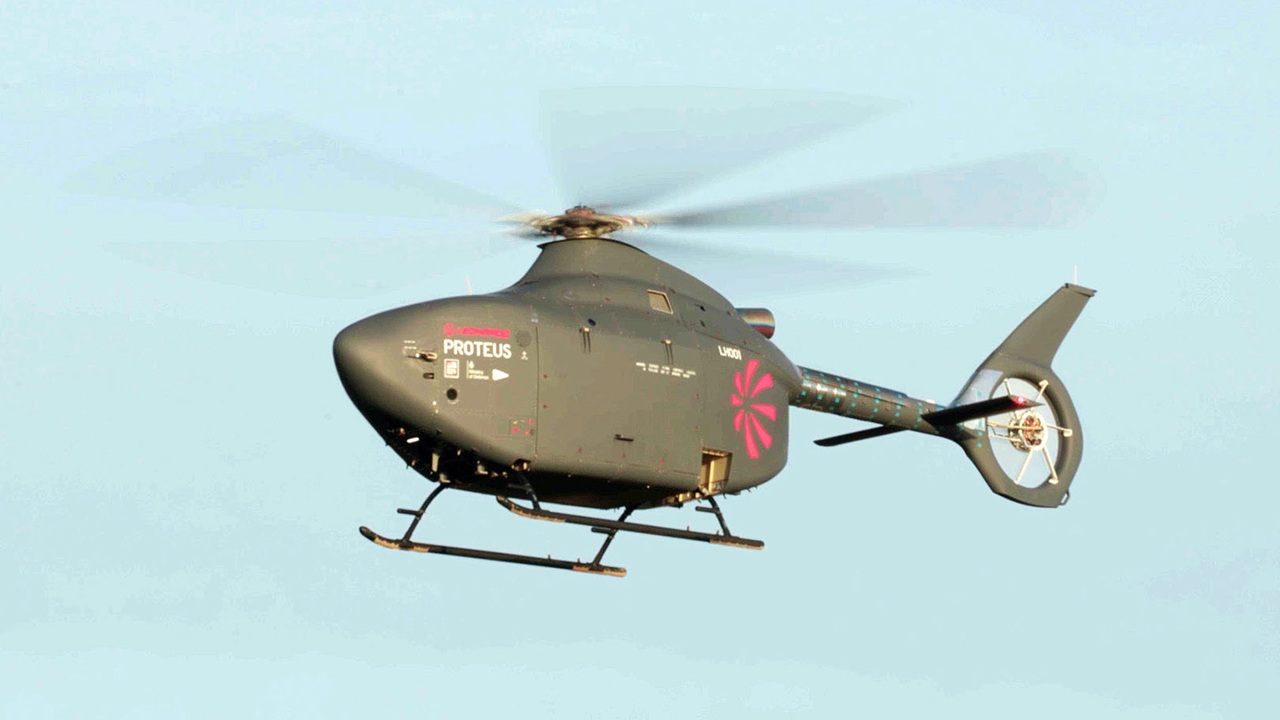
Though autonomous helicopters like the Proteus are still cutting-edge technology, they are expected to play a major role in the Royal Navy’s operations in the near future.
Last week, the Royal Navy conducted the maiden flight of the “Proteus,” a cutting-edge autonomous helicopter. The flight demonstration highlighted how unmanned vehicles could operate alongside crewed aircraft, as the UK’s senior service described in a social media post, forming a “hybrid air wing.”
The UK military already operates numerous unmanned aerial systems, but Proteus is different in that it exceeds the payload and endurance of the drones now in service.
The Proteus’ Flight Tests Were Successful
The Proteus was developed and built by the Italian-based defense conglomerate Leonardo to serve as a technology demonstrator for the Royal Navy. The maiden flight, conducted at the Predannack Airfield in Cornwall, took place only weeks after ground-based trials at the company’s Yeovil facility in South Somerset, England. Present at the flight test were engineers, technicians, and representatives of the aviation firm, joined by officials from the Royal Navy and the UK Defence Innovation (UKDI) unit, which was launched last July to enhance innovation and to secure “cutting-edge technology” for the British military.
Leonardo was tasked with developing the Proteus under a £60 million ($80 million) program—which, in addition to providing new technology for the UK’s Ministry of Defence (MoD), also supports upwards of 100 high-skilled jobs.
“The successful first flight of Proteus is a significant step in delivering the Royal Navy’s maritime aviation transformation vision, and in demonstrating our steadfast commitment to investing in autonomy as part of a hybrid air wing,” explained Commodore Steve Bolton, Royal Navy deputy director Aviation Future Programmes.
“This milestone signals our intent to lead technological innovation, to enhance the fighting effectiveness of the Royal Navy in an increasingly complex operating environment, and to maintain operational advantage against evolving maritime threats,” added Bolton.
During the test flight, the unmanned Proteus operated without human control but remained under “constant supervision and monitoring by test pilots on the ground.”
The UK’s New Hybrid Navy Is Taking Shape
Proteus has been touted to be among just a handful of full-sized autonomous helicopters developed to date. It is outfitted with an advanced computing system and sensors, controlled by advanced machine learning software.
It can operate without human intervention, with the software interpreting the environment, and even in inclement weather conditions such as high seas and strong winds. It can be used to transport equipment, including from land to a ship at sea.
Although it is unarmed, the autonomous rotary aircraft could be employed in an anti-submarine warfare (ASW) role,, including conducting patrols and relaying information back to a network of allied helicopters, ships, and submarines, as part of the “Atlantic Bastion strategy,” the service suggested.
“Proteus represents a step-change in how maritime aviation can deliver persistence, adaptability and reach – conducting the dull, dirty and dangerous missions in challenging environments without putting human operators at risk,” said Nigel Colman, managing director, Helicopters UK for Leonardo. “As the UK’s only end-to-end rotary wing manufacturer, it has been a pleasure working with the Royal Navy and seeing Proteus take off for the first time after being designed, developed, and manufactured at Leonardo’s Yeovil site is a fantastic milestone.”
The flight further supports the Strategic Defence Review’s calls for a “New Hybrid Navy,” which would employ autonomous and semi-autonomous systems, to strengthen the British military.
“This maiden flight is a proud moment for British innovation. Designed and built in Yeovil, Proteus supports skilled UK jobs while helping deliver the hybrid navy outlined in our Strategic Defence Review,” said Minister for Defence Readiness and Industry Luke Pollard. “Autonomous systems like this will be vital in protecting our seas without putting personnel in harm’s way.”
About the Author: Peter Suciu
Peter Suciu has contributed over 3,200 published pieces to more than four dozen magazines and websites over a 30-year career in journalism. He regularly writes about military hardware, firearms history, cybersecurity, politics, and international affairs. Peter is also a contributing writer for Forbes and Clearance Jobs. He is based in Michigan. You can follow him on Twitter: @PeterSuciu. You can email the author: [email protected].
Image courtesy of Royal Navy / Leonardo.